


















Lesson 44 of 50 · Analysis and Composition
Chapter 8 review: analysis and composition
Review the analysis method, secondary dominants, modulation, borrowed chords and the composing process with one picture, one table, an ear test and ten questions.
This chapter turned your toolbox into a workshop. You learned a routine for taking music apart and the same ideas in reverse for putting music together. The review below places the pieces side by side: a picture of the layers, a table of the key moves, a worked analysis that uses most of them at once, and a chord-classification game for your ears.
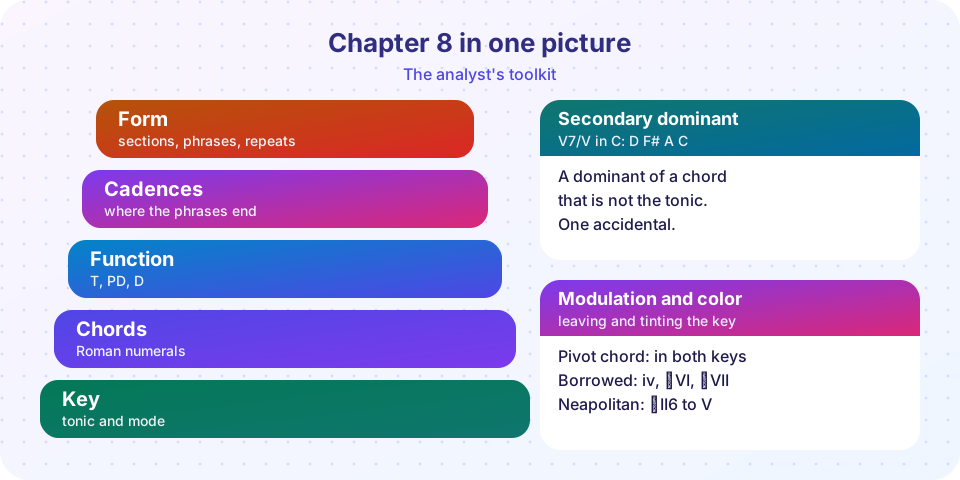
The chapter in one table
| Topic | Key idea | Quick test | Lesson |
|---|---|---|---|
| Analysis routine | Survey, key, chords, function, cadences, form | What do you do first? (survey) | Method |
| Inversions | 6 = third in bass; 6/4 = fifth in bass; 6/5, 4/3, 4/2 for sevenths | Label G7 with D in the bass (V4/3) | Method |
| Non-chord tones | Passing, neighbor, suspension, appoggiatura | Which resolves down by step from a held note? (suspension) | Method |
| Secondary dominant | V or V7 of a chord that is not I | Spell V7/vi in C (E7) | Secondary dominants |
| Modulation | New key confirmed by a cadence; pivot chord is in both keys | A pivot between C and G? (Am, C, Em, G) | Secondary dominants |
| Borrowed chords | From the parallel key: iv, bVI, bVII, bIII | Spell bVI in C (A-flat major) | Borrowed chords |
| Neapolitan and augmented sixth | Flat II in first inversion; It, Fr, Ger sixths resolve to V | What does the augmented sixth expand to? (octave on V) | Borrowed chords |
| Composing | Frame, cadences, chords, melody on chord tones, decoration, motif, polish | Which notes go on strong beats? (chord tones) | Composing |
A worked analysis that uses it all
Consider this progression in C major, one chord per bar: C | Am | D7 | G | C | F | Fm | C | G7 | C.
- Survey. Ten bars, 4/4 assumed, no key signature, one chord per bar.
- Key. C major: it starts and ends on C and the G7 with B precedes the last chord.
- Numerals. I, vi, V7/V, V, I, IV, iv, I, V7, I.
- What is special. D7 contains F♯, a note outside C major. It resolves to G, which is V. So D7 is a secondary dominant: V7/V. The F minor chord in bar 7 contains A♭, also outside the key. Since the surrounding chords are F and C, and Fm is the minor version of IV, this is a borrowed chord (minor iv).
- Function. T, T, D(of V), D, T, PD, PD, T, D, T. The path T, T, PD, D, T is the cycle with decoration.
- Cadences. Bars 3 to 5: V7/V, V, I, an authentic cadence preceded by a secondary dominant. The bars 6 to 8 section: IV, iv, I: a plagal cadence in which the minor iv makes the "amen" darker. The last three chords V7, I give a final perfect authentic cadence.
- Key. No modulation: every chromatic note resolves immediately, so the key stays C major throughout.
Notice how many different ideas came from a single line of ten chords: that is the point of analysis. Each accidental is a clue, and each clue has a name.
Choosing between similar-looking things
Three confusions come up repeatedly. Here is how to resolve them.
- Secondary dominant or borrowed chord? Both bring an accidental. A secondary dominant resolves to a chord a fifth below it; a borrowed chord comes from the parallel key and usually moves by step or leads to V or I. D7 resolving to G is secondary; Fm moving to C is borrowed.
- Tonicization or modulation? Look for a cadence in the new key and a stay of at least a phrase. A brief V7/V to V is a tonicization; a phrase that ends with a perfect authentic cadence in G after a pivot is a modulation.
- Chord tone or non-chord tone? Check the strong beats and the bass; the rest is usually decoration.
Try it
Hear a chord in C major and classify it. Each chord is played after a C major chord so that you can hear it in context. The categories are the four you studied: diatonic, secondary dominant, borrowed and the flat II chord.
Check your understanding
Quick check · 10 questions
of 10 answered You scored / 10 · perfect!
-
1. A D7 chord in C major resolving to G is labeled...
D7 is the dominant seventh of G, which is V in C major. -
2. Which chord can serve as a pivot between C major and G major?
Am is vi in C and ii in G; it belongs to both keys. -
3. What does an accidental outside the key usually signal in analysis?
Accidentals are clues; check what the chord does and what follows. -
4. Which is the Neapolitan chord in C minor?
A major chord on the lowered second degree, typically in first inversion. -
5. Which step comes first when composing a phrase?
Frame and cadences give the phrase a destination. -
6. How is a G7 chord with B in the bass labeled?
First inversion of a seventh chord, with the third in the bass, is 6/5. -
7. What does minor iv in a major key usually do?
It is a borrowed predominant that gives a shadowed version of IV. -
8. What resolves outward to an octave on the dominant note?
The lowered sixth falls and the raised fourth rises, both to the fifth degree. -
9. Which of these is a non-chord tone that steps away from a chord tone and returns?
A neighbor tone moves by step away and back. -
10. Which modulation method changes key with no connecting chord?
A direct modulation simply begins the new key.
Summary
- Analyze in layers: key, chords, function, cadences, form.
- Accidentals are clues: secondary dominants resolve down a fifth; borrowed chords come from the parallel key; modulations are confirmed by cadences.
- Neapolitan and augmented sixth chords are chromatic predominants that lead to V.
- Compose from the frame inward: cadences, chords, chord-tone melody, decoration, motif and polish.
Track your progress
Create a free account to tick off lessons and pick up where you left off on any device.
of Music Theory lessons completed