


















Lesson 22 of 50 · Intervals and Chords
Chapter 4 review: intervals and chords
Review interval size and quality, inversion, consonance, triads, seventh chords and chord inversions with an interval ruler, a recap table and a ten-question quiz.
This chapter turned the scales of chapter 3 into building blocks. You learned to measure the distance between any two notes as an interval, to flip intervals upside down, to judge how stable they sound, and to stack thirds into triads and seventh chords. All of harmony, which is the subject of chapter 5, is made from these pieces, so it is worth making them automatic.
What you will learn
- A one-page summary of chapter 4
- How the interval ruler and the chord recipes fit together
- A method for identifying a chord from its notes
Chapter in one picture
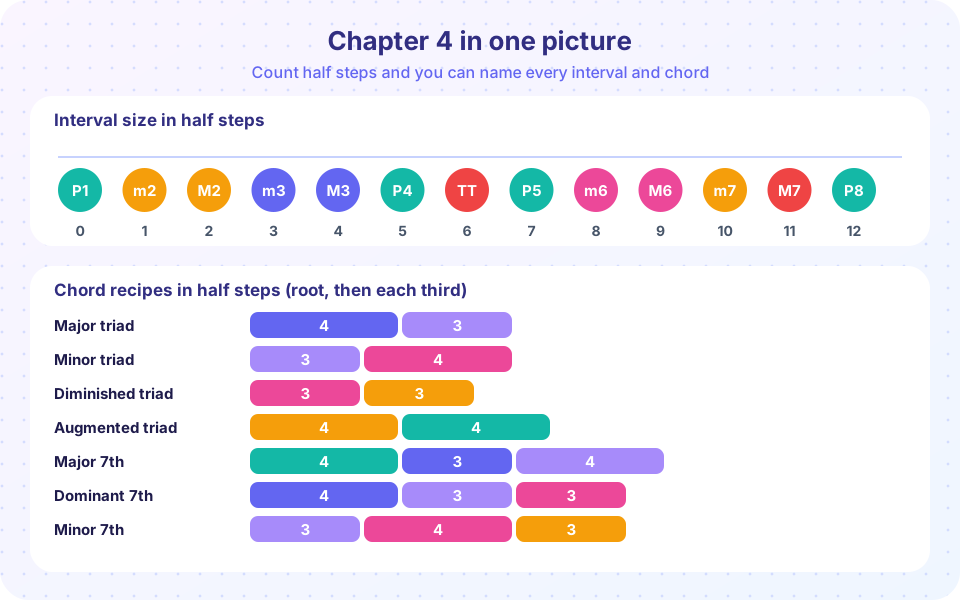
The picture has two halves. The top half is a ruler of intervals: thirteen circles, one for each size from 0 to 12 half steps, labeled P1, m2, M2, m3, M3, P4, TT (the tritone), P5, m6, M6, m7, M7 and P8. The colors group them by how they sound: teal for perfect, indigo for the thirds, pink for the sixths, amber for the seconds and sevenths and red for the most tense ones. The bottom half is a list of chord recipes drawn as bars: each chord is a sequence of stacked thirds, and each bar's length is the number of half steps. A major triad is a 4 then a 3. A minor triad is a 3 then a 4. A dominant seventh is 4, 3, 3.
Everything in the chapter is a variation on one idea: count half steps, and read the letters. The number of letters gives the interval's name (third, fifth) and the half steps give its quality. The same measure, applied to stacked thirds, gives the chord.
Recap table
| Topic | Key facts |
|---|---|
| Interval number | Count letter names including both notes (C to G = fifth) |
| Quality | Perfect: 1, 4, 5, 8. Major/minor: 2, 3, 6, 7. Augmented is a half step larger, diminished a half step smaller |
| Half steps | m2 1, M2 2, m3 3, M3 4, P4 5, tritone 6, P5 7, m6 8, M6 9, m7 10, M7 11, P8 12 |
| Inversion | Numbers add to 9; major and minor swap; perfect stays perfect; half steps add to 12 |
| Consonance | Perfect (P1, P8, P5), imperfect (thirds, sixths), dissonant (seconds, sevenths, tritone, altered) |
| Triads | Major M3+m3, minor m3+M3, diminished m3+m3, augmented M3+M3; major key: I ii iii IV V vi vii° |
| Seventh chords | maj7, dominant 7, m7, half-diminished (ø7), diminished (°7); only V7 is dominant in a major key |
| Inversions | First: third in bass (6); second: fifth in bass (6/4); third (sevenths): seventh in bass (4/2); slash chords such as C/E |
A method for identifying a chord
Given a set of notes, how do you name the chord? Follow these four steps:
- Reduce to letter names and remove repeated notes (a chord with C, E, G, C is still C E G).
- Rearrange the letters into a stack of thirds. Look for the arrangement where each letter skips one: for E G C, the stack of thirds is C E G, so the root is C. The chord is a C chord in first inversion (E is in the bass).
- Measure the thirds in half steps to find the quality. C to E is 4 and E to G is 3: major.
- Name the bass note to give the inversion: E in the bass means C/E, first inversion.
For a four-note chord with B♭, D, F, A♭: the thirds stack as B♭ D F A♭. B♭ to D is 4 half steps, D to F is 3 and F to A♭ is 3, so the chord is B♭7, a dominant seventh. With practice you will see the stack immediately.
Where learners go wrong
Counting half steps without checking letters. C to D♯ is a second (augmented), not a third. Count the letters first.
Calling every fifth perfect. A fifth can be diminished (C to G♭) or augmented (C to G♯).
Reading the root from the bass. In an inverted chord the bass is not the root. Rearrange the notes into thirds to find it.
Treating "7" as "major 7". A plain 7 in a chord symbol means a dominant seventh with a minor seventh.
Forgetting that the qualities of an inverted interval swap. A major third becomes a minor sixth, not a major sixth.
Try it
First, test chord reading. The page shows three note names in a random order. Decide whether the chord is major, minor, diminished or augmented. Because the notes may be written in any order, you need to find the root and measure the thirds.
Second, write the identification method as code. The program takes any set of note names, tries each note as a possible root, measures the stack of thirds and reports the chord name and inversion. Add your own chords at the end.
Press Run (or Ctrl + Enter) to see the result here.
Program input · what you'd type while the program runs
Type the answers before you press Run, one per line. Each time the program reads a line (with input()), it gets the next line from this box.
Check your understanding
Quick check · 10 questions
of 10 answered You scored / 10 · perfect!
-
1. What is the interval from E up to C (the next C above)?
E to C spans six letters (E F G A B C) and eight half steps: a minor sixth. It is the inversion of C up to E, a major third. -
2. How many half steps are in a perfect fifth?
A perfect fifth has seven half steps. A perfect fourth has five. -
3. A major seventh inverts to:
Numbers add to 9 (7 + 2) and major becomes minor: a minor second. The half steps add to 12 (11 + 1). -
4. Which intervals are perfect consonances?
Unison, fifth and octave are the perfect consonances; thirds and sixths are imperfect consonances. -
5. What are the notes of an A minor triad?
A minor triad is a minor third (A to C) plus a major third (C to E): A C E. -
6. Which triad quality has two stacked major thirds?
Augmented triads stack M3 + M3, giving C E G♯. -
7. G7 contains which tritone?
B to F is six half steps, the tritone that makes the dominant seventh tense. -
8. A chord with the notes E G C is:
Rearranged in thirds it is C E G, a C major triad. With E in the bass it is in first inversion (C/E). -
9. Which seventh chord on C contains B-flat but also E-natural and G-natural?
C7 is C E G B♭: a major triad plus a minor seventh. -
10. What figured bass indicates a seventh chord in second inversion?
Root position 7, first inversion 6/5, second inversion 4/3, third inversion 4/2.
Summary
- Name an interval by letters (number) and half steps (quality); memorize the thirteen sizes from 0 to 12.
- Inversion: numbers add to 9, half steps to 12, major and minor swap, perfect stays perfect.
- Perfect consonances are stable, thirds and sixths warm, seconds, sevenths and the tritone tense.
- Triads: major M3+m3, minor m3+M3, diminished m3+m3, augmented M3+M3.
- Seventh chords add a third; V7 is the only dominant seventh in a major key and its tritone drives the resolution to I.
- To identify a chord, find the stack of thirds, measure it for the quality and check the bass for the inversion.
Track your progress
Create a free account to tick off lessons and pick up where you left off on any device.
of Music Theory lessons completed