


















Lesson 27 of 50 · Harmony and Progressions
Voice leading basics: connecting chords smoothly
Learn SATB ranges, spacing and doubling, the four kinds of motion, and the classic rules against parallel fifths and octaves, with a worked I-V7-I example.
When a choir sings a chord, each singer holds a single line. The soprano does not care that she is part of a G7 chord; she cares that her note follows the one before it in a way that is easy to sing and pleasant to hear. Voice leading is the art of writing each of those lines well. Chord symbols tell you what vertical sounds to use. Voice leading tells you how to move from one sound to the next so that the music flows instead of jumping around.
Even if you will never write for a choir, voice leading explains why some chord changes sound smooth, why a keyboard player naturally keeps their hand close to where it was, and why a few specific habits (parallel fifths especially) have been avoided in classical harmony for centuries.
What you will learn
- The four voices of a standard chorale (SATB) and their comfortable ranges
- Spacing and doubling rules for triads and seventh chords
- The four types of motion: parallel, similar, oblique and contrary
- Why parallel fifths and octaves are avoided, and how to spot them
- How to resolve the leading tone and the chordal seventh
- How to connect I, V7 and I smoothly
Key terms
Voice: an individual melodic line within the harmony, whether sung or played.
SATB: soprano, alto, tenor, bass: the four voices of a mixed choir and the standard texture for harmony exercises.
Common tone: a note shared by two successive chords, usually held in the same voice.
Parallel motion: two voices moving in the same direction by the same interval.
Resolution: the movement of a tendency tone to its expected destination.
Four voices, four ranges
The standard texture of harmony study is four-part writing for mixed choir. Ranges below are approximate and good for exercises; real singers vary.
| Voice | Comfortable range | Staff |
|---|---|---|
| Soprano | C4 to G5 | treble |
| Alto | G3 to D5 | treble |
| Tenor | C3 to G4 | bass (or treble an octave lower) |
| Bass | E2 to C4 | bass |
The two upper voices sit on the treble staff, the two lower voices on the bass staff. Write the soprano with stems up and the alto with stems down when they share a staff, and likewise for tenor and bass.
Spacing: keep the distance between neighboring upper voices (soprano to alto, alto to tenor) to an octave or less. The bass may stand farther from the tenor, since low notes need breathing room. Voices should not cross each other (alto above soprano) and should not overlap (a voice jumping above the previous note of the voice above it).
Doubling: a triad has three notes but you have four voices, so one note must be doubled. In a root-position triad, double the root. Never double the leading tone, because it is a tendency tone and doubling it forces two voices to resolve upward in octaves.
Motion between voices
Choose any two voices and compare what they do between two chords.
| Motion | What happens | Effect |
|---|---|---|
| Parallel | same direction, same interval size | voices lock together |
| Similar | same direction, different interval | acceptable, but check outer voices |
| Oblique | one voice holds, the other moves | smooth; keeps independence |
| Contrary | opposite directions | the best way to preserve independence |
Contrary motion is especially useful between the outer voices (soprano and bass), the lines the ear follows most easily. If the bass rises, let the soprano fall.
The classic rules
- Keep common tones. If two chords share a note, hold it in the same voice. Going from C major (C E G) to A minor (A C E), the voices holding C and E stay still and only one voice moves.
- Move the other voices by step. The shortest path is the smoothest. Leaps are fine in the bass (which usually follows the roots), but inner voices are best kept to steps and small leaps.
- No parallel perfect fifths or octaves. If two voices a fifth or octave apart both move to another fifth or octave, the voices sound like one line with a thickened tone. Their independence disappears. The rule goes back to the Renaissance, and it has been taught ever since because it keeps lines distinct. Rock and pop break it on purpose (power chords are parallel fifths), but the aim there is thickness, not independence.
- Resolve the tendency tones. The leading tone rises to the tonic (when in an outer voice, always; in an inner voice it may sometimes fall to the fifth). The chordal seventh, the added note in V7, falls by step.
- Avoid awkward leaps. Augmented intervals (such as a leap of an augmented second) are hard to sing. Avoid them unless the line goes in a harmonic minor scale.
A related guideline: avoid hidden (direct) fifths and octaves, which means arriving at a perfect fifth or octave between the outer voices by similar motion. The rule is relaxed when the soprano moves by step.
Worked example: I, V7, I
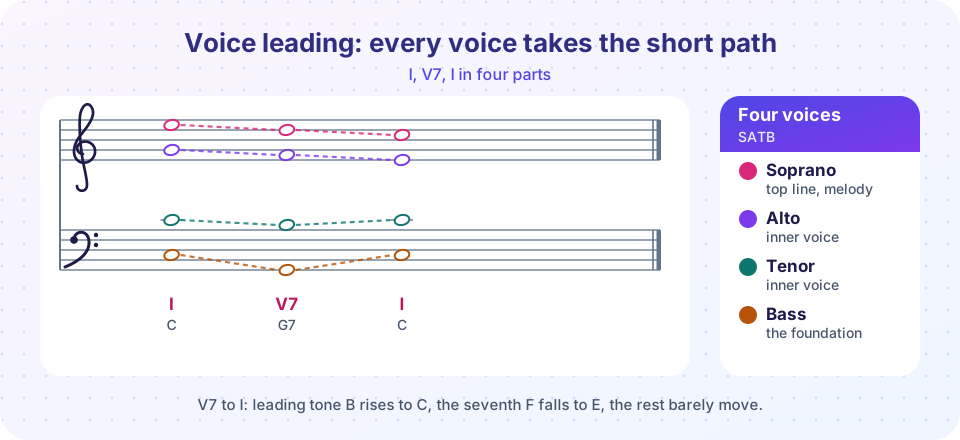
Take the figure above and trace each voice.
- First chord, C major. Bass C3, tenor C4, alto G4, soprano E5. The chord is complete (C E G) with the root doubled.
- Second chord, G7. Bass G2, tenor B3, alto F4, soprano D5. Notes G B D F: every note of the seventh chord appears once.
- Third chord, C major. Bass C3, tenor C4, alto E4, soprano C5.
Movement between chords one and two: soprano E down to D, alto G down to F, tenor C down to B, bass C leaps to G. All upper voices move by step, and no common tone is needed because the chords share only G, which goes to the bass.
Movement between chords two and three: the leading tone B (tenor) rises to C; the seventh F (alto) falls to E; soprano D falls to C; bass G leaps up a fourth to C. The final tonic chord has three roots and a third and no fifth. It is called an incomplete tonic chord and is perfectly standard after a complete V7.
Check the rules. No voices move in parallel fifths or octaves. The leading tone resolves up and the seventh resolves down. Common tones are used where available. Outer voices (soprano E5 to D5 to C5 and bass C3 to G2 to C3) move in contrary or oblique motion. This is textbook voice leading.
Why smooth is better
You can feel the benefit by playing the same progression with and without smooth voice leading. In the Try it demos below, the "block" version places every chord in root position beginning on its root, so every voice leaps up or down. The "smooth" version picks, for each chord, the arrangement of notes closest to the previous chord. The total distance moved is often cut to a third.
Common misconceptions
"Parallel fifths are always wrong." They are against the rules of common-practice harmony exercises. In other styles (medieval organum, rock power chords, impressionism) they are deliberately used. The rule describes one style, not a law of nature.
"Voice leading only matters for choirs." It matters for any texture where several notes sound together: piano, guitar voicings, string quartets and arranging.
"The bass should also move by step." The bass often leaps because it follows chord roots; stepwise and leaping bass lines both occur, and the root-position leaps of a fourth or fifth are very characteristic.
Try it
First compare block chords with smooth voice leading. The total shows how far all the upper voices moved in semitones.
Now check voice leading yourself. Type four notes per chord (soprano, alto, tenor, bass) such as E5 G4 C4 C3. The program looks for parallel fifths and octaves between every pair of voices.
Check your understanding
Quick check · 5 questions
of 5 answered You scored / 5 · perfect!
-
1. Which note is normally doubled in a root-position triad?
Doubling the root keeps the chord stable. The leading tone is never doubled. -
2. Two voices a fifth apart both move up a step to another fifth. What is this called?
Same direction and same perfect interval is parallel motion; between fifths it is the forbidden parallel fifths of common-practice harmony. -
3. How should the chordal seventh of V7 normally resolve?
The seventh of a dominant seventh chord falls by step; in G7 to C the F falls to E. -
4. Which type of motion best preserves the independence of two voices?
When one voice rises while the other falls, the lines are clearly distinct. -
5. In a standard final I chord after V7, why is the fifth often missing?
Resolving the leading tone and seventh and keeping the bass on the root gives three roots and a third, a normal incomplete tonic.
Summary
- Each voice is a line; good voice leading makes each line easy to follow.
- SATB ranges and spacing keep the chord in a natural order, with the root doubled.
- Keep common tones, move by step, use contrary motion, and avoid parallel fifths and octaves.
- Resolve the leading tone up and the chordal seventh down.
- Smooth connections can cut the total distance moved by two thirds or more compared with block chords.
Next: Chapter 5 review
Track your progress
Create a free account to tick off lessons and pick up where you left off on any device.
of Music Theory lessons completed