


















Lesson 8 of 50 · Sound, Notes and Rhythm
Rhythm: note values, rests, dots and ties
Learn whole, half, quarter, eighth and sixteenth notes and rests, how a dot adds half the value, how ties join notes and how to count rhythms aloud.
Pitch tells you which note to play. Rhythm tells you when to play it and how long to hold it. Two songs can use exactly the same pitches and still sound completely different because the rhythms differ: compare a lullaby with a march built from the same few notes. Rhythm is also the part of music you can feel in your body, in a tapping foot or nodding head.
In written music, durations are not measured in seconds. They are measured relative to each other. One note is twice as long as another, or half as long. This relative system lets the same piece be played fast or slow without rewriting it, and it is built from a few simple shapes. This lesson teaches the shapes, the matching silences called rests, and the two tools for stretching a note: the dot and the tie.
What you will learn
- The names and relative lengths of the five common note values
- How each note value is drawn (head, stem, flag, beam) and its matching rest
- How a dot and a tie lengthen a note, and how they differ
- How to count rhythms aloud and check that a measure adds up
Key terms
Beat: the steady pulse you tap your foot to.
Note value: the length of a note relative to a whole note.
Rest: a symbol for a silence of a certain length.
Dot: a dot after a note that adds half the note's value.
Tie: a curved line joining two notes of the same pitch into one longer sound.
The beat and the note values
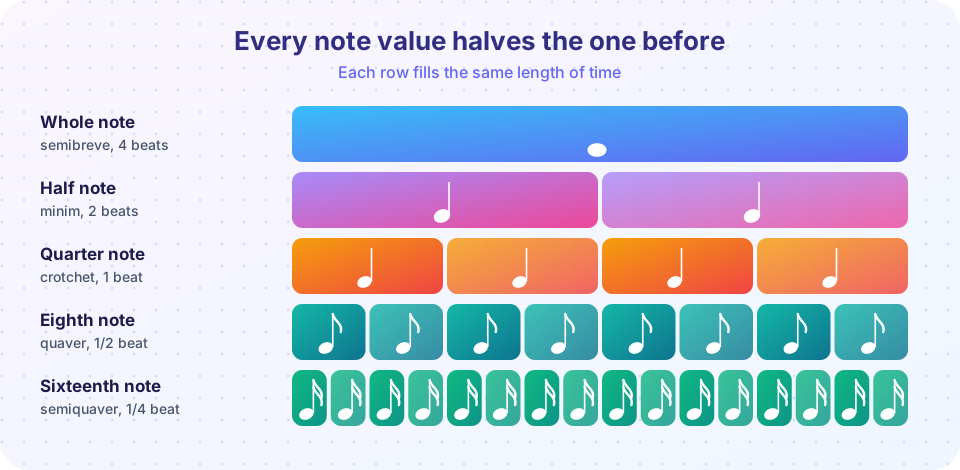
Listen to a piece of music and tap your foot along. The steady pulse you tap is the beat. In most notation, the quarter note gets one beat, and all other note values are measured against it. The names come from fractions of a whole note, the longest note in common use. (British English uses other names, which appear in brackets below.)
| Note | Name | Beats (quarter = 1) | Fraction of a whole |
|---|---|---|---|
| Open oval | Whole note (semibreve) | 4 | 1 |
| Open oval with stem | Half note (minim) | 2 | 1/2 |
| Filled oval with stem | Quarter note (crotchet) | 1 | 1/4 |
| Filled with stem and one flag | Eighth note (quaver) | 1/2 | 1/8 |
| Filled with stem and two flags | Sixteenth note (semiquaver) | 1/4 | 1/16 |
Each value is half the length of the one before it. This is why the picture above fills the same width in every row: two halves make a whole, two quarters make a half, and so on. You can go on halving to thirty-second notes and sixty-fourth notes, though these are less common.
Notice the anatomy. A whole note is an open oval with no stem. A half note is open with a stem. A quarter note is filled with a stem. Flags added to the stem divide it further: one flag for an eighth and two for a sixteenth. When several short notes are next to each other, their flags join into beams, thick lines connecting the stems. Beams do more than save ink: they show which notes belong together within a beat, so you can read a group at a glance. In 4/4 time, eighth notes are usually beamed in groups of two (one beat each) or four.
Rests: silences with lengths
Silence is part of rhythm, and each note value has a matching rest. A rest does not mean "nothing happens": the beat continues and you count the silence just as you count a note.
- A whole rest is a small block hanging below the fourth line of the staff. It lasts a whole measure of 4/4. It is also used to signal a full-measure rest in any time signature.
- A half rest is a block sitting on top of the middle line. It lasts two beats.
- A quarter rest is a zigzag squiggle lasting one beat.
- An eighth rest looks like a slanted stroke with a dot and lasts half a beat. Further flags add more dots for shorter rests.
A memory aid for the whole and half rest: a whole rest is heavy, so it hangs down like a hat on a peg, and a half rest is lighter and sits up on the line like a hat on your head. This helps you not to mix up the two blocks.
Dots: adding half
A dot written just after a note head makes the note half as long again. A half note lasts 2 beats; a dotted half note lasts 2 + 1 = 3 beats. A quarter note lasts 1 beat; a dotted quarter lasts 1 + 1/2 = 1½ beats. An eighth note lasts 1/2 beat; a dotted eighth lasts 3/4 beat.
The dot always adds half of the note's own value, not half of a beat. A second dot adds half of the first dot. A double-dotted half note lasts 2 + 1 + 1/2 = 3½ beats. Dots work on rests as well, so a dotted quarter rest is a rest of 1½ beats.
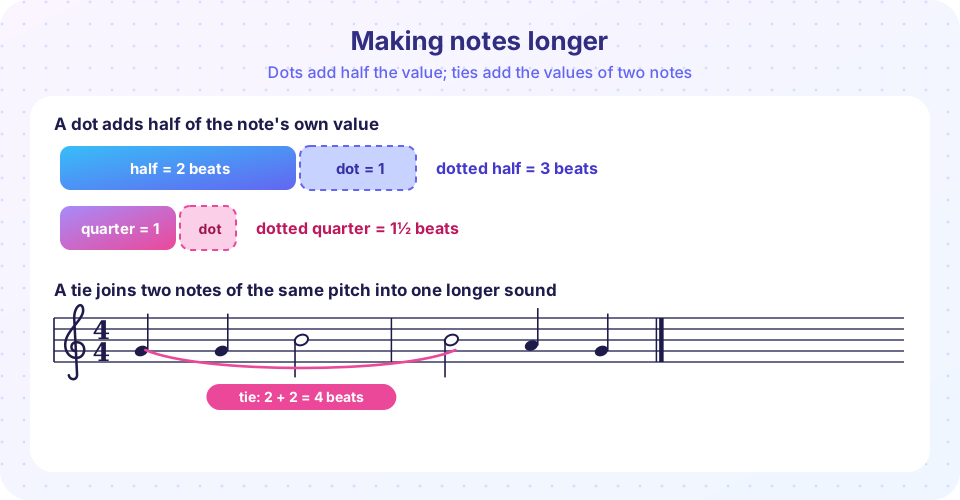
A very common pattern is the dotted quarter followed by an eighth: 1½ + ½ = 2 beats. You hear it in marches and many folk tunes, a long-short, long-short lilt. Counting it as "1 (2) & 3 (4) &" will feel natural after a few tries.
Ties: joining notes
A tie is a curved line that connects two notes of the same pitch (the same line or space, with any accidental). You play the first note and do not play the second one again: you hold the sound for the combined length. A whole note tied to a quarter note lasts 4 + 1 = 5 beats.
Ties solve a problem the dot cannot. A note cannot cross a barline: music is divided into measures, and a note that must last across the bar is split into two notes joined by a tie. They also let you write lengths that no single note can show, such as 5 beats (a whole tied to a quarter).
Do not confuse a tie with a slur. A slur is a curve over different pitches, and it means "play these smoothly (legato)", without separating them. A tie always joins two identical pitches. Both are curved lines, but the notes beneath them tell you which one you are looking at.
Counting rhythms aloud
Musicians count rhythm with syllables so that the position of every note is clear. In 4/4 time:
- Count quarter-note beats as 1 2 3 4.
- Count eighth notes with "and": 1 & 2 & 3 & 4 &.
- Count sixteenth notes with "e" and "a": 1 e & a 2 e & a.
To check that a measure is correct, add the values. In 4/4, a measure holds four quarter-note beats. A measure with quarter, quarter and half notes is 1 + 1 + 2 = 4, so it is complete. A measure with a dotted half and a quarter is 3 + 1 = 4, also complete. A measure with a whole note and an extra quarter is 5 beats and does not fit 4/4.
Common misconceptions
"A bigger-looking note lasts longer." Length depends on the note's shape (open or filled, stem, flags), not on how large it is drawn.
"A dot adds one beat." A dot adds half the note's value: one beat to a half note, half a beat to a quarter.
"A tie and a slur are the same." A tie joins two notes of the same pitch into one long note. A slur connects different pitches in one smooth phrase.
"Notes get faster as they get shorter." The beat stays the same. A sixteenth note is not played faster; four of them simply fit into one beat.
Try it
Build a measure of 4/4. Click the buttons to add notes and rests, watch the total, and press Play to hear your rhythm as clicks. A rest stays silent. When the total reaches exactly 4 beats, the measure is complete.
Now let a program do the arithmetic. Fractions make the value of dotted notes and ties exact. The measure_ok function checks whether a list of notes fills a measure in a given time signature.
Press Run (or Ctrl + Enter) to see the result here.
Program input · what you'd type while the program runs
Type the answers before you press Run, one per line. Each time the program reads a line (with input()), it gets the next line from this box.
Check your understanding
Quick check · 6 questions
of 6 answered You scored / 6 · perfect!
-
1. How many beats does a dotted half note last (quarter note = 1 beat)?
A half note is 2 beats. The dot adds half of that, 1 beat, for a total of 3 beats. -
2. Which curved line joins two notes of the same pitch into one longer sound?
A tie joins same-pitch notes. A slur connects different pitches in a smooth phrase. -
3. How many eighth notes fit into one half note?
A half note equals two quarters, and each quarter equals two eighths, so four eighths. -
4. Which rest hangs below a line and can fill a whole measure of 4/4?
The whole rest hangs below the fourth line. The half rest sits on top of the middle line. -
5. A dotted quarter note plus an eighth note lasts:
A dotted quarter is 1.5 beats and an eighth is 0.5, so the pair lasts 2 beats. -
6. What does a beam connecting several eighth notes show?
Beams replace separate flags and group short notes so the beat structure is easy to see.
Summary
- The beat is the steady pulse; note values are lengths relative to it: whole 4, half 2, quarter 1, eighth 1/2, sixteenth 1/4 (in quarter-note beats).
- Each value halves the one before; flags and beams show shorter notes and group them.
- Rests are silences with the same lengths; the whole rest also fills any full measure.
- A dot adds half the note's value; a second dot adds half of that.
- A tie joins same-pitch notes (across a barline too); a slur connects different pitches.
- To check a measure, add the values and compare with the time signature.
Track your progress
Create a free account to tick off lessons and pick up where you left off on any device.
of Music Theory lessons completed