


















Lesson 43 of 50 · Analysis and Composition
Writing a melody and harmony: a repeatable process
A practical composing method: choose key and form, plan cadences, build a chord skeleton, write a melody on chord tones, add passing notes, develop a motif and polish.
Many people think composing begins with inspiration, a tune that arrives from nowhere. Sometimes it does. But most working composers, from Bach to film writers, rely on a process: a series of small, concrete decisions that turn a blank page into a piece. Constraints help. When you decide "eight bars, C major, a sentence ending on a perfect authentic cadence", the infinite choices shrink to a manageable few, and the tune you write fits the form you chose. This lesson gives you a seven-step process built from everything in this course. It is deliberately mechanical, and it works.
What you will learn
- A seven-step composing process from plan to polish
- How to write cadences and chords before the melody
- How to build a melody from chord tones and decorate it with non-chord tones
- How to develop a motif into a phrase with repetition, sequence and contrast
- How to diagnose and fix common problems in a draft
Key terms
Skeleton: the essential notes of a melody (usually chord tones on strong beats), before decoration.
Chord tone: a note that belongs to the current chord.
Passing tone: a non-chord note that connects two chord tones by step.
Neighbor tone: a non-chord note that steps away from a chord tone and returns.
Texture: how the layers of music are arranged: melody alone, melody and chords, or several lines.
The seven-step process
1. Decide the frame
Choose the key, mood, tempo and meter. Choose the length: eight bars is a good size. Choose the shape: a period (question, answer) or a sentence (idea, repeat, continuation). Write these on the page. You can change them later, but the first draft needs a frame.
2. Write the cadences
Phrases are defined by their endings, so decide those first. For a period in C major: the first phrase ends on a half cadence in bar 4 (V), the second on a perfect authentic cadence in bar 8 (V7 to I, with the melody ending on C). For a sentence of four bars: one cadence at the end. Writing the cadences first means you always know where each phrase is heading.
3. Fill in the chords
Draw a skeleton of chords between the cadences. Use the function cycle: begin with tonic, go through a predominant, reach the dominant, finish on the tonic. For eight bars you might use I, IV, I, V in the first half, and I, IV, V7, I in the second. Start with one chord per bar. A slow harmonic rhythm gives the melody room. If the harmony feels boring, you can speed it up later or add a secondary dominant or a borrowed chord.
4. Write the melody on chord tones
This is the heart of the process. For each bar, write a melody using mostly the notes of the current chord, especially on the strong beats (1 and 3). A melody built from chord tones always sounds like it fits. Here is a good routine:
- Choose a climax note and place it about two-thirds of the way through the phrase.
- Begin on a chord tone of the tonic: the root, third or fifth.
- Move by step or small leap through chord tones toward the climax.
- After the climax, descend toward the cadence.
- End each phrase on a chord tone of its cadence chord: the fifth or root of V for a half cadence, the tonic for a perfect authentic cadence.
5. Add non-chord tones
Now decorate. Insert passing tones between chord tones a third apart (E to G becomes E, F, G). Add neighbor tones that step up or down from a chord tone and come back (G, A, G). Use a suspension on a strong beat to add expressive tension: hold a note from the previous chord, then let it fall by step. These decorations make the line smooth and shapely. The rule is that the strong-beat notes should still be chord tones or deliberate dissonances that resolve.
6. Shape the rhythm and motif
Choose a short motif, a rhythmic and melodic cell of three or four notes, and make most of your melody from it. In a sentence, state the motif in bar 1, repeat it on a new chord in bar 2 and then fragment it into shorter, faster pieces in bar 3. In a period, begin both phrases with the same motif and change the end. Vary the rhythm enough that it does not become mechanical: use a long note after a run of short ones, add a rest for breath, and avoid starting every bar the same way.
7. Add a bass and texture, then polish
Add a bass line. Root-position roots are the simplest. A bass that moves by step (using first-inversion chords, such as C/E between C and F) gives a more refined sound. Choose a texture: block chords, broken chords (arpeggios), a repeated pattern. Then play the piece, listen as a stranger would, and revise. Check:
- Does each phrase end where you planned?
- Is there one clear climax?
- Is there at least one place where the melody rests?
- Do any notes clash with the chord on strong beats for no reason?
A worked example
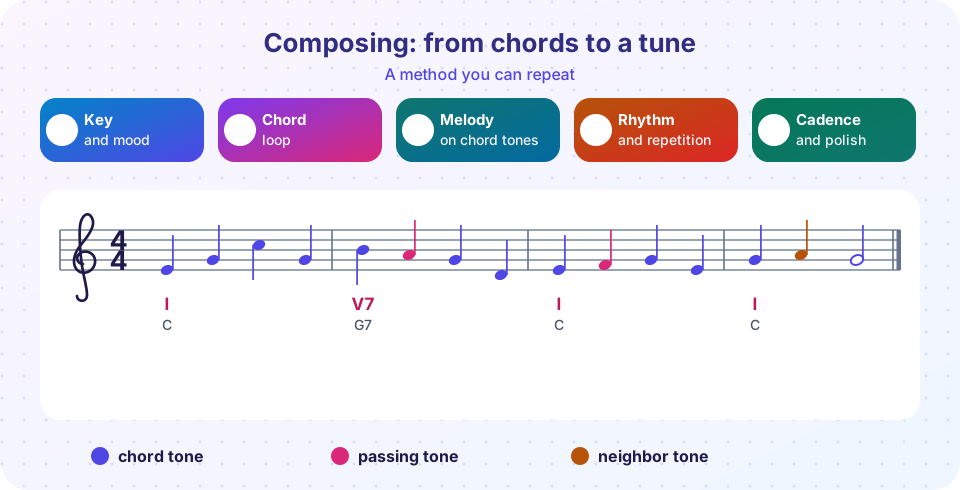
The picture shows a four-bar melody built with this process.
- Frame. C major, 4/4, a four-bar phrase ending on a perfect authentic cadence.
- Cadence. G7 in bar 3 resolving to C in bar 4.
- Chords. C | G7 | C | C. (A real piece would add more variety, but a skeleton is enough to start.)
- Melody on chord tones. Bar 1: E G C G (C major chord tones). Bar 2: B, A, G, D. B, G, D belong to G7. Bar 3: E, F, G, E. Bar 4: G, A, G.
- Decoration. In bar 2 the A is a passing tone between B and G. In bar 3 the F is a passing tone between E and G. In bar 4 the A is a neighbor tone between two Gs. The picture colors these pink and amber, while the chord tones are blue.
- Ending. The last bar holds G, the fifth of the tonic chord, then C would follow in the next phrase.
Notice that the "decorated" version is the skeleton plus small steps. If you remove the pink and amber notes and hold the previous note instead, the melody still works. That is a test of a good skeleton.
Common problems and fixes
| Problem | Likely cause | Fix |
|---|---|---|
| The tune wanders | no clear climax or motif | choose one climax; use one motif |
| It sounds mechanical | every bar has the same rhythm | vary note lengths, add a long note or a rest |
| It ends too early | cadence arrives before the phrase length is used | extend with a sequence or repeat the cadence |
| It sounds wrong over the chords | strong-beat notes are not chord tones | move those notes to chord tones |
| Phrases feel the same | all cadences are identical | use a half cadence for the first phrase |
| Too many leaps | no steps for recovery | fill in with passing notes, turn back after a leap |
| Harmony is boring | one chord for too long | add a secondary dominant or a borrowed chord |
Common misconceptions
"Composing needs talent, not rules." Rules are shortcuts that previous composers discovered. Talent shows in how you choose among them.
"If I follow the process the result will be generic." The process produces a draft. Originality comes from the choices inside it: the motif, the climax, the surprise you add.
"A melody must never use notes outside the chord." Passing and neighbor tones are what make melodies sing. The rule is only that strong beats favor chord tones.
Try it
Hear how a melody is decorated. The first button plays only the chord tones (the skeleton), the second plays the finished melody with passing and neighbor tones, and the third plays both together.
Now let the program draft a four-bar sentence for you. It follows the process: a motif from chord tones in bar 1, the same motif one step lower on the dominant in bar 2, a descending continuation in bar 3 and a final tonic in bar 4. Generate several and notice how the motif changes the character.
Check your understanding
Quick check · 5 questions
of 5 answered You scored / 5 · perfect!
-
1. What should you decide first when composing a phrase?
Knowing where the phrase must end makes every other decision easier. -
2. Which notes should usually land on strong beats?
Chord tones on strong beats make a melody fit its harmony. -
3. What is a neighbor tone?
Neighbor tones decorate a chord tone by moving a step away and back. -
4. How does a sentence develop its motif?
A sentence presents the idea, repeats it, then fragments it for momentum. -
5. Your melody sounds mechanical. Which fix is suggested?
Rhythmic variety and breathing room make a melody feel alive.
Summary
- Compose in order: frame, cadences, chords, melody on chord tones, non-chord tones, motif and rhythm, bass and polish.
- Strong-beat notes should be chord tones; passing and neighbor tones decorate them.
- Use one climax and one motif; develop the motif with repetition, sequence and fragmentation.
- Diagnose drafts by comparing symptoms with causes: wandering means no climax, mechanical means no rhythmic variety.
Next: Chapter 8 review
Track your progress
Create a free account to tick off lessons and pick up where you left off on any device.
of Music Theory lessons completed