


















Lesson 47 of 50 · Projects and Practice
Practice set: harmony, form, rhythm and analysis
Twenty-four practice problems on triads, Roman numerals, cadences, form, voice leading, rhythm and analysis, with a full answer key and two interactive drills.
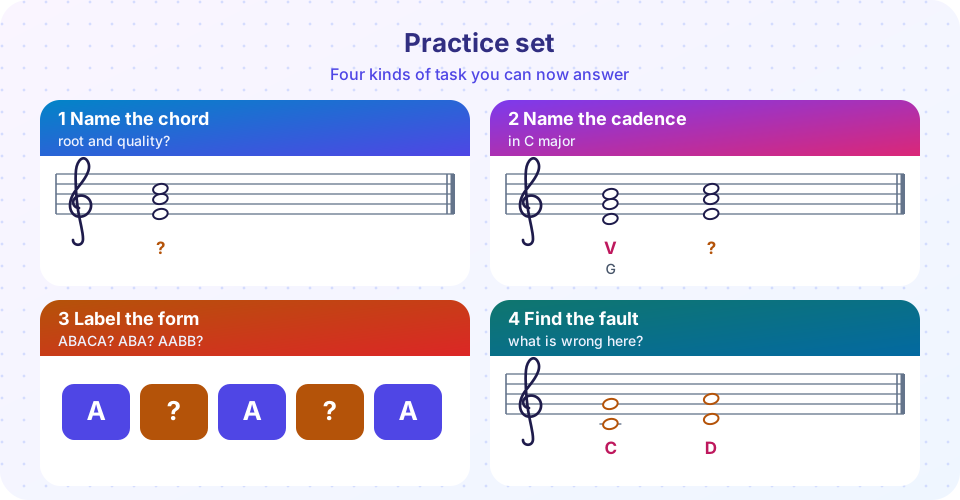
Reading about theory is the first half of learning it. The second half is doing problems until the answers feel automatic. This lesson gives you a set of 24 practice problems that cover chapters 5 to 8, a full answer key and two interactive drills that generate new questions without end. Work on paper if you can. Cover the answer key, try each problem, check, and mark the ones you missed; then look back at the lesson named beside each section.
What you will learn
- How to check your own recall across the four main topics of chapters 5 to 8
- Which question types still need work
- How to use worked answers to find the mistake behind a wrong answer
Key terms
Retrieval practice: testing yourself from memory, which strengthens learning more than rereading.
Error log: a short list of the problems you got wrong and why.
Interleaving: mixing different problem types in one session rather than doing one type at a time.
How to use this set
Do the problems in order once, writing answers before you look. Then do the interactive drills, which mix topics. Keep an error log: for each wrong answer write one line on the cause (a concept, a slip, a spelling error). After a week, redo only the problems you missed. This is far more efficient than rereading lessons.
Part A: triads and Roman numerals
Review: Diatonic triads and Roman numerals.
- Write the seven triads of D major, with Roman numerals.
- In F major, what chord is vi?
- The chord symbol Am is used in three keys: C major, G major and F major. What is its Roman numeral in each?
- Spell the notes of V7 in G major.
- Give the function (tonic, predominant or dominant) of ii, iii and vii° in a major key.
- In A minor with the raised seventh degree, what is the V chord and what are its notes?
Part B: cadences and progressions
Review: Function and Cadences.
- In C major, name the cadence: G to C, root position, melody ending on C.
- In C major, name the cadence: F to C.
- In C major, name the cadence: C to G at the end of a phrase.
- In G major, name the cadence: D to Em.
- Write the function path of the progression I, vi, ii, V, I.
- Why is vi often called a "tonic substitute"?
Part C: melody, phrase and form
Review: Contour and motifs, Phrases and Forms.
- A motif G G G E-flat is repeated as F F F D. What is this technique called?
- A four-bar phrase ends on a half cadence and is followed by a four-bar phrase that begins the same way and ends with a perfect authentic cadence. What is the structure?
- Give the letter pattern for a rondo with two episodes.
- In a major-key sonata form, in which key does the second theme appear in the exposition? In the recapitulation?
- A sentence has a presentation of two bars and a continuation. How long is the continuation in an eight-bar sentence?
Part D: voice leading
Review: Voice leading.
- Two voices move from C4 and G4 up to D4 and A4. What is wrong?
- In G7 resolving to C, where do B and F go?
- Which note should not be doubled in a major triad in root position?
Part E: rhythm and meter
Review: the rhythm chapter, starting with the overview.
- How is 7/8 grouped as 2 + 2 + 3 counted?
- How many grid steps are needed to notate 4 against 3?
- At quarter = 90, a dotted quarter note becomes the new quarter note. What is the new tempo?
Part F: analysis
Review: the analysis chapter.
- In C major a chord progression is C, D7, G, C. Label it with Roman numerals and name the special chord.
Answer key
Part A. (1) D (I), Em (ii), F♯m (iii), G (IV), A (V), Bm (vi), C♯° (vii°). (2) Dm. (3) In C major vi; in G major ii; in F major iii. (4) D, F♯, A, C. (5) ii is predominant, iii is tonic (a tonic substitute, sometimes a connector), vii° is dominant. (6) E major: E, G♯, B.
Part B. (7) Perfect authentic cadence. (8) Plagal cadence. (9) Half cadence. (10) Deceptive cadence (V to vi). (11) T, T, PD, D, T. (12) vi shares two notes with I (C and E in C major), so it can replace the tonic with a softer arrival.
Part C. (13) Sequence. (14) A parallel period: an antecedent followed by a consequent. (15) A B A C A. (16) Dominant in the exposition, tonic in the recapitulation. (17) Four bars.
Part D. (18) Parallel perfect fifths (C to G is a fifth, D to A is a fifth, both voices move up). (19) B rises to C; F falls to E. (20) The leading tone (and in general, avoid doubling tendency tones).
Part E. (21) 1 2 1 2 1 2 3. (22) 12. (23) New tempo = 90 × 1 ÷ 1.5 = 60.
Part F. (24) I, V7/V (or V/V), V, I. The special chord is D7, a secondary dominant whose F♯ is the leading tone of G.
Where students most often slip
After marking many practice sets, a few patterns come up again and again, and knowing them in advance saves points.
- Spelling errors, not concept errors. In keys with sharps or flats, the chords of the scale are easy to misspell. Write the scale first, then build chords from it. In D major, the vii chord is C-sharp diminished, not C diminished.
- Confusing a cadence with a chord. A cadence is two chords and a position in the phrase. V alone is a chord; V at the end of a phrase is a half cadence.
- Reading the time signature instead of the groups. A bar of 7/8 does not tell you where the accents fall. Look for beams and accents.
- Forgetting that Roman numerals depend on the key. Always write the key before you write the numerals.
- Calculating tempo changes the wrong way round. Write the old value and the new value on paper before you multiply.
Try it
First, a mixed quiz engine. Each round draws eight random questions from a bank that spans all four topics, and gives instant feedback and a score. Play several rounds and watch which topics you miss.
Second, a voice-leading spotter. Two voices move from one interval to another. Listen and decide whether the motion is parallel fifths, parallel octaves or fine.
Check your understanding
Quick check · 4 questions
of 4 answered You scored / 4 · perfect!
-
1. What is the best way to use a practice set?
Retrieval followed by review of errors is the most efficient study method. -
2. In D major, what is the Roman numeral of F-sharp minor?
D major: D E F# G A B C#. F# is the third degree and the chord is minor, so iii. -
3. What is the grid size for 4 against 3?
The least common multiple of 4 and 3 is 12. -
4. C, D7, G, C in C major contains which special chord?
D7 is V7/V.
Summary
- Practice by retrieval: attempt, check, log, repeat.
- This set covers triads and numerals, cadences, melody and form, voice leading, rhythm and analysis.
- Interleave topics in a mixed session; redo missed problems after a few days.
- Use the drills for unlimited extra practice.
Next: Glossary of terms
Track your progress
Create a free account to tick off lessons and pick up where you left off on any device.
of Music Theory lessons completed