


















Lesson 45 of 50 · Projects and Practice
Project: compose a 16-bar theme
A guided composing project: use a 16-bar blueprint of phrases, chords and cadences, write a melody on it, then test it with a checker that plays and analyzes your theme.
Time to use everything. In this project you will compose a complete 16-bar theme in C major. You will not start from a blank page: you will start from a blueprint that fixes the form, the chords and the cadences, and then you will write the melody. The blueprint is a standard classical layout, so the result will feel like a real tune, and a checker built into this lesson will play your theme with chords and tell you what it hears. The aim is not a masterpiece. The aim is to make every decision consciously and to hear the effect of each choice.
What you will learn
- How to use a formal blueprint to plan a long theme
- How to write a melody that fits given chords and cadences
- How to shape a four-phrase theme with contrast and return
- How to check your own work for cadences, strong-beat chord tones, range and climax
- How to revise a draft with a clear checklist
Key terms
Blueprint: a plan that fixes the number of bars, the phrase structure, the chords and the cadence points before the melody is written.
Double period: four phrases forming two question-and-answer pairs, normally 16 bars.
Contrast phrase (B): the third phrase, which moves away from the opening material and often visits the relative minor.
Return (A''): the fourth phrase, which brings back the opening idea.
Strong beat: beat 1 and beat 3 in 4/4; melody notes here are usually chord tones.
The plan
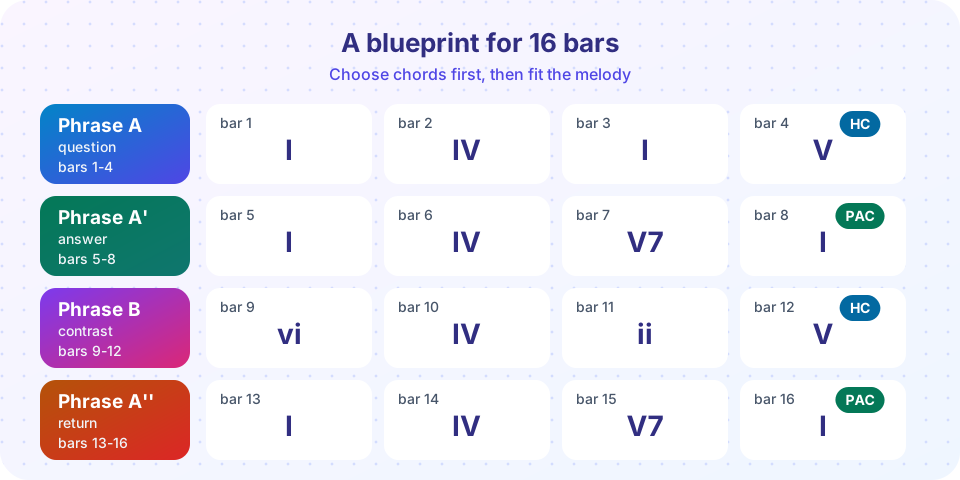
The blueprint above is a 16-bar double period. Read it row by row.
| Phrase | Bars | Chords | Job | Cadence |
|---|---|---|---|---|
| A | 1 to 4 | I, IV, I, V | state the opening idea | half cadence on V in bar 4 |
| A' | 5 to 8 | I, IV, V7, I | answer with the same start and a stronger ending | perfect authentic cadence in bar 8 |
| B | 9 to 12 | vi, IV, ii, V | contrast: move to the minor side, build to the climax | half cadence in bar 12 |
| A'' | 13 to 16 | I, IV, V7, I | return home | perfect authentic cadence in bar 16 |
Why does this work? Phrase A asks a question. Phrase A' answers it. Phrase B steps away and ends on V again, which holds the tension so that the last phrase, a return of A, feels like arriving home. The half cadences at bars 4 and 12 lift the energy; the authentic cadences at bars 8 and 16 settle it. This is the shape of countless Classical themes and hymn tunes, and also of many songs.
The harmonies follow the function cycle from chapter 5: I, IV, V (tonic, predominant, dominant), with vi and ii in the third phrase giving a gentler route to the dominant (tonic substitute, then predominant).
Step by step
Step 1: choose the rhythm of your opening idea
Pick a bar of 4/4 using a short pattern, for example quarter, quarter, half. Using a similar rhythm in many bars gives the tune identity. You will vary it, but the first bar sets the character. Good starting rhythms:
- quarter, quarter, half (calm, song-like)
- dotted quarter, eighth, half (more flowing)
- quarter, eighth, eighth, half (a little busier)
In the checker, write durations in beats: a quarter is 1, a half is 2, an eighth is 0.5.
Step 2: write phrase A on chord tones
Bar 1 (chord I = C E G): choose a motif from C, E, G, C. Bar 2 (IV = F A C): move the motif up or down to fit the chord. Bar 3 (I): return to C chord tones. Bar 4 (V = G B D): end on a chord tone of V, probably D or G, so the phrase sounds open. Aim for steps and small leaps.
Step 3: answer it in phrase A'
Copy the shape of phrase A for bars 5 and 6, then change bar 7 (V7 = G B D F) so the line heads for the tonic, and end bar 8 on C (a perfect authentic cadence). If the melody in bar 7 includes F, remember that F falls to E.
Step 4: contrast in phrase B
Use the chords vi, IV, ii, V (A minor, F, D minor, G). Make the melody go higher here: this is where your climax should appear, probably in bar 11 or 12. Change the rhythm a little, for instance a rising sequence. End on a chord tone of V so that the ear is hungry for the return.
Step 5: return in phrase A''
Bring back the beginning of phrase A and finish with the same ending as phrase A' (or a slight variant). The repeated opening is what makes the theme feel complete.
Step 6: test and revise
Paste your melody into the checker. It plays your theme with chords and gives a report on four things: whether the bars add up, whether the cadence bars end on the right notes, how many strong-beat notes are chord tones and where the climax is. Treat the report as a checklist, not a grade. A strong-beat chord-tone percentage of 80 or more usually means the melody fits its chords; a few non-chord tones on strong beats are fine if they resolve.
Try it
Write notes as name:beats, such as E4:1 for a quarter note on E and C5:2 for a half note on C. Separate bars with |. The example theme is loaded for you: it is a complete answer, but you will learn more by changing it. Replace a bar, press Check and Play, and listen to how the report and the sound change.
Revision checklist
After your first draft, ask these questions about it, one at a time, and change only one thing per pass.
- Does each phrase end where the blueprint says? If not, fix the last note of bars 4, 8, 12 and 16 first.
- Does the melody fit its chords? Aim for most strong-beat notes to be chord tones. Move any others or make them resolve.
- Is there one high point? If your highest note appears more than once, lower the early ones.
- Is there enough variety? If every bar uses the same rhythm, change one bar.
- Is there enough sameness? If no two bars sound related, repeat a motif.
- Can you sing it? A good theme is singable. Remove awkward leaps.
Going further
Once your theme works, you can extend it in three directions. First, change the mood: transpose it to A minor, change the tempo or play it with different chords. Second, vary it: write a variation in which every note is decorated with passing tones. Third, add a second voice: write a bass line that moves by step using first-inversion chords, and check for parallel fifths and octaves with the voice-leading detector. Each of these exercises uses a different lesson from the course.
Check your understanding
Quick check · 4 questions
of 4 answered You scored / 4 · perfect!
-
1. In the 16-bar blueprint, what cadence closes phrase A in bar 4?
Phrase A is the question, so it ends on V. -
2. Where should the climax of the theme normally appear?
Phrase B is the contrast and the place to build toward the highest point. -
3. What should most strong-beat melody notes be?
Chord tones on beats 1 and 3 make the melody fit the harmony. -
4. Which chords form phrase B in the blueprint?
The contrast phrase uses vi, IV, ii and V, ending on the dominant.
Summary
- A 16-bar double period has four phrases: A (question), A' (answer), B (contrast) and A'' (return).
- Fix the chords and cadences first, then write the melody on chord tones.
- Place one clear climax in the contrast phrase.
- Use the checker to test cadences, strong-beat chord tones, range and leaps, and revise one thing at a time.
Track your progress
Create a free account to tick off lessons and pick up where you left off on any device.
of Music Theory lessons completed