


















Lesson 40 of 50 · Analysis and Composition
The method of analysis: Roman numerals, inversions and form
A step-by-step method for harmonic analysis: find the key, label chords with Roman numerals and inversions, separate non-chord tones, name cadences and map the form.
Analysis can feel intimidating because a score is a wall of notes. The way through is routine. Experienced analysts do not stare at a page and wait for insight; they run through the same short list of questions every time, and the answers assemble into a picture. This lesson gives you that list, shows how to label chords including inversions, explains which notes to ignore when you identify a chord, and then works a complete example from start to finish.
What you will learn
- A six-step routine that works for almost any tonal piece
- How to read and write inversions: 6, 6/4, 7, 6/5, 4/3 and 4/2
- How to recognize non-chord tones so that you do not mislabel them as chords
- How to combine chords, function and cadences into a statement about form
- The most common mistakes to avoid
Key terms
Roman numeral analysis: labeling each chord with a numeral showing its root's scale degree and its quality.
Inversion: a chord with a note other than the root in the bass.
Figured bass symbols: small numbers next to a numeral, such as 6 or 6/4, showing which inversion is played.
Non-chord tone (NCT): a note that sounds against a chord but does not belong to it.
Harmonic rhythm: the rate at which chords change.
The six-step routine
- Survey. Look at the whole piece before you label anything. Note the time signature, the key signature, the length and any repeat signs. Glance at the first and last bars.
- Find the key. A key signature offers two candidates (for instance, no sharps or flats means C major or A minor). Decide between them by looking at the first and last chords and the cadences. A raised seventh degree with an accidental points to a minor key. If the key changes midway, mark each change.
- Label the chords. On each beat or each bar (wherever the harmony changes), identify the chord: its root, quality and inversion. Write chord symbols first, then convert to Roman numerals.
- Name the function. Mark each chord T, PD or D. Look for the cycle. Mark places where it is broken.
- Mark the cadences. Circle the chords at the end of each phrase and name the cadence (PAC, IAC, HC, plagal, deceptive).
- Map the form. Group the phrases into periods or sentences and the sections into binary, ternary, rondo, sonata or a song form.
Most mistakes come from skipping step 1 or 2. If you misidentify the key, every numeral that follows is wrong, no matter how careful you are.
Inversions and figured-bass symbols
A chord is in root position when its root is the lowest note. If its third or fifth is in the bass, it is inverted. In Roman numeral analysis, an inversion is shown by small numbers written after the numeral. They come from figured bass, the system used by Baroque keyboard players and they describe the intervals above the bass note.
| Chord type | Bass note | Symbol | Example in C major |
|---|---|---|---|
| Triad, root position | root | none | C = I |
| Triad, first inversion | third | 6 | C/E = I6 |
| Triad, second inversion | fifth | 6/4 | C/G = I6/4 |
| Seventh chord, root position | root | 7 | G7 = V7 |
| Seventh chord, first inversion | third | 6/5 | G7/B = V6/5 |
| Seventh chord, second inversion | fifth | 4/3 | G7/D = V4/3 |
| Seventh chord, third inversion | seventh | 4/2 | G7/F = V4/2 |
Usually the Roman numeral stays the same, and the inversion symbol is added to it. This is why V and V6 are both "the dominant": same chord, different bass note.
Non-chord tones: ignore them (but name them)
Not every note you see belongs to the chord. A melody often moves through notes that are not chord tones, decorating the harmony. If you treated each such note as a new chord, your analysis would be a mess. Use the following test: look at the notes that sound on the strong beats, together with the bass; most of the time they spell the chord. Then examine the remaining notes.
| Type | What it does | Where it sits |
|---|---|---|
| Passing tone | fills the step between two chord tones | usually weak beat |
| Neighbor tone | steps away from a chord tone and returns | weak beat; upper or lower |
| Suspension | holds a note from the previous chord, then falls by step to a chord tone | strong beat; resolves down |
| Anticipation | arrives early; the next chord's tone | at the end of a beat |
| Appoggiatura | leaped to, on a strong beat, then resolves by step | strong beat |
| Escape tone | step away and then leap in the opposite direction | weak beat |
| Pedal point | a sustained note (often bass) that stays while the chords change | the whole stretch |
Naming them correctly is a skill, but the rule of thumb is enough for now: label chords from the notes on strong beats and in the bass, and treat the rest as decoration unless the harmony clearly changes.
A worked example
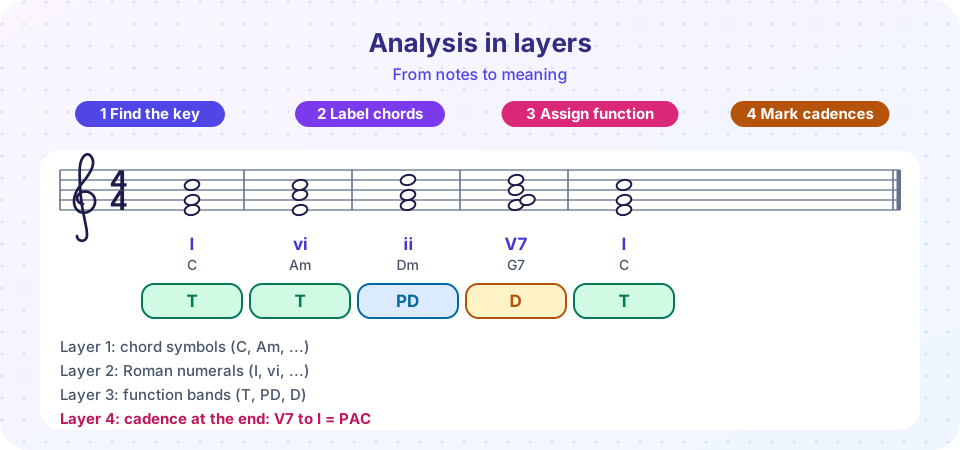
Here is a four-bar excerpt in C major (shown in the picture). Each chord is a whole note, so the harmony is easy to read.
- Survey. 4/4, no key signature, five chords.
- Key. C major: the first and last chords are C major and there is a G7 (with the leading tone B) before the last chord.
- Chords. C, Am, Dm, G7, C.
- Numerals. I, vi, ii, V7, I. All diatonic, so no accidentals are needed.
- Function. T, T, PD, D, T. The vi is a tonic substitute, ii prepares the dominant and V7 resolves to I.
- Cadence. G7 to C in root position: a perfect authentic cadence if the melody ends on C; an imperfect one if it ends on E or G.
You can now describe the passage in plain language: "The phrase moves from the tonic through its relative minor, passes to ii as a predominant, builds tension on V7 and resolves with an authentic cadence." That sentence is an analysis, and it is made from your six steps.
Using the method on the period from the earlier lesson
The eight-bar tune from the phrases lesson can be analyzed in the same way. Its bar-by-bar harmony is I, IV, V, V | I, IV, V7, I. The first half ends on V (half cadence) and the second half ends on I (perfect authentic cadence), which confirms that it is a period: the antecedent ends on a half cadence and the consequent on a PAC.
Common mistakes
Labeling every note. Passing tones and neighbor tones are not chords. Find the strong-beat notes first.
Ignoring the bass. The lowest note decides the inversion. A C major chord with E in the bass is I6, not I.
Trusting the key signature blindly. A key signature allows two keys, and pieces may modulate. Check the cadences.
Forgetting accidentals. An accidental outside the key is a signal: a secondary dominant, a borrowed chord or a modulation. Never skip it.
Using chord symbols from a lead sheet without checking them. They describe one possible harmonization; your task is to determine what the notes actually do.
Try it
First, a chord analyzer for major keys. Type a key and a list of chord symbols separated by spaces (such as C Am Dm G7 C) and see the numerals and functions. It also recognizes secondary dominants and some borrowed chords.
Now practice by hand. A chord chart appears and you must pick the numeral for each chord in turn. The answers give feedback straight away.
Check your understanding
Quick check · 5 questions
of 5 answered You scored / 5 · perfect!
-
1. A C major chord with E in the bass is labeled...
First inversion (third in the bass) is shown by the figure 6. -
2. What is the first step of the routine?
Looking at time signature, key signature and layout first prevents later mistakes. -
3. Which note type is approached by leap, on a strong beat, then resolves by step?
An appoggiatura is a leaped-to dissonance on a strong beat that resolves by step. -
4. How is G7 with F in the bass labeled in C major?
Third inversion of a seventh chord (the seventh in the bass) is 4/2. -
5. Why should you check the cadences when choosing between a major key and its relative minor?
The tonic is where the music rests, and its dominant leads to it.
Summary
- Use a fixed routine: survey, key, chords, function, cadences, form.
- Inversion symbols (6, 6/4, 7, 6/5, 4/3, 4/2) are added to the numeral and describe the bass note.
- Label chords from strong-beat notes and the bass; classify other notes as non-chord tones.
- An accidental outside the key is a clue to a secondary dominant, a borrowed chord or a modulation.
- Combine your findings into a plain-language statement of how the music moves.
Track your progress
Create a free account to tick off lessons and pick up where you left off on any device.
of Music Theory lessons completed