


















Lesson 12 of 50 · Scales and Keys
The major scale
Build the major scale from the whole-whole-half pattern, name its scale degrees, spell it on any note without repeating letters and train your ear to spot wrong notes.
The major scale is the backbone of Western music. Most nursery rhymes, hymns, folk songs and pop hooks draw their notes from it, and nearly every other scale and chord is described by comparing it with the major scale. If you know it well, you know where to find its seven notes, how they relate to each other and how to rebuild it starting from any pitch.
The idea is beautifully simple: one pattern of whole and half steps, repeated from any starting note. In this lesson you will learn the pattern, see why it makes the scale sound the way it does, and learn the one rule that makes written scales correct: use every letter name exactly once.
What you will learn
- The step pattern W W H W W W H and where the half steps sit
- The names of the seven scale degrees
- Why the scale can be seen as two identical four-note groups
- How to spell a major scale on any starting note
- How to hear the difference between a correct and an altered scale
Key terms
Major scale: the seven-note scale with step pattern whole, whole, half, whole, whole, whole, half.
Tetrachord: a group of four notes spanning a perfect fourth; the major scale is two tetrachords W W H joined by a whole step.
Scale degree: a note's number in the scale, 1 to 7.
Transposition: moving a melody or scale to start on a different note while keeping its pattern.
Spelling: choosing the correct letter names and accidentals for each note.
The pattern: W W H W W W H
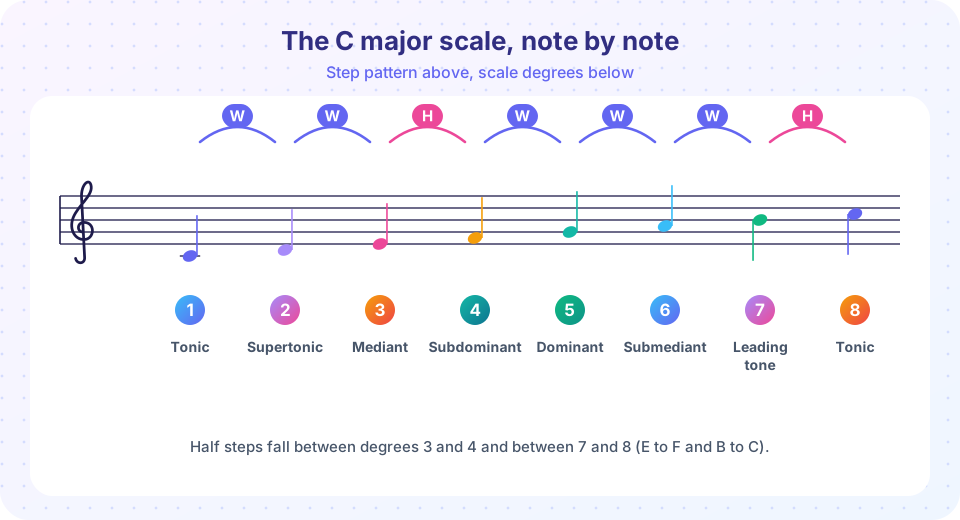
Start on C and walk up the white keys: C, D, E, F, G, A, B, C. Look at the keyboard, and you will see black keys between C and D, D and E, F and G, G and A and A and B, but none between E and F or between B and C. So the distances are:
| From | To | Step |
|---|---|---|
| C | D | whole |
| D | E | whole |
| E | F | half |
| F | G | whole |
| G | A | whole |
| A | B | whole |
| B | C | half |
That sequence, whole, whole, half, whole, whole, whole, half, is the major scale pattern. The two half steps fall between degrees 3 and 4 and between degrees 7 and 8. Those are the places where the scale "leans". Degree 7 (the leading tone) is only a half step below the tonic, so it strongly wants to rise to it. That tension and release is what the major scale sounds like: bright, stable and resolved.
You will often see the pattern written with the shorthand 2 2 1 2 2 2 1, counting half steps. The seven numbers add up to 12, the number of half steps in an octave.
Degrees and their names
Each note has a number (1 to 7), a traditional name and a syllable. The names describe the function of the degree in harmony:
| Degree | Name | Solfège | Character |
|---|---|---|---|
| 1 | Tonic | Do | home, rest |
| 2 | Supertonic | Re | an active passing note |
| 3 | Mediant | Mi | halfway between tonic and dominant; decides major or minor |
| 4 | Subdominant | Fa | a pull downward |
| 5 | Dominant | Sol | strong, next to the tonic in stability |
| 6 | Submediant | La | a gentle, warm note |
| 7 | Leading tone | Ti | tense, wants to go up to 1 |
The word "dominant" for degree 5 reflects how important that note is to the tonic: it is the second most significant degree in a key, and the harmony built on it is the strongest way to lead back home. "Subdominant" for degree 4 means the dominant below the tonic, as far below the tonic as the dominant is above. Learn the numbers first and the names will follow.
Two tetrachords
A tetrachord is a group of four notes spanning a perfect fourth. In the major scale, notes 1 to 4 (C D E F) follow whole, whole, half. Notes 5 to 8 (G A B C) follow the same pattern: whole, whole, half. The two tetrachords are linked by one whole step (F to G). This view, inherited from ancient Greek music theory, explains a handy trick: the upper tetrachord of one major scale becomes the lower tetrachord of the next. The upper tetrachord of C major is G A B C, and it begins the scale of G major: G A B C, then D E F♯ G. You will use this idea in the next lesson to understand key signatures.
Building a major scale on any note
Suppose you want the major scale starting on G. Apply the pattern: G up a whole step is A, another whole step is B, a half step is C, a whole step is D, a whole step is E, a whole step is F♯ (plain F would be only a half step above E), and a half step brings you to G. The result is G A B C D E F♯ G: the scale contains one sharp.
Why F♯ and not G♭? Here is the rule that makes written scales correct:
A scale uses each of the seven letter names exactly once (and then repeats the first letter at the top).
G, A, B, C, D, E, F-something, G: each letter appears once. If you spelled the seventh note as G♭, the letter G would appear twice and F would be missing. So the seventh note must have the letter F, and it needs a sharp to be the right pitch. Follow this method:
- Write the seven letters in order starting from the tonic (for D: D E F G A B C).
- Apply the whole-half pattern in sound, and decide for each letter whether it needs a sharp or a flat to land on the correct pitch.
Examples:
- D major: D E F♯ G A B C♯ D (two sharps)
- F major: F G A B♭ C D E F (one flat, B♭, because the half step must fall between degrees 3 and 4: A to B♭)
- B♭ major: B♭ C D E♭ F G A B♭ (two flats)
- F♯ major: F♯ G♯ A♯ B C♯ D♯ E♯ F♯ (six sharps, including E♯, which is the white key F)
The last example shows why the letter rule matters. E♯ looks odd, since F is a natural white key, but the seventh degree of F♯ major must be some kind of E, and E♯ keeps the letters in order. The sound is identical to F, but the spelling is correct, and a reader sees the scale's structure.
Transposition and why the pattern matters
Singing "Happy Birthday" in a lower or higher key keeps the tune, because you keep the pattern of steps. Moving all notes of a melody by the same interval is transposition. A singer can pick the key that suits their voice, and a clarinet player must read transposed parts because the instrument sounds a step lower than written. Since each major scale has the same pattern, any melody built on one can be moved to another.
Common misconceptions
"The major scale is made of white keys." Only C major is. The others use black keys because the pattern, not the key colors, defines the scale.
"You can spell any scale with whichever accidentals are handy." Correct spelling uses each letter once. F♯ major has E♯, not F, for the seventh note.
"The half steps are between degrees 4 and 5." They fall between 3 and 4 and between 7 and 8.
Try it
Choose any major key and see its correct spelling, then listen. The program uses the "each letter once" rule: it works out each note's letter first, then the accidental needed to reach the right pitch.
The same algorithm in Python prints the correct spelling of all fifteen major keys that appear in key signatures (seven with sharps, seven with flats, and C). Check the F sharp major line: it has to contain E sharp.
Press Run (or Ctrl + Enter) to see the result here.
Program input · what you'd type while the program runs
Type the answers before you press Run, one per line. Each time the program reads a line (with input()), it gets the next line from this box.
Finally, train your ear. This game plays a major scale in which one degree has been lowered by a half step. Decide which degree sounds wrong. The three changes that make the biggest difference are degrees 3, 6 and 7, which turn the scale toward the minor sound.
Check your understanding
Quick check · 5 questions
of 5 answered You scored / 5 · perfect!
-
1. Between which scale degrees do the half steps fall in a major scale?
The pattern is W W H W W W H, so the half steps are 3 to 4 and 7 to 8. -
2. What is the correct spelling of the D major scale?
D major has F sharp and C sharp. Applying W W H W W W H from D gives D E F♯ G A B C♯ D. -
3. Why is the seventh degree of F♯ major written E♯ and not F?
The scale F♯ G♯ A♯ B C♯ D♯ E♯ F♯ uses each letter once. E♯ sounds identical to F but is spelled to preserve the letter sequence. -
4. Which scale degree is called the dominant?
Degree 5 is the dominant, the second most important note of the key after the tonic. -
5. In a major scale, the upper four notes (degrees 5 to 8) form a tetrachord with the steps:
Both tetrachords of the major scale are W W H, joined by a whole step.
Summary
- The major scale pattern is W W H W W W H (2 2 1 2 2 2 1 half steps), with half steps between degrees 3-4 and 7-8.
- Degrees are tonic, supertonic, mediant, subdominant, dominant, submediant and leading tone.
- The scale is two W W H tetrachords joined by a whole step.
- Spell a scale with each letter name used once, then add the sharps or flats needed.
- Any melody can be transposed because the pattern, not the notes, makes a major scale.
Track your progress
Create a free account to tick off lessons and pick up where you left off on any device.
of Music Theory lessons completed