


















Lesson 46 of 50 · Projects and Practice
Project: analyze a short piece
Apply the full analysis routine to an original eight-bar melody in G major: key, Roman numerals, function, a secondary dominant, cadences, phrases and form.
You have learned the method; now you will use it. This project walks you through a complete analysis of a short original piece: eight bars in G major with a melody and chord symbols. The piece is small enough to hold in your head and rich enough to contain a secondary dominant, two cadences, a clear motif and a two-phrase form. Work through the questions first, writing your own answers, and only then read the model analysis. The difference between reading an analysis and doing one is the difference between watching a swimmer and swimming.
What you will learn
- How to apply the six-step routine to a complete piece
- How to recognize a secondary dominant from a single accidental
- How to find cadences, phrase boundaries and form by listening and by reading
- How to describe the melody's design: chord tones, arpeggios, climax
- How to write a short summary of an analysis in plain language
Key terms
Arpeggiated melody: a melody that moves through the notes of a chord one after another.
Secondary dominant: a dominant chord that points at a chord other than the tonic (here A7 pointing at D).
Authentic cadence: V or V7 moving to I.
Phrase: a musical sentence ending at a cadence.
Harmonic rhythm: how often the chords change; here, one chord per bar.
The piece
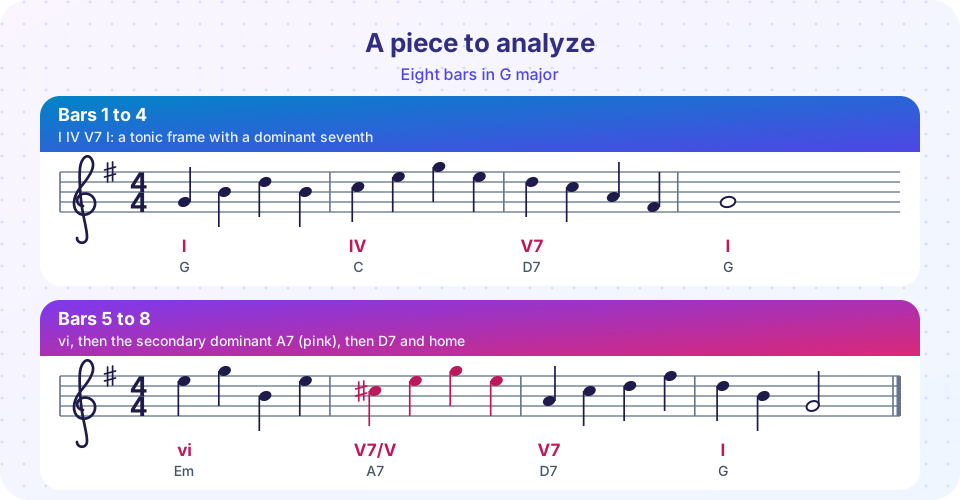
Bar by bar, the chords are:
| Bar | 1 | 2 | 3 | 4 | 5 | 6 | 7 | 8 |
|---|---|---|---|---|---|---|---|---|
| Chord | G | C | D7 | G | Em | A7 | D7 | G |
The melody is written in the picture. It moves mostly by arpeggios and short scale fragments, and it stays within a range of a little over an octave, from F♯4 up to G5.
The questions
Work through these before reading on. Write short answers.
- What is the time signature and the key signature? What key does the piece seem to be in, and what evidence supports your answer?
- Write the Roman numeral for each bar.
- Mark each chord T, PD or D. Does the piece follow the function cycle?
- Which chord contains an accidental that is not in the key signature? What does that accidental do?
- Where are the cadences? Name each.
- Is this a period, a sentence or something else?
- How is the melody built? Which notes on strong beats are chord tones?
- What is the climax of the melody?
- Write two sentences describing how the piece moves from beginning to end.
Model analysis
1. Key and meter
The time signature is 4/4. The key signature has one sharp (F♯), which allows G major or E minor. The piece begins and ends on G major, the fifth chord D7 contains C and F♯ that pull toward G, and the Em chord in bar 5 is a vi. Everything points to G major.
2 and 3. Numerals and function
| Bar | Chord | Numeral | Function |
|---|---|---|---|
| 1 | G | I | tonic |
| 2 | C | IV | predominant |
| 3 | D7 | V7 | dominant |
| 4 | G | I | tonic |
| 5 | Em | vi | tonic (substitute) |
| 6 | A7 | V7/V | dominant of V |
| 7 | D7 | V7 | dominant |
| 8 | G | I | tonic |
Both four-bar halves follow the cycle: T, PD, D, T in the first half, and T, (D of V), D, T in the second. Bar 5 is a tonic substitute, so the second phrase does not start with the same chord as the first and avoids a feeling of repetition.
4. The accidental
In bar 6 the melody contains C♯, and the chord is A7 (A, C♯, E, G). C♯ is not in G major. A7 is the dominant seventh of D, and D is V in G major. So A7 is a secondary dominant: V7/V. The C♯ is the leading tone of D, and it resolves up by half step to D in the next bar. The G (seventh of A7) falls by step to F♯, a note of D7. Notice that A7 does not resolve to a plain V triad but to V7, so the chain A7, D7, G is a chain of descending fifths: V7/V, V7, I.
The key does not change. Only one chord has an accidental and it resolves at once, so this is a tonicization, not a modulation. For a moment D is treated as home, and then the music finishes in G.
5. Cadences
- Bars 3 and 4: D7 to G. V7 to I, both in root position, and the melody ends on G (scale degree 1). This is a perfect authentic cadence. The first phrase is therefore complete and conclusive.
- Bars 7 and 8: D7 to G. The same chord progression, and the melody ends on G again. A second perfect authentic cadence.
6. Phrase structure
There are two four-bar phrases. A period would have a half cadence at the end of the first phrase and an authentic cadence at the end of the second. Here both phrases end with an authentic cadence, so it is not a period in the strict sense. A better description is two independent phrases, the second of which is a contrasting continuation that extends the harmonic story. The first phrase says everything in the plainest terms: I, IV, V7, I. The second phrase begins on a different chord (vi), adds the secondary dominant and reaches the cadence by a longer route, so it feels like a new thought with a more colorful journey.
In terms of form, the piece is a small binary structure (A B), neither section modulating and both ending in the tonic. A real piece would continue; this is the exposition of an idea.
7. The melody
Nearly every strong-beat note is a chord tone. Bar 1 outlines the G chord upward: G, B, D, then back to B. Bar 2 repeats the same up-and-back shape on the new chord: C, E, G, E. Bar 3 descends through D7 by a step and then two thirds: D, C, A, F♯, all chord tones of D7. This descending arpeggio is the first change of direction and it ends on the leading-tone side of the tonic.
Bars 5 to 7 use the same arpeggio idea at a higher register: E, G, B, E on Em; C♯, E, G, E on A7; A, C, D, F♯ on D7. Bar 8 closes with D, B, G, down the G chord to the tonic note.
8. The climax
The highest note is G5, which first appears in bar 2 and again in bars 5 and 6. The peak is therefore reached early and revisited, which is a point where an analyst might suggest a change: the melody does not have a single clear highest point, so the second phrase reinforces rather than surpasses the first. That is not a flaw but a design choice worth noticing.
9. A two-sentence summary
"The piece is an eight-bar theme in G major made of two four-bar phrases that both close with a perfect authentic cadence. The second phrase adds color through a secondary dominant (A7, V7/V) that tonicizes D for a moment before the music returns to G."
Try it
Hear the piece and reveal the analysis layer by layer. Press Play to hear the melody and chords; use the toggle buttons to show or hide chord symbols, numerals, functions and cadences.
Finally, check your understanding with flash questions. Try to answer in your head before pressing Show answer.
Check your understanding
Quick check · 4 questions
of 4 answered You scored / 4 · perfect!
-
1. What is the A7 chord in bar 6 of the G major piece?
A7 is the dominant seventh of D, which is the dominant of G. -
2. Why is the piece not a period?
A period needs a half cadence at the end of the first phrase. -
3. Which description of bars 1 to 4 is right?
The first phrase is plain and conclusive. -
4. What happens to C sharp in bar 6?
C sharp is the leading tone of D and rises by half step.
Summary
- The piece is a G major theme of two four-bar phrases, both closing with perfect authentic cadences.
- The second phrase adds color with the secondary dominant A7 (V7/V), which tonicizes D without changing key.
- The melody is built from arpeggios on strong-beat chord tones.
- Analyze with the routine: key, numerals, function, accidentals, cadences, phrase structure and melody.
Track your progress
Create a free account to tick off lessons and pick up where you left off on any device.
of Music Theory lessons completed