


















Lesson 10 of 50 · Sound, Notes and Rhythm
Chapter 2 review: sound, notes and rhythm
Review frequency and pitch, harmonics and timbre, note values, rests, dots, ties, time signatures and tempo with a one-page picture and a ten-question quiz.
This chapter followed a note from its physical birth to its place on the page. A vibration has a frequency, which we hear as pitch. Its overtone recipe gives it timbre. On paper its duration is written with note values, dots and ties, and measures group those durations into the repeating pattern of a meter at a chosen tempo. This review gathers that journey on one page and tests it.
What you will learn
- A one-page summary of chapter 2
- How the lessons connect, from physics to notation
- Which skills to practice before chapter 3
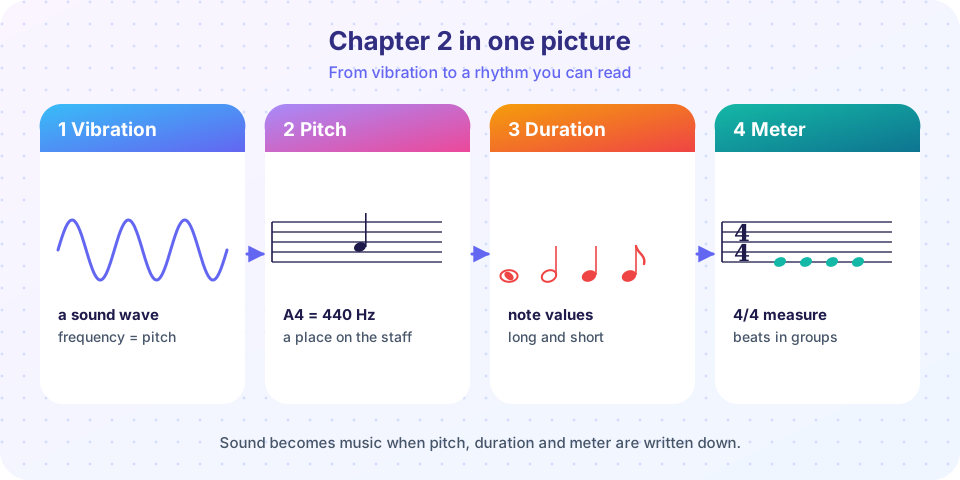
Chapter in one picture
Read the picture left to right. First, a vibration: the wave repeats a certain number of times per second, and that number is the frequency. Second, pitch: the frequency becomes a note name, so 440 Hz is A4, and the staff gives that note a place. Third, duration: shapes from whole to sixteenth note say how long each sound lasts, relative to the beat. Fourth, meter: barlines and a time signature gather beats into measures, with the first beat accented.
Two big ideas run through the chapter. The first is that musical relationships are ratios: an octave is 2:1, a fifth is about 3:2, and the equal-tempered semitone multiplies the frequency by 2^(1/12). The second is that rhythm is relative: a note's length is a fraction of a whole note, and the tempo decides the actual time.
Recap table
| Lesson | Key ideas | Remember |
|---|---|---|
| Pitch, frequency and timbre | Hz, A4 = 440, octave = 2:1, 12-tone equal temperament, harmonic series, waveforms | f = 440 × 2^((n − 69) / 12); the first harmonics outline a major triad |
| Note values, dots and ties | Whole 4, half 2, quarter 1, eighth 1/2, sixteenth 1/4 beats; rests; dot adds half; tie joins same pitch | A dot adds half the note's own value |
| Time signatures and tempo | Top = beats per measure, bottom = note value of the beat; simple (2) vs compound (3) division; BPM | 6/8 is felt in two; 3/4 in three |
| Dynamics and timbre | pp, p, mp, mf, f, ff; timbre = overtone mix and envelope | Pitch and loudness are independent |
Mixed formulas to remember
- Frequency of an equal-tempered note:
f = 440 × 2^((n − 69) / 12)with n the MIDI number. - Cents between two frequencies:
1200 × log2(f2 / f1). - Duration in seconds of one beat:
60 / BPM. - Value of a dotted note:
value × 1.5; double-dotted:value × 1.75. - Length of a piece:
measures × beats per measure × 60 / BPM.
Where learners go wrong
Equating pitch with loudness. They are separate properties: frequency versus amplitude.
Reading the bottom number as a quantity. It names a note value. 3/8 is three eighth-note beats per measure, not "three eighths of a second".
Counting 6/8 as six beats. At normal speed it is two beats, each in three parts.
Forgetting that ties need the same pitch. A curve over different pitches is a slur.
Adding a dot's value to the wrong note. A dot adds half of the note it follows, not half of a beat.
Try it
Tempo is easier to feel than to read. This tap-tempo tool measures your tapping speed. Tap the button steadily to a song in your head, and it reports your BPM and the nearest Italian tempo word.
A chart makes the note values concrete. This plot shows how many beats each value lasts, and how the lengths halve.
Press Run (or Ctrl + Enter) to see the result here.
Program input · what you'd type while the program runs
Type the answers before you press Run, one per line. Each time the program reads a line (with input()), it gets the next line from this box.
Check your understanding
Quick check · 10 questions
of 10 answered You scored / 10 · perfect!
-
1. What is the frequency of the A one octave above A4 (440 Hz)?
An octave doubles the frequency. -
2. Equal temperament multiplies the frequency of each half step by:
Twelve equal steps multiply to 2, so each step is the twelfth root of 2. -
3. Which harmonic has a frequency three times the fundamental?
The nth harmonic has n times the fundamental frequency. The third harmonic is a fifth above the second. -
4. A square wave consists of:
Square waves contain the odd harmonics, which fall off as 1/n. Sawtooth waves contain all harmonics. -
5. How long is a dotted quarter note in beats (quarter = 1)?
1 + half of 1 = 1.5 beats. -
6. A tie joins:
A tie joins same-pitch notes. A slur joins different pitches. -
7. In 3/4 time, what does the 3 tell you?
The top number is the number of beats per measure. -
8. 6/8 is called compound meter because:
In compound meter the beat is a dotted note that divides into three equal parts. -
9. How many seconds does one beat last at 75 BPM?
60 divided by 75 equals 0.8 seconds. -
10. Which pair of properties of sound are independent of each other?
Pitch comes from frequency and loudness from amplitude, so one can change without the other.
Summary
- Pitch is frequency; octaves double it; equal temperament spaces the twelve half steps by 2^(1/12).
- A note is a fundamental plus overtones; their recipe and the envelope give timbre.
- Note values halve (whole 4 beats to sixteenth 1/4 beat), rests mirror them, dots add half, ties join same pitches.
- Time signatures give beats per measure and the beat note; simple meters divide the beat in two, compound meters in three.
- Tempo is BPM; one beat lasts 60 / BPM seconds.
Track your progress
Create a free account to tick off lessons and pick up where you left off on any device.
of Music Theory lessons completed