


















Lesson 34 of 50 · Rhythm and Meter in Depth
Chapter 7 overview: rhythm and meter in depth
A map of the advanced rhythm chapter: syncopation, polyrhythm, odd and additive meters, hemiola and metric modulation, with playable beat machines.
Tap your foot to any song you like. That steady tapping is the pulse, and it is the first thing the brain finds in music. Everything else in rhythm is a conversation with that pulse: notes that agree with it, notes that push against it, patterns that group it into twos and threes, and tricks that make it seem to speed up or change shape without really changing at all. Earlier in the course you learned to count beats and read rhythms in simple and compound meters. This chapter takes you into the richer territory: off-beat accents, two pulses at once, meters with five or seven beats, and the clever grouping tricks of composers from Brahms to Brubeck.
What you will learn
- How syncopation creates energy by accenting weak positions
- How polyrhythm sets two different pulse groupings against one another
- How to count and feel odd and additive meters such as 5/4, 7/8 and 9/8
- How hemiola reinterprets groups of three as groups of two, and the reverse
- How metric modulation changes tempo by turning one note value into another
Key terms
Pulse: the steady underlying beat you could tap along to.
Meter: the grouping of pulses into strong and weak beats, shown by the time signature.
Syncopation: placing accents or long notes on normally weak beats or between beats.
Polyrhythm: two or more conflicting rhythmic groupings sounding at the same time.
Additive meter: a meter built from unequal groups of twos and threes, such as 3 + 2 + 2.
Pulse, meter and rhythm are three different things
It helps to separate three layers that people often blur together.
- Pulse is a stream of equal, evenly spaced beats. It is a fact about time.
- Meter is how those beats are grouped: in fours (4/4), threes (3/4), or in six eighth notes as two groups of three (6/8). Meter is something your mind imposes by hearing some beats as stronger than others.
- Rhythm is the pattern of actual note lengths played against the meter. You can play many different rhythms in the same meter.
Complex rhythm arises from tension between layers: a rhythm that contradicts the meter (syncopation), a second meter that overlaps the first (polyrhythm), or a meter whose groups are uneven (odd meters). Because the listener's sense of meter is a prediction, rhythmic surprises are really mismatches between what the music does and what you expected.
The ingredients
Chapter 7 toolkit
Changing time
What each lesson covers
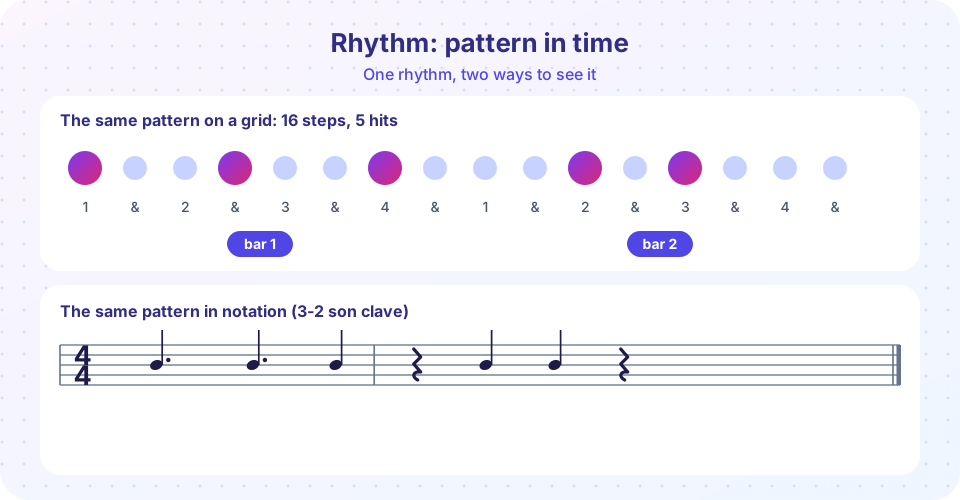
- Syncopation and polyrhythm: off-beat accents, the clave, and three against two.
- Odd and additive meters: how to count 5/4, 7/8 and 9/8 so they feel natural.
- Hemiola and metric modulation: regrouping beats and changing tempo with a common value.
- Chapter 7 review: one picture, one table, ten questions.
Hear it first
Choose a meter and listen to how the accents change the feeling. Pay attention to where the loud click falls. Accents divide the same steady pulse into different groups.
Next, a drum-machine grid. Click steps to switch them on, press Play and hear your own pattern against the steady hi-hat. Try the presets.
How to study this chapter
Rhythm is learned in the body first. Clap or tap every pattern before you read it, count aloud with the group syllables, and only then check the notation. The playable demos are made for that: set the tempo low, loop a pattern and speak the counts over it. When a pattern feels tricky, slow it down until each hit falls cleanly in a grid of equal steps, then bring the tempo up. Pay particular attention to the ear-versus-eye difference: many of the rhythms in this chapter look complicated on the page but feel obvious in a groove, and the reverse is also true.
If counting notation is unfamiliar, the earlier chapters on note values, rests and time signatures introduce the vocabulary; from the track page you can reach any of them.
Check your understanding
Quick check · 3 questions
of 3 answered You scored / 3 · perfect!
-
1. Which layer of rhythm is the steady, evenly spaced stream of beats?
Pulse is the underlying beat; meter groups it and rhythm is the pattern played over it. -
2. How is 7/8 often felt?
Odd meters are usually felt as short groups of twos and threes. -
3. What is syncopation?
Accents on weak beats or off-beats contradict the meter and create energy.
Summary
- Pulse, meter and rhythm are three layers; complex rhythm comes from tension between them.
- Syncopation, polyrhythm, odd meters, hemiola and metric modulation are different ways of creating that tension.
- Counting groups, not just beats, is the key skill for odd meters.
- Feel the rhythm in your body before reading it.
Track your progress
Create a free account to tick off lessons and pick up where you left off on any device.
of Music Theory lessons completed