


















Lesson 42 of 50 · Analysis and Composition
Borrowed chords and chromatic color
Learn modal mixture, how chords borrowed from the parallel minor darken a major key, plus Neapolitan, augmented sixth and chromatic mediant chords, with audio examples.
So far every chord in this chapter has either belonged to the key or been a dominant pointing at a chord that does. But composers also reach for chords that sound like they come from somewhere else: a cloud passing over a sunny key, a dark chord in a bright progression, a harmony that seems to glow from the side. This lesson covers the most useful of these color chords. They all have a logic, and once you know it you can spot them in a score by their accidentals and use them in your own writing.
What you will learn
- What modal mixture is and which chords are usually borrowed
- How to spell and label borrowed chords in major and minor
- What a Neapolitan sixth chord is and how it resolves
- What augmented sixth chords are and why they resolve outward
- How chromatic mediants and the tritone substitution add color
Key terms
Modal mixture: using chords from the parallel key (same tonic, opposite mode) within a key. Also called borrowing.
Parallel key: the major and minor keys with the same tonic: C major and C minor.
Neapolitan sixth (N6): a major chord built on the lowered second degree, usually in first inversion.
Augmented sixth chord: a chord containing a lowered sixth degree and a raised fourth degree, which form an augmented sixth that expands outward to an octave.
Chromatic mediant: a chord whose root is a third away from the previous root and that shares one note, not belonging to the diatonic scale.
Modal mixture: borrowing from the parallel key
C major and C minor share a tonic but differ in three scale degrees: the third, sixth and seventh. In C minor these are E♭, A♭ and B♭. Composers regularly dip into the minor key's palette while staying in major. A chord taken from the parallel minor is a borrowed chord, and the technique is modal mixture.
In C major the most common borrowed chords are:
| Label | Chord | Spelling | Where it comes from | Typical role |
|---|---|---|---|---|
| iv | Fm | F A♭ C | C minor | predominant, darkens IV |
| ♭VI | A♭ | A♭ C E♭ | C minor | predominant or approach to ♭VII |
| ♭VII | B♭ | B♭ D F | C minor (natural) | dominant-like; leads to I |
| ♭III | E♭ | E♭ G B♭ | C minor | tonic-like; color |
| ii° | D° | D F A♭ | C minor | predominant; rare |
| i | Cm | C E♭ G | C minor | ending a piece in a minor tonic |
Notice the pattern in the labels. A flat before the numeral means the root is a half step lower than the major-scale degree. A lowercase numeral means a minor chord. So ♭VI means "a major chord whose root is the lowered sixth degree" and iv means "a minor chord on the fourth degree".
The effect
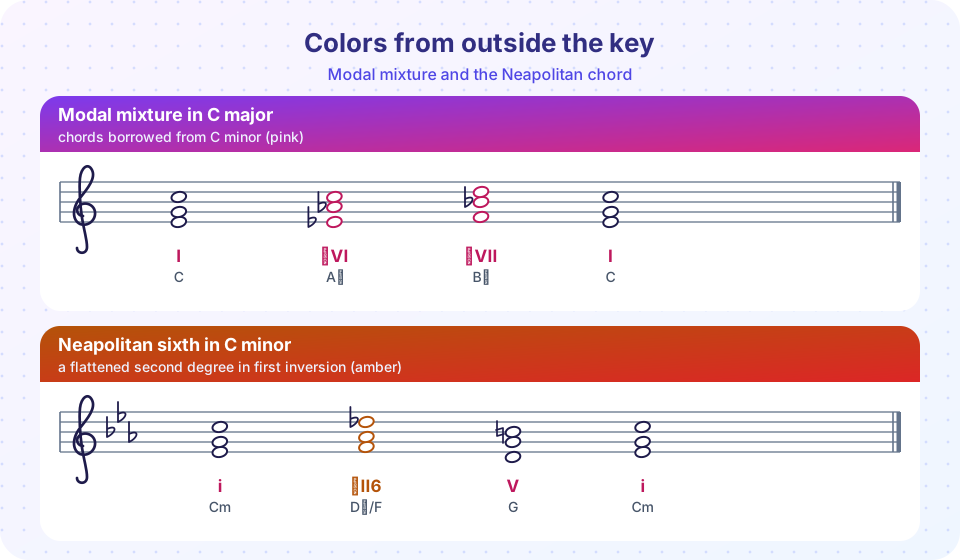
The ear hears these chords as a shadow. Minor iv in particular is one of the most affecting moves in music: the subdominant turns sad for a moment, then resolves to a bright I. The progression I, ♭VI, ♭VII, I is common in rock and film scores for a heroic, triumphant feel: each chord is a major triad, yet none of them is in the major key. A sudden ♭III gives a mysterious or fantastic color.
The same idea works in reverse. In a minor key, the major chord on the fourth degree (IV, taken from the parallel major) is a "Dorian" brightening, and a Picardy third at the end of a minor piece turns the final tonic chord into a major chord.
The Neapolitan sixth
In a minor key, the second degree of the scale is a whole step above the tonic. The Neapolitan chord is a major triad built on a lowered second degree. In C minor that is D♭ major: D♭ F A♭. It is almost always used in first inversion, with F in the bass, which is why it is written N6 or ♭II6. The name comes from the Neapolitan school of eighteenth-century opera composers, with whom the chord became associated.
Its function is predominant: it replaces iv or ii° before the dominant. The characteristic progression is i, N6, V, i. The sound is a weighty bend: a major chord that feels tragic because it arrives in a minor key and sits a half step above the tonic. Melodically, the lowered second degree tends to fall to the leading tone, which adds to the feeling of pressing toward V.
The bottom row of the picture shows the progression in C minor (three flats): the tonic chord, the Neapolitan sixth with its D♭, the dominant with a natural sign on B and the tonic again.
Augmented sixth chords
The augmented sixth chord is the most intense chromatic predominant. Its defining feature is the interval of an augmented sixth between the lowered sixth degree and the raised fourth degree. In C minor those notes are A♭ and F♯. When they are resolved, A♭ falls by a half step to G and F♯ rises by a half step to G, so the two voices expand outward to an octave on the dominant note. That motion is what makes the chord sound so inevitable.
There are three common types, named by the nationalities that tradition attached to them.
| Type | Notes in C minor | Description |
|---|---|---|
| Italian (It+6) | A♭ C F♯ | three notes, the simplest |
| French (Fr+6) | A♭ C D F♯ | adds scale degree 2 |
| German (Ger+6) | A♭ C E♭ F♯ | adds the minor third; sounds like A♭7 |
The German version sounds identical to a dominant seventh chord on A♭ (spelled with G♭ instead of F♯), which is why it can pivot into surprising keys. All three move to V, often with a cadential six-four, and all three share the same outward-resolving pair of voices.
Other chromatic colors
Chromatic mediants. A chord whose root is a third away from the previous one, but which does not belong to the scale, produces a sudden, glowing shift. In C major, moving from C to E major or to A♭ major is a chromatic mediant relationship. The two chords share only one note (C and E share E; C and A♭ share C), so the transition is dramatic but not jarring. Film composers use these chords to evoke wonder or mystery.
Tritone substitution. A jazz technique: replace a dominant seventh chord with the dominant seventh whose root is a tritone away. G7 becomes D♭7. The two chords share the same tritone, B and F in G7, spelled C♭ and F in D♭7, so the essential tension survives and the bass moves chromatically: D, D♭, C. It gives a smooth, sophisticated line.
Chromatic passing chords. A diminished chord between two diatonic chords whose roots are a whole step apart fills the gap with a smooth chromatic bass line.
How to spot color chords
Scan for accidentals. A flat that is not in the key signature, appearing in several voices at once, is usually a borrowed chord. A single raised note that resolves up by half step is often a secondary dominant. A chord that is major in a minor key and has a flat second degree in the bass is Neapolitan. Then check the function: color chords nearly always take the place of a normal predominant, and they often resolve to V or I.
Common misconceptions
"A flat in a major key means a modulation." It may only be a borrowed chord. The key does not change unless a cadence in a new key follows.
"The Neapolitan chord is built on the second note of the scale." It is built on the lowered second degree, a half step above the tonic, and is usually in first inversion.
"Augmented sixth chords are dissonances without rules." They have a very strict resolution: the augmented sixth expands to an octave.
Try it
First, compare plain and colored progressions in C major. Each pair plays the diatonic version and then the borrowed-chord version.
Now try the minor-key chromatic predominants. Hear i - iv - V - i, then the same phrase with the Neapolitan sixth and then with the Italian augmented sixth, all in C minor.
Check your understanding
Quick check · 5 questions
of 5 answered You scored / 5 · perfect!
-
1. In C major, which chord is a borrowed chord?
Fm (iv) is not in C major; it comes from C minor. -
2. What is the Neapolitan chord in C minor?
The Neapolitan is a major chord on the lowered second degree: D-flat major. -
3. How does the augmented sixth interval resolve?
The lowered sixth falls and the raised fourth rises, both landing on the dominant note. -
4. What is a Picardy third?
Raising the third of the final chord gives a bright ending to a minor-key piece. -
5. What does tritone substitution replace G7 with?
D-flat 7 shares the same tritone as G7 and moves the bass down by half step.
Summary
- Modal mixture borrows chords from the parallel key: iv, ♭VI, ♭VII and ♭III in major add shadow and drama.
- The Neapolitan sixth is a major chord on the lowered second degree in first inversion, used as a predominant.
- Augmented sixth chords (Italian, French, German) resolve outward to V.
- Chromatic mediants and tritone substitution add glow and sophistication.
- Spot color chords by accidentals and check the function they serve.
Track your progress
Create a free account to tick off lessons and pick up where you left off on any device.
of Music Theory lessons completed