


















Lesson 39 of 50 · Analysis and Composition
Chapter 8 overview: analysis and composition
A map of the analysis and composition chapter: reading Roman numerals, secondary dominants, modulation, borrowed chords, and writing your own melody and harmony.
You now own the main tools of tonal music: scales, chords, functions, cadences, phrases, forms and the vocabulary of rhythm. This chapter shows you how to use them in two directions. Analysis takes a piece apart and asks why it works: which key it is in, what each chord does, where it turns and why that feels the way it does. Composition puts one together, using the same tools in reverse. The two skills train each other. Every analysis teaches you a trick you can steal, and every composition exercise makes the next analysis easier because you know what the composer was choosing between.
What you will learn
- A repeatable method for analyzing a piece: key, chords, function, cadences, form
- What non-chord tones are and how to avoid mislabeling them as chords
- How secondary dominants and modulations bend a key
- How borrowed chords and special chromatic chords add color
- How to compose a melody and harmony in a chosen style, starting from a plan
Key terms
Analysis: studying how a piece is built by identifying its key, chords, cadences, phrases and form.
Secondary dominant: the dominant chord of a chord other than the tonic, such as D7 leading to G in C major.
Modulation: a lasting change of key within a piece.
Borrowed chord: a chord taken from the parallel major or minor key, such as A-flat major in C major.
Non-chord tone: a melody note that is not part of the current chord, such as a passing note.
Two directions, one skill
A good analyst reads a piece like a detective reads a scene: with a plan. A good composer works like an architect: with a plan too, but making the decisions instead of discovering them. Both start with the same questions. What key are we in? What does the music do at the end of each phrase? Where is the tension, and where is the release?
Think of tonal music as having layers, like the stack in the review picture at the end of the chapter: at the bottom the key, above it the chords, then their functions, then the cadences that punctuate the phrases, and at the top the form of the whole piece. Analysis climbs this stack from the bottom, noticing one layer at a time. Composition descends: you start by choosing a form and a key, then the cadences, then the chords, and finally the notes. Doing both makes each easier.
Analyze in layers
Bend the key
Add color
Compose
What each lesson covers
- The method of analysis: a step-by-step routine, non-chord tones and a worked example.
- Secondary dominants and modulation: how to tonicize a chord and how to change key smoothly.
- Borrowed chords and chromatic color: modal mixture, Neapolitan and augmented sixth chords.
- Writing a melody and harmony: a repeatable composing process.
- Chapter 8 review: one picture, one table and ten questions.
Hear it first
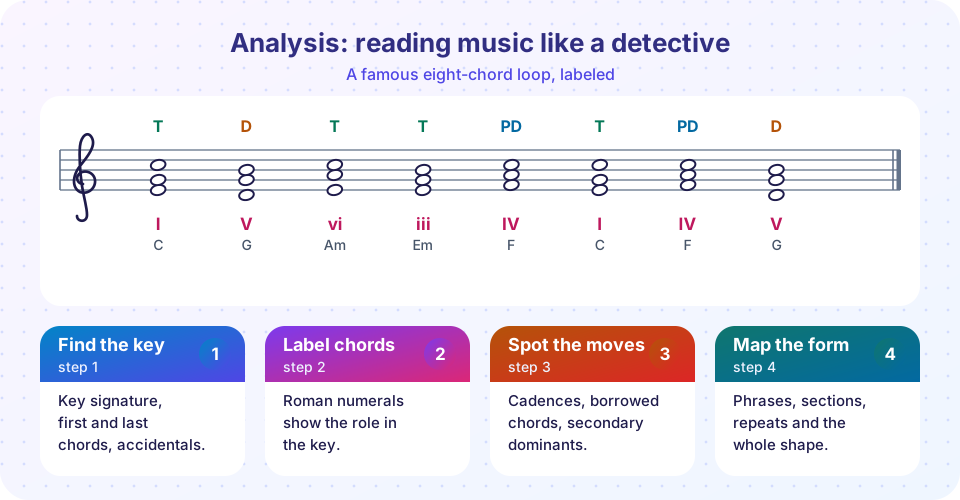
The eight-chord loop in the picture is the skeleton of Pachelbel's famous Canon in D and of many pop songs. Play it, watch the function labels light up and notice how the loop returns to where it began.
Now a quick key-finding game. A chord chart is shown in letters; decide which key it belongs to.
Check your understanding
Quick check · 3 questions
of 3 answered You scored / 3 · perfect!
-
1. What does a composer decide first when working top-down?
Composing top-down starts with the big plan and works toward the notes. -
2. What is a secondary dominant?
A secondary dominant tonicizes a chord by playing its own dominant, such as D7 before G in C major. -
3. Which is a borrowed chord in C major?
A-flat major (bVI) comes from C minor, the parallel key.
Summary
- Analysis climbs from key to chords to function to cadences to form; composition descends the same stack.
- Secondary dominants and modulations bend the key; borrowed chords add color.
- Every analysis teaches a technique you can use in your own writing.
Next: The method of analysis
Track your progress
Create a free account to tick off lessons and pick up where you left off on any device.
of Music Theory lessons completed