


















Lesson 2 of 47 · Getting Started
Why law matters: what rules are for
Why societies have law: keeping order, settling disputes, enabling cooperation and limiting power, with the social contract idea and a runnable trust simulation.
Imagine a town with no law at all. No police, no courts, no contracts, no property records. You grow tomatoes; a stronger neighbor takes them. You lend money; the borrower disappears. You want to build a bakery, but nobody can promise you the shop will still be yours next year. In such a place people have to spend their energy guarding what they have, and they will hesitate to cooperate with anyone they do not already trust.
Law exists to change that. It is one of the most important social inventions, and this lesson looks at what it does for us, why we put up with its limits, and why a legal rule is not the same thing as a good rule.
What you will learn
- The four main functions of law and an everyday example of each.
- The social contract idea in the work of Thomas Hobbes, John Locke and Jean-Jacques Rousseau.
- Why coordination rules (like which side of the road to drive on) are law even though they are not about right and wrong.
- Why a rule can be legal and still unjust.
Key terms
Law: rules recognized by a society as binding and backed by organized enforcement.
Sanction: a consequence imposed for breaking a rule, such as a fine, damages or imprisonment.
Social contract: the philosophical idea that legitimate government rests on an agreement, real or hypothetical, among the people it governs.
Legitimacy: the quality of being accepted as rightful authority, not just obeyed out of fear.
Coordination problem: a situation where everyone benefits if all follow the same rule, whichever rule it is.
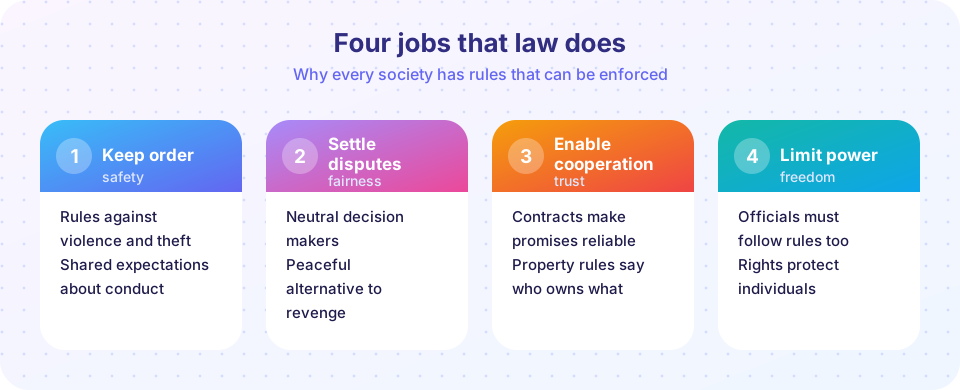
Function 1: keeping order and safety
The oldest job of law is to prevent violence and theft. Every legal system forbids killing, assault and stealing, and gives some public body the power to investigate and punish. Political philosophers have long asked why people accept this. The English thinker Thomas Hobbes, writing in his book Leviathan (1651) in the shadow of the English Civil War, argued that without a common authority people would live in constant fear and conflict. His solution was a powerful sovereign to whom people hand over some freedom in return for security.
John Locke, writing a generation later, started from a more hopeful picture and argued that government exists to protect people's lives, liberty and property, and loses its claim to obedience if it systematically fails to do so. Jean-Jacques Rousseau, in the eighteenth century, argued that legitimate law expresses the "general will" of a free people. These three disagree about a great deal, but all treat law as something that people have reasons to want. The label "social contract" covers all of them. Remember that it is a way of thinking about legitimacy, not a historical record of anyone actually signing a document.
Function 2: settling disputes
People disagree constantly: who owns this fence, who owes whom money, who caused the accident. Without a neutral procedure, disagreements turn into feuds. Law offers a peaceful alternative: bring the dispute to a court, an arbitrator or an agency that applies known rules. Notice what makes this work.
- The decision maker is not one of the parties.
- Both sides can present their case.
- The result is tied to rules, not to whoever is stronger.
- The state will help carry out the decision, for example by seizing property to pay a debt.
Most disputes never reach a judge. Because the rules are known, people can predict how a court would rule and settle in "the shadow of the law", a phrase used by legal scholars to describe how legal rules shape private bargaining even without a trial.
Function 3: enabling cooperation
This is the function that surprises many beginners. Law does not only forbid; it also makes things possible.
- Contracts let strangers rely on promises. A supplier ships goods before payment because the law will help collect the debt.
- Property rules tell you who may use and sell a thing, so you can invest in it.
- Company law lets many people pool money in a business while limiting how much each can lose.
- Standards and licensing let you trust that a doctor is qualified or a bridge is safe.
Some rules exist purely to solve coordination problems. Driving on the left in the United Kingdom and Japan, and on the right in the United States and France, is not a moral difference. What matters is that everyone follows the same rule. Traffic law, time zones, standard weights and measures and the format of land registers all work this way.
Function 4: limiting power
Law also constrains those who make and enforce it. Constitutions say what a government may and may not do. Courts can order officials to follow the rules, and individuals hold rights that governments must respect. This idea is often called the rule of law: that government officials as well as citizens are bound by law that is public, general and applied fairly. Chapter 2 and chapter 4 return to it in detail.
Law is not the same as justice
A rule can be perfectly legal and still deeply unjust. Many societies have had laws that permitted slavery, denied women the vote or discriminated against minorities. Because such laws were valid in the system that enacted them, studying law requires you to hold two questions apart:
- What is the law? (a question about what rules exist and how they apply)
- What should the law be? (a question about justice, ethics and policy)
Lawyers answer the first question every day; citizens, legislators and philosophers argue the second. Chapter 2 explores how thinkers have connected them.
Common misconceptions
"Law is just a list of prohibitions." Much of law is permission and structure: how to form a company, make a will, marry or sell a house.
"If it is legal, it is right." Legality and morality overlap but are not identical. Some legal acts are widely thought wrong, and some illegal acts, such as civil disobedience, are defended on moral grounds.
"Law only matters when you go to court." Law shapes everyday choices long before any court is involved: your lease, your phone plan and your employment contract are all legal documents.
Try it
First, a model of why enforcement helps cooperation. In this trust game, two people trade repeatedly. Each round, each side either delivers honestly or cheats. Cheating pays well once if there is no penalty. With enforcement, cheating costs more than it gains. It is a toy model, not a prediction of real behavior.
Press Run (or Ctrl + Enter) to see the console output here.
No output.
Second, a coordination demo in the browser: drivers who choose sides at random collide often, while a shared rule removes the collisions.
Check your understanding
Quick check · 4 questions
of 4 answered You scored / 4 · perfect!
-
1. Which philosopher argued in Leviathan (1651) that people need a strong common authority to escape constant fear and conflict?
Hobbes argued for a powerful sovereign in return for security. Locke and Rousseau offered different accounts of legitimate government. -
2. Why is the rule about driving on the left or right a good example of law solving a coordination problem?
Either side works, but only if everybody agrees. The legal rule creates the shared expectation. -
3. Which of these is a function of law that goes beyond forbidding things?
Law enables cooperation by making promises and ownership reliable, not only by prohibiting conduct. -
4. What does it mean to say that a law can be legal but unjust?
A rule can be validly enacted yet violate widely held standards of justice, which is why we ask two different questions.
Summary
- Law has four major jobs: keep order, settle disputes, enable cooperation and limit power.
- Social contract theorists such as Hobbes, Locke and Rousseau offered competing explanations of why people should accept legal authority.
- Many rules solve coordination problems rather than moral ones.
- The rule of law means officials are bound by law too.
- What the law is and what it should be are different questions.
Next: The branches of law
Track your progress
Create a free account to tick off lessons and pick up where you left off on any device.
of Introduction to Law lessons completed