


















Lesson 7 of 47 · What Law Is and Where It Comes From
Law and morality: natural law, positivism and beyond
How thinkers from Aquinas to Hart and Dworkin answer whether an unjust rule can be law, with the Hart-Fuller debate, the Radbruch formula and legal realism explained.
Suppose a legislature passes a statute that is properly adopted, published and enforced, but requires officials to do something horrifying. Is it law? Many people feel torn. On one hand, ignoring a validly made rule seems to dissolve the idea of law altogether. On the other hand, saying "it is law, and it is evil" feels strangely thin. The way thinkers answer this puzzle defines the main schools of legal philosophy, and it has real effects on how courts and citizens behave.
What you will learn
- The central claims of natural law, legal positivism and interpretive theories.
- The key thinkers and works associated with each.
- What the Nuremberg trials and the Hart-Fuller debate show about the issue.
- What legal realists add: law as it works in practice.
Key terms
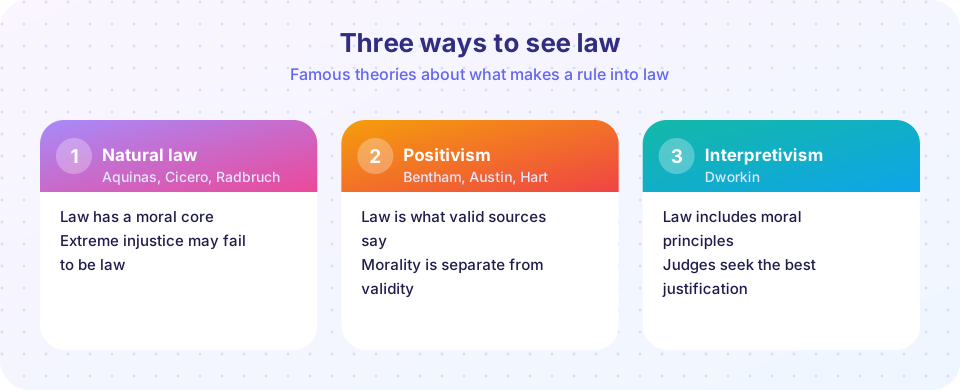
Natural law: the view that law has a necessary connection to morality, so that some moral standards limit what can count as law.
Legal positivism: the view that what law is depends on social facts (who made it, how), not on whether it is morally good.
Rule of recognition: in H. L. A. Hart's theory, the social rule that tells officials what counts as valid law in their system.
Legal realism: a movement emphasizing how law actually operates through the decisions of judges and officials.
Principle: a general standard, such as fairness, that guides decisions without fixing one exact outcome.
Natural law
Natural law thinking is very old. Greek and Roman writers such as Aristotle and Cicero spoke of a law of nature, binding on all people and accessible to reason, as distinct from the laws of particular cities. In the thirteenth century, the theologian Thomas Aquinas gave a systematic account: human law gets its authority from fitting with reason and the common good, and a human rule that grossly violates them has the character of violence rather than law. A phrase often quoted in this tradition is that an unjust law is no law at all, though scholars debate exactly how Aquinas meant it, and he did not say that every unjust law loses its force in all circumstances.
Natural law influenced modern rights thinking. John Locke wrote that people have natural rights to life, liberty and property that governments must respect. The American Declaration of Independence (1776) and the French Declaration of the Rights of Man and of the Citizen (1789) both speak the language of natural rights. After World War II, the Universal Declaration of Human Rights (1948) expressed similar ideas as a list of rights people hold simply as human beings.
Modern natural lawyers such as John Finnis argue that law's central purpose is to serve the common good, and that this gives it a moral dimension. They do not claim that every unjust law is invalid; most hold that law can be defective, and that the more unjust it is, the weaker its claim on our obedience.
Legal positivism
Positivists say that what counts as law is a matter of social fact, not moral merit. Early versions came from the English philosopher Jeremy Bentham and his follower John Austin. In The Province of Jurisprudence Determined (1832) Austin described law as commands of a sovereign backed by threats. That picture was criticized as too crude: it fits criminal statutes better than rules that grant powers, such as the rules for making a will or a contract, and it cannot explain how law continues when the sovereign changes.
The Austrian jurist Hans Kelsen proposed a "pure theory" in the early twentieth century in which every legal norm derives its validity from a higher norm, up to a basic norm presupposed by the system. The most influential modern version is H. L. A. Hart's The Concept of Law (1961). Hart distinguished:
- Primary rules, which impose duties (do not steal, drive on the left).
- Secondary rules, which give powers and organize the system: rules of change (how laws are made and repealed), of adjudication (who decides disputes) and, most important, the rule of recognition, a shared practice among officials that identifies which rules count as law.
In the United Kingdom, for example, the rule of recognition includes that what the Queen or King in Parliament enacts is law. Positivists stress that this separates two questions: is it law? and is it morally good? The separation, they argue, lets us criticize bad laws clearly, because we can say "this is law, and it ought not to be".
A test case: Nuremberg and the Hart-Fuller debate
After World War II, Nazi officials were tried at Nuremberg (1945 to 1946) for crimes that were, in many cases, legal under the German law of the time. The tribunal rejected the defense that they were just following the law of their own state, relying on international law and on the idea that some acts are crimes regardless of local rules.
The German legal philosopher Gustav Radbruch, who had earlier been seen as a positivist, wrote in 1946 that when statutory law reaches an intolerable level of injustice, it must give way to justice. That idea is called the Radbruch formula. In 1958, in the Harvard Law Review, Hart and the American scholar Lon Fuller debated a post-war German case in which a woman who had denounced her husband under Nazi-era laws was later punished. Hart argued that it is clearer and more honest to say the law was valid but so evil it should not be obeyed (or applied retroactively through an openly new law). Fuller argued that a system that fails the basic requirements of legality, such as clear, public, stable and non-retroactive rules, was not fully legal. He later set out eight such requirements in The Morality of Law (1964). You will see them again in the lesson on the rule of law.
Neither side denies that Nazi atrocities were wrong. The disagreement is about how best to describe and respond to them.
Interpretive and principle-based theories
Ronald Dworkin criticized positivism by pointing to cases in which judges seem to rely on principles rather than only on rules. A famous example he used is Riggs v Palmer (New York, 1889): a grandson who murdered his grandfather to inherit under his will. The statute of wills said nothing about murderers, but the court refused to let him inherit, relying on the principle that no one should profit from their own wrong. Dworkin argued that law includes such principles, and that in hard cases judges should find the reading that best fits and justifies the existing legal materials, a view he called "law as integrity". Positivists reply that a rule of recognition can include principles, and that Dworkin's theory leaves the line between law and morality hard to see.
Legal realism and law in action
Realists were more interested in how law works than in what it is. The American judge Oliver Wendell Holmes Jr. wrote in 1897 that if you want to know the law, look at it as a "bad man" who cares only about the material consequences predicted by courts. Later realists in the United States and Scandinavia argued that judges are influenced by facts, policy and social circumstances as well as formal rules. The movement's lasting lesson is practical: to understand a legal system you need to look at what judges, police and officials really do, not only at the books.
Common misconceptions
"Positivists think law is good, or that you must obey it." Positivism is a claim about what law is, not about whether we should obey it. Many positivists think unjust laws should be resisted.
"Natural lawyers think every unjust rule is void." Most modern natural lawyers hold that injustice weakens a law's claim, with extreme injustice being the clearest case.
"Judges just apply rules mechanically." Rules run out, and judges often must choose among reasonable readings. How they do it is one of the central questions of legal theory.
Try it
The first demonstration is a toy classifier that applies each theory's test to a described rule. It cannot decide real controversies; it only shows how the tests differ.
Press Run (or Ctrl + Enter) to see the console output here.
No output.
The second demonstration lets you move an injustice slider and see where each simplified view draws the line.
Check your understanding
Quick check · 5 questions
of 5 answered You scored / 5 · perfect!
-
1. Who wrote The Concept of Law (1961)?
H. L. A. Hart wrote The Concept of Law and introduced primary and secondary rules and the rule of recognition. -
2. What does the rule of recognition do?
It is a shared practice among officials that identifies valid law. -
3. What is the Radbruch formula about?
After 1945 Radbruch argued that statutes of intolerable injustice should yield to justice. -
4. In Riggs v Palmer (1889), what did Dworkin say the court relied on?
The statute was silent, but the court applied a general principle, which Dworkin used to argue that law includes principles. -
5. What is a lasting lesson of legal realism?
Realists stressed law in action: real behavior and consequences, not only the written rules.
Summary
- Natural law says law has a necessary connection to morality; positivism says law's existence depends on social facts, not moral merit.
- Hart's theory uses primary and secondary rules, with a rule of recognition at the center.
- Nuremberg and the Hart-Fuller debate tested these theories on Nazi-era law.
- Dworkin argued that principles are part of law; realists focus on how law works in practice.
- The debate is not settled, and each view captures something real.
Next: Sources of law
Track your progress
Create a free account to tick off lessons and pick up where you left off on any device.
of Introduction to Law lessons completed