


















Lesson 11 of 47 · Legal Systems and Courts
Chapter 3 overview: legal systems and courts
A preview of chapter 3: how common law, civil law and mixed systems differ, how courts are organized, how precedent works and how civil and criminal cases proceed.
Chapter 2 asked what law is and where it comes from. Chapter 3 looks at the machinery that turns law into decisions: the legal traditions that shape how lawyers think, the courts that apply the law and the procedures that cases follow. If you understand this machinery, you can follow how a dispute travels from a first complaint to a final judgment, in almost any country.
What you will learn
- What the four lessons of this chapter cover and how they connect.
- Why the same facts can be handled quite differently in different systems.
- Which terms you will meet: jurisdiction, appeal, precedent, trial, burden of proof.
The big picture
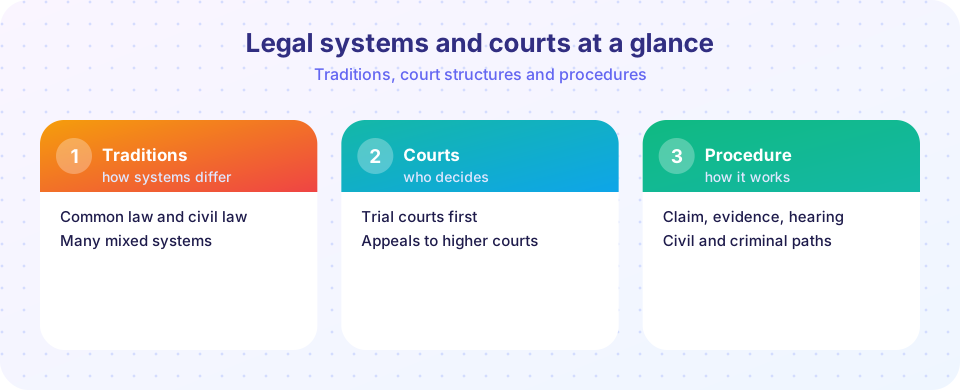
When you ask "how does the law work in this country?", the answer has three layers.
- Tradition. The deep habits of a legal culture: whether the main source is a code or a line of cases, who runs a trial, how judges are trained. The two largest Western traditions are the common law and the civil law.
- Structure. The courts and who sits above whom. Most systems have first-instance courts that hear evidence, appeal courts that review decisions and a top court that settles disputed questions of law. Some countries add a separate constitutional court or specialist courts for labor, family or administrative matters.
- Process. The steps from filing to final decision: how a claim is started, how evidence is gathered, how a hearing proceeds and how appeals work. Rules about the burden and standard of proof sit here, as do rights such as the right to a fair hearing.
Tradition
Structure
Process
The four lessons
- Common law and civil law: history, differences and mixed systems.
- Courts and appeals: the hierarchy of courts, jurisdiction, specialist courts, judges and juries.
- Precedent and stare decisis: how earlier decisions guide later ones, and how courts distinguish and overrule them.
- Civil and criminal procedure: the steps of a case, the burden and standard of proof, and fair trial principles.
- Chapter 3 review: recap and a longer quiz.
How to use this chapter
Read the four lessons in order. The first gives you the cultural background that explains why courts in London and Paris behave differently. The second gives you the structure to place any case in a hierarchy. The third explains how courts treat earlier decisions, which is essential for the reasoning skills of Chapter 8. The fourth shows the path of a case. After each lesson, try to explain the main idea to a friend in two sentences: if you can, you have understood it.
A word of caution
Because each country has its own institutions, any short description is a generalization. When we describe a court structure we say which country we draw it from (usually England and Wales, the United States, France or Germany as examples). Real systems have exceptions, special courts and reforms, and they change from year to year. Use the descriptions as models for understanding, not as a guide to what to do in a real case.
Try it
First, a glossary of the chapter's terms that you can extend. Run it, then add your own entries.
Press Run (or Ctrl + Enter) to see the console output here.
No output.
Second, a drag-free map: pick a country and see which tradition is usually used to describe it. The classifications are simplified; real systems are often mixed.
Check your understanding
Quick check · 3 questions
of 3 answered You scored / 3 · perfect!
-
1. What are the three layers described in this overview?
Tradition (legal culture), structure (courts) and process (procedure) together describe how a legal system works. -
2. What does a court of first instance mainly do?
First instance courts hear the case first, including evidence, though appeal courts mostly review legal questions. -
3. Why does this course name the country when describing a court structure?
Courts and procedures differ across systems, so naming the system keeps descriptions accurate.
Summary
- A legal system has a tradition, a court structure and procedures.
- The common law and civil law are the two largest traditions; many systems mix them.
- Courts are usually organized in tiers, with appeals to higher courts.
- Descriptions of any system are generalizations that should name the country.
Next: Common law and civil law
Track your progress
Create a free account to tick off lessons and pick up where you left off on any device.
of Introduction to Law lessons completed