


















Lesson 41 of 47 · Legal Reasoning and Practice
IRAC and clear legal writing
Learn the IRAC method for legal problem questions: issue, rule, application and conclusion, with a worked example, plain-language tips and common mistakes.
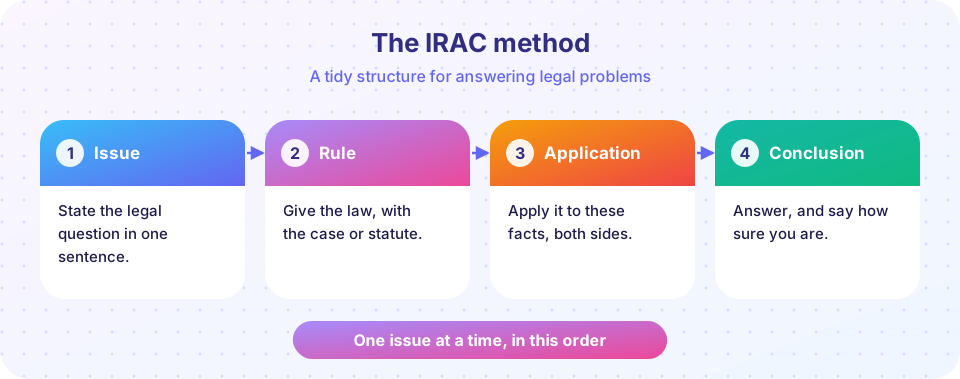
A good legal answer is not a pile of facts and case names. It is an argument, organized so a reader can follow it from the question to the conclusion. The most widely taught structure is IRAC: Issue, Rule, Application, Conclusion. It looks simple, but using it well is what separates a strong answer from a weak one. In this lesson you will learn each step, see a full worked example and practice spotting issues.
Educational use only. IRAC is a study and writing technique. Real legal advice depends on full facts and current law in a specific place, and should come from a qualified lawyer. The example uses English law.
What you will learn
- What each letter of IRAC asks you to do
- How to spot multiple issues in one story
- How to apply a rule to facts with arguments on both sides
- How to write in clear, plain language and cite properly
Key terms
Issue: the specific legal question raised by the facts. Rule: the legal principle from a statute or case. Application: the reasoning that links facts to the rule. Conclusion: the answer to the issue, with a level of confidence. Problem question: a fact scenario for which you must advise a party.
I is for Issue
The issue is a question that the law can answer. It is not the whole story, and it is not just a topic like "contract." A good issue combines a legal test with the key facts: "Did the supplier's reply create a counter-offer that ended Maya's offer?" Notice that it names the legal idea (counter-offer) and anchors it to the facts. A scenario usually contains several issues, and you should list them in a logical order, often chronological. Read the facts slowly and highlight every event that might have legal consequences. Ask also: who is asking for advice, and what do they want?
R is for Rule
State the relevant law accurately and briefly: the statute section or the case and its principle. For example, "An acceptance must match the offer, and a counter-offer ends the original offer: Hyde v Wrench (1840)." Use the rule as it would be understood by a reader who knows nothing about the area, but keep it short. Do not recite the entire case history. If the rule has elements, list them: duty, breach, causation, damage. If different rules apply in different jurisdictions, say which you are using.
A is for Application
This is the heart of the answer and where most marks (and most legal work) are earned. Apply the rule to the facts element by element. Use the facts of the problem, not general statements, and show your reasoning: "Because the supplier changed the delivery date, its reply did not mirror the offer, so it is more likely to be a counter-offer." Consider both sides: what the other party would argue, and how a court would weigh the arguments. Compare to similar cases: "In Hyde v Wrench, the lower price counter-offer ended the first offer; here the changed date works similarly, though a court might ask whether the date was a minor detail." Avoid simply restating facts.
C is for Conclusion
Answer the issue in a sentence: "Maya is therefore unlikely to have a contract for delivery on 10 March." Show your level of certainty: "likely," "probably," "uncertain." Lawyers rarely say a case is certain. If the answer depends on a fact not given, say what it depends on. Then move to the next issue.
A worked example
Facts. Maya, a baker, emails: "I will buy 500 kg of flour at 1.20 pounds a kilo, delivery on 10 March." The supplier replies: "Agreed, but delivery on 12 March." Maya does not respond. The flour does not arrive on 10 March, and Maya buys elsewhere at 1.50 pounds a kilo. She wants to know whether she can recover the extra cost.
Issue 1: Was there a contract for delivery on 10 March?
Rule. A contract needs offer and acceptance. Acceptance must be unqualified, and a reply that changes the terms is a counter-offer that ends the original offer (Hyde v Wrench). Silence is not acceptance.
Application. Maya's email is likely an offer, as it states clear terms. The supplier's reply accepted the price but changed the delivery date. If delivery date matters, which it plausibly does for a bakery, the reply does not mirror the offer and is likely a counter-offer. Maya's silence cannot be acceptance, as silence is not acceptance. The supplier might argue that "Agreed" shows an intention to be bound and that the date was a minor detail, but the date is part of the bargain here.
Conclusion. Probably there is no contract at all for either date, unless Maya's later conduct shows she agreed to 12 March. She is therefore unlikely to recover the extra cost.
Issue 2 (in case a contract for 10 March did exist): Is the extra cost recoverable damages?
Rule. Damages put the innocent party where performance would have left them, subject to remoteness and the duty to mitigate (Hadley v Baxendale).
Application. The extra cost is 0.30 pounds a kilo times 500 kg, which is 150 pounds. Replacing the flour was a reasonable step to mitigate, and the loss is of a kind that arises naturally from non-delivery.
Conclusion. If there was a contract, Maya could probably recover about 150 pounds.
Writing clearly
- Plain language. Prefer short sentences. Say "the court decided" instead of "it was adjudicated".
- One idea per paragraph. Start with a signpost sentence.
- Cite accurately. Give the case name, year and the principle. Do not invent or guess a citation; if you are unsure, describe the principle without a citation.
- Be balanced. Present the strongest argument for each side, then choose.
- Use headings for each issue in long answers.
- Stay in the facts. Do not add facts that are not in the scenario; say instead what you would need to know.
Common mistakes
Missing issues. Read the scenario twice and list possible issues before you write.
Rule dumping. Writing everything you know about a topic instead of the part that matters.
Weak application. Repeating the facts and then jumping to a conclusion without reasoning.
False certainty. Saying "she will win" when the law is arguable.
Try it
Press Run (or Ctrl + Enter) to see the result here.
Program input · what you'd type while the program runs
Type the answers before you press Run, one per line. Each time the program reads a line (with input()), it gets the next line from this box.
Check your understanding
Quick check · 5 questions
of 5 answered You scored / 5 · perfect!
-
1. What does the A in IRAC stand for?
Application of the rule to the facts. -
2. A good issue statement:
For example: did the reply create a counter-offer? -
3. In Application you should:
Reasoning links facts to the rule. -
4. If unsure of a case citation, you should:
Never invent authorities. -
5. A strong conclusion:
Lawyers show certainty levels.
Summary
- IRAC: Issue, Rule, Application, Conclusion.
- Spot every issue, then take them one at a time.
- Application is the heart: facts against rule, both sides.
- Write plainly, cite accurately, state your level of confidence.
Next: Chapter 8 review
Track your progress
Create a free account to tick off lessons and pick up where you left off on any device.
of Introduction to Law lessons completed