


















Lesson 5 of 47 · Getting Started
Chapter 1 review: getting started
Review chapter 1: the functions of law, public and private branches, criminal and civil cases, and the facts-rule-application-conclusion method, with a ten question quiz.
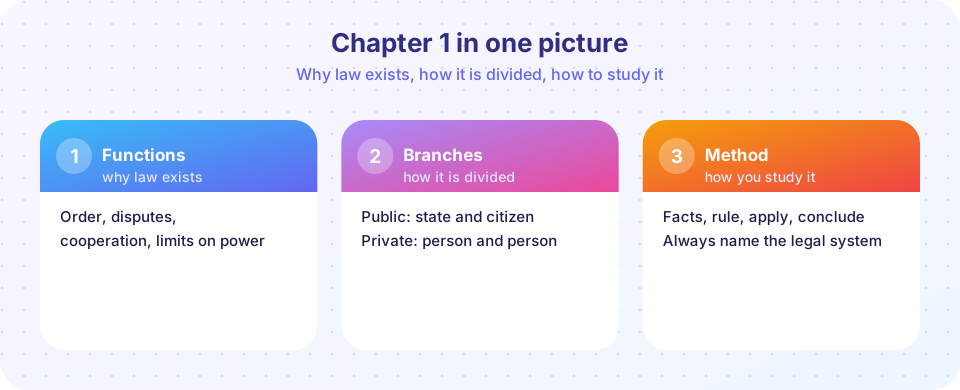
You have now covered the foundations: why societies have law, how lawyers divide it, and how to read and reason with legal texts. This review pulls the chapter together in one picture, one table and a longer quiz that mixes all four lessons.
What you will check
- You can name the four functions of law and give an example of each.
- You can place a situation in the right branch and say who brings the case.
- You can break a rule into elements and apply it to facts.
The chapter in brief
The first lesson told you that law is not one thing everywhere: every jurisdiction has its own rules, so a careful student always names the system. The second lesson asked why societies bother with law at all, and found four answers: order, dispute settlement, cooperation and limits on power. Those answers come from a long line of thinkers, from Hobbes and Locke to modern theorists, who disagree about the details but agree that law serves human purposes.
The third lesson divided the subject. Public law concerns the state; private law concerns people dealing with each other; criminal law punishes wrongs against society; substantive law says what the rights are and procedural law says how to enforce them. One event, such as a traffic accident, can touch several branches at once, which is why issue spotting is the first skill to practice. The fourth lesson gave you the method for the rest of the course: read the primary source, break rules into elements, apply them to the facts and conclude honestly, naming the weak point.
Recap table
| Lesson | Key idea | One example |
|---|---|---|
| Course map | Law differs by jurisdiction, so always name the system | Consideration matters in English contract law but not in French law |
| Why law matters | Law keeps order, settles disputes, enables cooperation and limits power | A contract lets strangers trade; a constitution limits a government |
| Branches of law | Public against private, criminal against civil, substantive against procedural | One road accident can raise criminal, tort, contract and administrative issues |
| How to study law | Read primary sources, break rules into elements, use facts, rule, application, conclusion | The made-up bicycle taking rule with five elements |
Common mistakes to avoid
- Treating "civil law" as a single idea: it can mean the non-criminal branch or the continental European tradition.
- Stating a rule without saying which legal system it comes from.
- Answering "yes" or "no" without showing the elements and the weak point.
- Using this course as legal advice about a real problem.
Try it
Run the flashcard review, then add a few cards of your own. It shuffles each time so you do not memorize the order.
Press Run (or Ctrl + Enter) to see the console output here.
No output.
Check your understanding
Quick check · 10 questions
of 10 answered You scored / 10 · perfect!
-
1. Which is a function of law that is about making things possible rather than forbidden?
Contracts, property rules and company law enable people to cooperate with confidence. -
2. The social contract tradition includes which thinkers?
Hobbes, Locke and Rousseau are the classic social contract theorists, each with a different account. -
3. Which pair of branches is typically public law?
Constitutional and administrative law govern the state and its relations with individuals. -
4. Why is the criminal standard of proof higher than the civil standard?
The stakes are liberty and stigma, so the law demands stronger proof. -
5. A claim is rejected because it was filed after the deadline. Which kind of law decided it?
Time limits are procedural rules that apply even when the claim would otherwise be good. -
6. Which statement about 'civil law' is correct?
The same two words have two meanings, so context is essential. -
7. What does a holding do?
The holding is the court's answer to the legal issue before it. -
8. In the bicycle taking example, what happens if the borrower always meant to return the bike?
The offense requires intending to keep the bike permanently, so a genuine plan to return it defeats that element. -
9. Which source should you read when exact wording matters?
Primary sources are authoritative; they must also be current, since laws are amended and cases overruled. -
10. Which statement best describes this course?
It is educational information only; real problems require a qualified professional in the right jurisdiction.
Summary
- Law keeps order, settles disputes, enables cooperation and limits power.
- Branches: public and private, criminal and civil, substantive and procedural.
- Analyze with elements and the four steps; name your sources and your system.
- Educational information is not legal advice.
Track your progress
Create a free account to tick off lessons and pick up where you left off on any device.
of Introduction to Law lessons completed