


















Lesson 3 of 47 · Getting Started
The branches of law
Learn how law is divided into public and private law, criminal and civil law, and substantive and procedural law, with one event traced through several branches.
Law is large, so lawyers divide it into branches. The divisions are not walls: one event can touch several branches at once. But knowing the main categories helps you ask the right first question about any problem: "Who is against whom, and what is the state's role?" This lesson gives you the map you will use for the rest of the course.
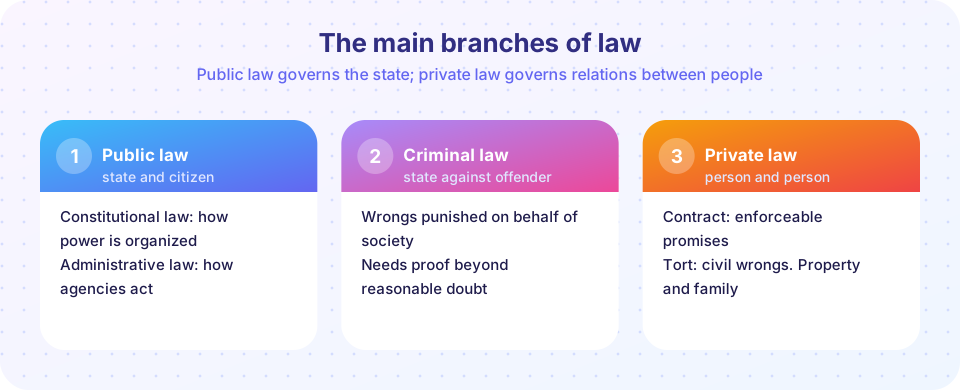
What you will learn
- The difference between public law and private law.
- How criminal law and civil law differ in purpose, parties and proof.
- What substantive and procedural law mean.
- How one real-life event can raise issues in several branches at once.
Key terms
Public law: rules about the organization of the state and its relations with individuals (constitutional, administrative and, in many classifications, criminal law).
Private law: rules about relations between private persons, such as contracts, torts, property and family.
Civil law (the branch): non-criminal disputes, usually between private parties. Not to be confused with the civil law legal tradition.
Substantive law: rules that define rights, duties and wrongs.
Procedural law: rules for how cases are brought, proved and decided.
Public law and private law
The most famous division goes back to Roman law, where jurists distinguished the law concerning the Roman state from the law concerning individuals. Today:
- Constitutional law sets up the institutions of government, shares power among them and protects basic rights.
- Administrative law governs how ministries, agencies and local authorities make decisions, and how people can challenge them.
- Criminal law defines offenses against society and how they are punished. Many civil law countries treat it as part of public law, and common law lawyers often discuss it separately.
- Tax law, immigration law and regulatory law also sit here, because they involve the state exercising authority over individuals.
Private law covers relations among people and organizations:
- Contract law: agreements that the law will enforce.
- Tort law (called delict in many civil law systems): civil wrongs that cause harm, such as negligence or defamation.
- Property law: rights in land and things.
- Family law and succession law: marriage, children, wills and inheritance.
- Company law and employment law blend private agreements with public regulation.
The line is blurry in practice. Employment law, for instance, starts with a private contract but is heavily shaped by public rules such as minimum wage and safety standards.
Criminal law versus civil law
Criminal and civil proceedings may follow from the same event, but they work differently. Here we describe the typical common law pattern; civil law systems have similar ideas with different procedures.
| Feature | Criminal | Civil |
|---|---|---|
| Purpose | Punish and deter wrongdoing | Compensate or resolve a dispute |
| Who starts the case | The state (a prosecutor) | The injured party (claimant or plaintiff) |
| Typical outcomes | Fine, prison, community sentence | Money damages, orders, declarations |
| Standard of proof | Beyond reasonable doubt | Balance of probabilities (more likely than not) in England and many other systems, "preponderance of the evidence" in the United States |
| Parties | State v. defendant | Claimant v. defendant |
The higher standard in criminal cases reflects the seriousness of punishment and the principle that it is worse to convict an innocent person than to let a guilty one go free. Civil standards are lower because the dispute is usually about money or rights between two parties who are on a more equal footing.
Substantive law and procedural law
Another distinction cuts across the others. Substantive law tells you what the rights and wrongs are: theft is a crime, a seller must deliver goods as promised, a landlord must keep a home fit to live in. Procedural law tells you how to enforce them: which court to use, how to serve papers, what evidence is allowed, how long you have to sue.
You can win on substance and lose on procedure. A claim filed after the limitation period (the deadline set by law) may be rejected even if it was good, because legal systems want disputes brought while evidence is fresh. We will meet procedure in Chapter 3.
Other useful divisions
- Domestic and international law. Domestic law applies within a state. Public international law governs relations among states and international organizations (treaties, the law of the sea, the UN Charter). Private international law (also called conflict of laws) decides which country's courts and law apply to a dispute with foreign elements.
- National, regional and local law. In a federal country such as the United States, Germany or India, power is split between national and state or provincial governments.
- Statute law and case law. Whether a rule came from a legislature or from judges. Chapter 2 covers sources.
One event, many branches
Take an everyday accident: a delivery driver, in a hurry, runs a red light and injures a cyclist. Several branches may be involved:
- Criminal law: the prosecutor may charge careless or dangerous driving.
- Tort law: the cyclist may sue the driver, and possibly the employer, for negligence to get compensation for medical costs and lost earnings.
- Contract law: the driver's insurance policy decides whether an insurer must pay, and the cyclist's employment contract decides sick pay.
- Administrative law: the licensing authority may suspend the driver's license, and the driver may challenge that decision.
- Employment law: the employer's duties to a driver under time pressure may be examined.
Which of these happens depends on the country and the facts. This is why legal analysis begins by identifying every possible issue before diving into one. The skill is called issue spotting, and it is the first thing law students practice.
Common misconceptions
"Civil law" always means the civil law tradition. It has two meanings. In "civil law versus criminal law" it means non-criminal disputes; in "civil law versus common law" it means the tradition of codified systems such as France and Germany. Always check which one is meant.
"Suing someone is a criminal matter." Suing is a civil action. Only the state, through prosecutors, brings criminal charges in most systems, although some places allow private prosecutions in limited situations.
"If a person is acquitted in criminal court, they cannot be sued." An acquittal means the criminal standard was not met. A civil claim can still succeed on a lower standard of proof in many systems. (The famous example is the pair of cases involving O. J. Simpson in the United States in the 1990s.)
Try it
The first demonstration sorts situations into branches. Try to predict the answer before running it; then change the situations and see how the classifier behaves. It is a teaching aid with simple rules, not a legal tool.
Press Run (or Ctrl + Enter) to see the console output here.
No output.
The second demonstration is an interactive tracer. Click a branch to see the question it asks about the cyclist accident.
Check your understanding
Quick check · 5 questions
of 5 answered You scored / 5 · perfect!
-
1. In a typical common law criminal case, who starts the proceedings?
Criminal cases are brought on behalf of the state or society, usually by a prosecutor. -
2. What is substantive law?
Substantive law defines what the rights and wrongs are. Procedural law governs how they are enforced. -
3. Which standard of proof is typically higher?
Beyond reasonable doubt is the higher criminal standard. The other two are civil standards. -
4. Why can a person be acquitted in a criminal trial but still lose a civil case over the same event?
The criminal verdict only says guilt was not proved to the higher standard. A civil claim asks a different question under a lower standard. -
5. What is issue spotting?
Issue spotting is the first skill of legal analysis: identify all the legal questions a situation raises.
Summary
- Public law deals with the state and its relations to individuals; private law deals with relations between people.
- Criminal cases are brought by the state to punish; civil cases are brought by individuals to get remedies.
- Standards of proof differ: beyond reasonable doubt for crimes, a lower standard for civil claims.
- Substantive law defines rights and wrongs; procedural law governs enforcement.
- A single event can engage several branches at once.
Next: How to study law
Track your progress
Create a free account to tick off lessons and pick up where you left off on any device.
of Introduction to Law lessons completed