


















Lesson 44 of 47 · Projects and Practice
Practice: five problem questions with model outlines
Practice IRAC on five short problem questions covering contract, negligence, criminal law, employment and statutory interpretation, with model outlines.
Legal skill comes from practice. Below are five short problem questions, one from each of the main areas in this course. Try each one yourself first, using IRAC, and then compare your answer with the model outline. The outlines are not the only correct answers: in law, a well-reasoned different view can be just as good. They describe the law of England and Wales, so say so in your answer.
Educational exercises. These invented scenarios train a method. They are not legal advice and real cases depend on detailed facts and current law.
What you will learn
- How to approach a problem question step by step
- How to apply rules from several areas to short facts
- How to compare your answer with a model outline
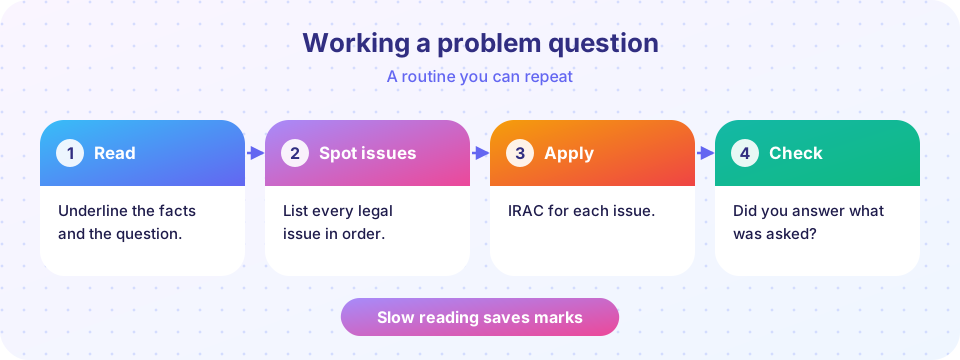
A routine for every problem
- Read twice. First for the story, then underline each fact that might matter and the question asked.
- List the issues in a sensible order.
- IRAC each issue, with arguments on both sides.
- Check. Did you answer what was asked? Did you state your confidence? Did you avoid adding facts?
Problem 1: the mispriced laptop (contract)
A shop's website lists a laptop for 5 pounds instead of 500 pounds because of a typing error. Noor places an order and receives an automatic email saying "We have received your order." The shop later emails: "Your order is cancelled because of a pricing error." Noor says she has a contract and demands the laptop.
Model outline. Issue: was there a contract at the 5-pound price? Rule: an offer must be accepted; goods on display are usually an invitation to treat, not an offer (Pharmaceutical Society v Boots, Fisher v Bell). Application: the website listing is likely an invitation to treat, so Noor's order is the offer. The automatic email only acknowledges receipt; it does not say the shop accepts. The shop's later email rejects the offer before acceptance. A shop can argue the price was an obvious mistake. Conclusion: probably no contract yet, so Noor has no right to the laptop at 5 pounds. Mention that terms and conditions might change this and that a court could treat a clear acceptance, such as dispatch, differently.
Problem 2: the stray ball (negligence)
A village cricket club's ground is surrounded by a fence 5 metres high. In 30 years a ball has cleared the fence only twice. One Saturday a ball clears it and strikes Imani, who is walking on the road, and breaks her arm.
Model outline. Issues: duty, breach, causation, damage. Rule: a duty is owed to those reasonably foreseeable as affected (Donoghue v Stevenson, Caparo); breach depends on the probability and seriousness of harm and the cost of precautions (Bolton v Stone). Application: duty is likely owed to passers-by since it is foreseeable that a ball could leave the ground. Breach is doubtful: the risk was very small, as a ball had cleared the fence only twice in 30 years, and the fence was already high. The club might have raised the fence, but the cost against a tiny risk may not be justified. Causation and damage are clear. Conclusion: the claim probably fails for lack of breach, in line with Bolton v Stone. Note the contrast if balls had cleared the fence often.
Problem 3: the insurance fire (criminal law)
Alex owns a failing shop. To claim insurance money, he starts a fire at night. He knows the flat above is occupied by a tenant. The tenant dies. Alex says he did not want anyone to die.
Model outline. Issue: does Alex have the mens rea for murder, which needs intent to kill or cause grievous bodily harm? Rule: intention can be direct, or oblique if death or serious harm was a virtual certainty and the defendant appreciated this, and the jury may then find intention (R v Woollin). The prosecution must prove it beyond reasonable doubt. Application: Alex did not aim at death, so direct intention is absent. But if he knew someone was in the flat and that the fire would almost certainly kill or seriously injure them, a jury may find oblique intention. Alex will argue he believed the tenant would escape. Conclusion: depends on what Alex appreciated. If the jury is not satisfied of virtual certainty, manslaughter (unlawful and dangerous act) or arson offenses may be more likely. State clearly that the outcome depends on the jury's view of the evidence.
Problem 4: the app rider (employment)
Dev delivers food through an app. The app sets the price he can charge, tracks his location, rates him and can deactivate his account. Dev may log in whenever he likes and use his own bicycle. The contract says "independent contractor." After a year, he asks for paid holiday.
Model outline. Issue: is Dev an employee, a worker or a contractor? Rule: courts look at the reality, not the label, including control, integration, substitution and mutuality (Ready Mixed Concrete); in Uber v Aslam (2021), drivers were held to be workers. Application: the app's control of pricing, rating and deactivation points toward subordination; his freedom to log in at will and to supply his own bicycle point the other way. A right to send a substitute would favor contractor status. Conclusion: a court would probably find at least worker status, which carries paid holiday, though employee status is less likely, since a lack of obligation to accept work weighs against it. The label in the contract is not decisive.
Problem 5: the park rule (statute)
A council by-law reads: "No person shall take a vehicle into the park." Kasim pushes his baby's pram through the gate. A warden says the pram is a vehicle and issues a notice.
Model outline. Issue: does "vehicle" include a pram? Rule: statutes are interpreted by literal, golden, mischief and purposive approaches. Application: literally, a pram has wheels and carries a person, so it could be a vehicle. The golden rule would avoid an absurd result: prohibiting parents from bringing babies into a park. The purpose of the by-law is likely safety and peace, which a pram does not threaten, and the ejusdem generis idea may help if the by-law lists motor vehicles. Conclusion: on a purposive reading, a pram is probably not a vehicle for this by-law, so the notice is likely invalid, although a literal reading would support the warden.
Try it
Press Run (or Ctrl + Enter) to see the console output here.
No output.
Check your understanding
Quick check · 5 questions
of 5 answered You scored / 5 · perfect!
-
1. In Problem 1, why was an automatic acknowledgment probably not an acceptance?
Acceptance must show clear agreement to the terms. -
2. In Problem 2, the key factor against breach was:
Bolton v Stone. -
3. In Problem 3, the Woollin test concerns:
Virtual certainty and appreciation of it. -
4. In Problem 4, labels such as 'independent contractor' are:
Status depends on the facts. -
5. In Problem 5, which approach most supports allowing the pram?
The by-law's purpose is safety and peace.
Summary
- Use a routine: read, list issues, IRAC each, check.
- Model outlines show one reasonable path; arguments on both sides matter.
- Always name the jurisdiction and your level of confidence.
Next: Glossary
Track your progress
Create a free account to tick off lessons and pick up where you left off on any device.
of Introduction to Law lessons completed