


















Lesson 21 of 47 · Constitutional and Public Law
Administrative law and judicial review
How courts check decisions by public bodies: illegality, irrationality and procedural fairness, natural justice, remedies, and how common law and civil law countries differ.
Most of the time, the government you meet is not a parliament or a supreme court but an official: someone who grants a license, refuses a benefit, orders a demolition or decides a visa application. These decisions are made by the thousands every day. Administrative law sets the rules for how public bodies make such decisions and gives people a way to challenge them. The main tool is judicial review, a process in which a court checks whether a public body acted within its powers and fairly.
What you will learn
- What administrative law covers and why it matters.
- The three classic grounds of judicial review and the principles of natural justice.
- What remedies courts give and what they do not do.
- How different systems organize review of official action.
Key terms
Administrative law: the law governing public bodies and their relations with individuals.
Judicial review: a court process checking the legality of decisions and actions of public bodies.
Ultra vires: Latin for "beyond the powers". A decision outside the legal powers of the body that made it.
Natural justice (procedural fairness): basic fairness requirements, especially the right to be heard and the rule against bias.
Quashing order: an order setting aside an unlawful decision (formerly called certiorari).
Why administrative law exists
A modern state regulates food safety, housing, schools, transport, immigration, taxes and much more. Legislatures set the framework and delegate details to ministers, agencies and local authorities, which exercise large amounts of discretion. Without legal control, discretion could be abused: licenses refused for personal dislike, benefits cut without notice, officials acting beyond their powers.
Administrative law therefore pursues several goals: legality (officials act under legal authority), fairness (people get a fair process), accountability (decisions can be explained and challenged) and good administration (decisions are made rationally and consistently). Courts are only one mechanism. Others include internal appeals, specialist tribunals, ombudsmen who investigate complaints, audit offices, parliamentary committees and freedom of information laws.
The three grounds of review
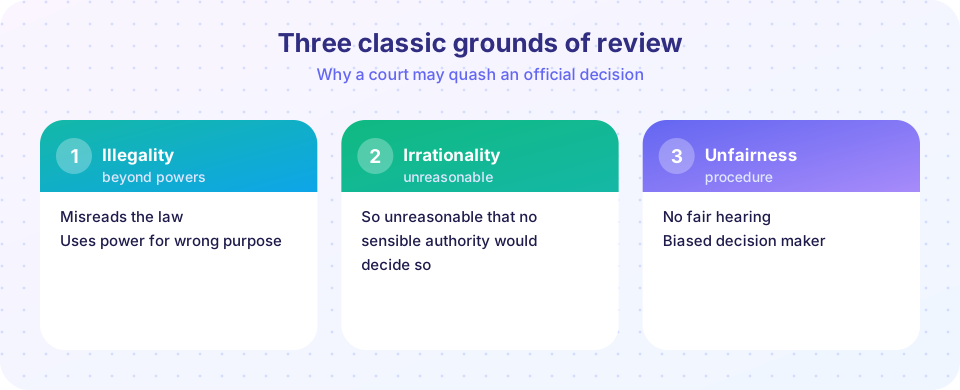
In English law, Lord Diplock summarized the grounds in the House of Lords case Council of Civil Service Unions v Minister for the Civil Service (1985), often called the GCHQ case. He named three:
1. Illegality
The decision maker must understand and apply the law correctly and stay within its powers. A decision is illegal if the body:
- lacked the power altogether (for example a council that licenses something it has no authority to license),
- misinterpreted the statute that gives it power,
- used its power for an improper purpose (using planning powers to punish a critic),
- took into account an irrelevant consideration or ignored a relevant one, or
- fettered its discretion by applying a rigid rule without considering individual cases.
2. Irrationality (unreasonableness)
The classic statement is from Associated Provincial Picture Houses v Wednesbury Corporation (1948): a decision may be quashed if it is so unreasonable that no reasonable authority could have made it. The test is deliberately demanding, because courts are not supposed to substitute their own view for the body's decision on the merits. When fundamental rights are involved, courts apply more intense scrutiny, and in many systems proportionality is used instead (see the previous lesson).
3. Procedural impropriety
Courts require fair process. Two core principles of natural justice (also called procedural fairness) are:
- Audi alteram partem: "hear the other side". A person affected by a decision should usually be told of the case against them and have a chance to respond before the decision is made. Ridge v Baldwin (1964) was a landmark case in which the House of Lords held that a chief constable dismissed without a hearing had been treated unfairly.
- Nemo iudex in causa sua: "no one should be a judge in their own cause". A decision maker must be free from actual or apparent bias.
Other aspects include giving reasons in appropriate cases and following any procedure set by statute, for instance a duty to consult. What fairness requires depends on the context: a deportation decision demands more than a parking permit.
Other systems use similar ideas under different names. Canadian law uses a "standard of review" framework (correctness or reasonableness). The Court of Justice of the EU reviews legality on grounds such as lack of competence, infringement of essential procedural requirements, infringement of the treaties and misuse of powers. In France, the Conseil d'État hears an action for excess of power (recours pour excès de pouvoir), which contains four grounds: lack of competence, procedural defect, violation of the law and misuse of powers. German administrative courts review the legality of acts, including whether discretion was properly exercised and whether the act was proportionate.
Remedies
Judicial review is about the lawfulness of a decision, not who is right on the merits. In England and Wales the main remedies are:
- a quashing order, which sets aside the decision (the public body usually has to decide again, properly);
- a mandatory order, which orders a body to perform a public duty;
- a prohibiting order, which stops a body from acting unlawfully;
- a declaration of the legal position, and in some cases an injunction or damages.
Because the court sends the matter back, a successful challenger may get the same result after a fair process. For this reason many people also use statutory appeals or tribunals which can reconsider the merits.
There are also practical limits. A claimant needs standing (a sufficient interest in the matter) and must act promptly: in England and Wales, a claim must be brought promptly and in any event within three months of the decision, subject to the court's discretion. Courts may refuse review where there is an adequate alternative remedy, such as an appeal to a tribunal.
Two models of administrative justice
- Unified courts (common law tradition). Ordinary courts hear challenges to official action, as in the United Kingdom, the United States and Canada. In the United States, the Administrative Procedure Act (1946) sets out how federal agencies make rules and decisions and when courts can review them. A long-running debate concerns how much deference courts should give to agencies' interpretations of statutes. A well-known 1984 doctrine (Chevron) favored deference, but in 2024 the US Supreme Court overruled it in Loper Bright Enterprises v Raimondo, so courts now decide questions of statutory meaning for themselves, while still giving weight to agency expertise in some contexts.
- Separate administrative courts (civil law tradition). In France, Germany, Italy and many other countries, a distinct branch of courts hears disputes with public authorities, headed by the Conseil d'État in France and the Federal Administrative Court in Germany. The idea is that these judges develop special expertise in public law.
Both models share the aim: to ensure that public power is used lawfully and fairly.
Common misconceptions
"Judicial review means the court decides whether the decision was right." Review checks lawfulness and fairness, not the merits. A court may uphold a decision it would not have made itself.
"Judicial review is the same as an appeal." An appeal usually asks whether the decision was correct; review asks whether it was lawful. Appeals exist only where a statute provides them.
"Winning review means winning the whole case." Often the decision is quashed and sent back for the body to decide again, perhaps with the same outcome after a fair procedure.
"Only courts hold officials to account." Ombudsmen, tribunals, audit bodies and the press are also important.
Try it
First, a classifier that sorts complaints about official decisions into the three classic grounds. It is a teaching aid with keyword-style tags, not a legal analysis.
Press Run (or Ctrl + Enter) to see the console output here.
No output.
Second, a decision walkthrough. Step through the stages of a fictional licensing decision, choose what the authority does at each stage, and see which ground a court might use.
Check your understanding
Quick check · 6 questions
of 6 answered You scored / 6 · perfect!
-
1. Which case summarized the three grounds of review as illegality, irrationality and procedural impropriety?
Lord Diplock's speech in the GCHQ case set out the three grounds. -
2. What does audi alteram partem mean?
It is one of the two core natural justice rules; the other is the rule against bias. -
3. What does a quashing order do?
The decision is set aside; the body may have to decide again lawfully. -
4. A council uses a licensing power to punish a critic. Which ground is this?
Using powers for purposes outside those the statute intends is an illegality ground. -
5. How do France and Germany differ from the UK in organizing review of official action?
Civil law countries typically have a separate branch of administrative courts, headed by bodies such as the Conseil d'Etat. -
6. Is judicial review mainly about whether the court agrees with the decision on the merits?
Courts check legality and procedure; they do not usually substitute their own view on the merits.
Summary
- Administrative law controls how public bodies use delegated power; judicial review is a main tool.
- Classic grounds: illegality, irrationality (Wednesbury) and procedural impropriety (natural justice).
- Remedies include quashing, mandatory and prohibiting orders and declarations; results often send the matter back to the decision maker.
- Common law countries typically use ordinary courts; civil law countries often have separate administrative courts.
Next: Chapter 4 review
Track your progress
Create a free account to tick off lessons and pick up where you left off on any device.
of Introduction to Law lessons completed