


















Lesson 31 of 47 · Torts and Criminal Law
Criminal law: actus reus, mens rea and the burden of proof
How crimes are defined and proved: the guilty act, the guilty mind, causation, strict liability, common defences, and the path of a criminal case.
When a crime is committed, the case is not "the victim against the offender" but "the Crown (or the People) against the defendant." The state brings the case because crime is treated as a wrong against society as a whole. Because a conviction can mean prison and a lasting record, the law demands a lot from the prosecution: it must prove each element of the offense beyond reasonable doubt. This lesson explains those elements and the main defences, then follows a case through the system.
Which system? This lesson describes criminal law in England and Wales, with some US comparisons. Criminal law varies sharply between countries and even between US states. Educational information only, not legal advice.
What you will learn
- What actus reus and mens rea mean, with examples
- How causation and omissions work
- What strict liability offenses are
- The main defences and the stages of a criminal case
Key terms
Actus reus: the guilty act: the conduct, circumstances and consequences that make up the offense. Mens rea: the guilty mind: the mental element, such as intention or recklessness. Burden of proof: the duty to prove the case; in criminal law, on the prosecution. Strict liability: an offense that needs no proof of a guilty mind as to one or more elements. Defence: a reason why the defendant should not be convicted, even if the elements are present.
The golden thread
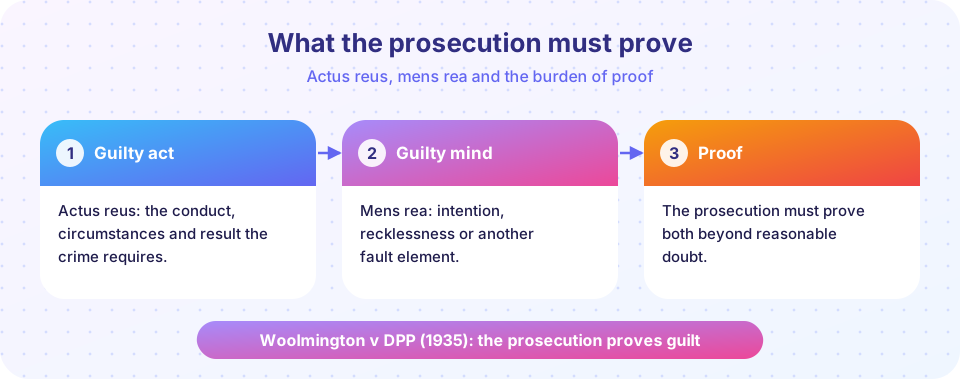
In Woolmington v DPP (1935), the House of Lords held that, subject to limited exceptions, it is for the prosecution to prove the defendant's guilt. Viscount Sankey called this "the golden thread" running through English criminal law. The defendant is presumed innocent. The prosecution must prove every element beyond reasonable doubt. In practice, juries are told they must be sure of guilt.
Actus reus: the guilty act
The actus reus depends on the offense. It may include conduct (hitting someone), circumstances (the property belonged to another) and a result (the victim died).
Voluntariness. The act must be voluntary. A person having an epileptic seizure who knocks over a child has not acted in the legal sense; this is the defence of automatism.
Omissions. The criminal law does not usually punish a failure to act, but there are exceptions where there is a duty to act, for instance a parent to a child, a person who has assumed responsibility, or someone who creates a dangerous situation. In R v Miller (1983), a squatter who fell asleep with a cigarette, woke up to find a mattress on fire and left without doing anything, was liable for arson because he had created the danger.
Causation. For result crimes, the defendant's conduct must be both the factual cause (the but-for test) and the legal cause of the result. The conduct need not be the only cause, but it must be more than a trivial contribution. In R v White (1910), a son who put poison in his mother's drink was not guilty of murder because she died of a heart attack before it took effect. In R v Blaue (1975), a victim of a stabbing refused a blood transfusion for religious reasons and died. The defendant could not rely on her refusal; the court applied the thin skull rule, meaning you take your victim as you find them. An intervening act, such as grossly negligent medical treatment, can break the chain, but only if it is "so independent of the defendant's acts and so potent" in causing death that it makes the defendant's contribution insignificant.
Mens rea: the guilty mind
Different crimes require different mental states.
- Intention. Direct intention means the defendant's aim or purpose was to bring about the result. Oblique intention is the harder idea. In R v Woollin (1999), the House of Lords said that a jury may find intention where the result was a virtual certainty as a consequence of the defendant's actions and the defendant appreciated that this was so. A person who sets fire to a house to claim insurance, knowing that those inside will almost certainly die, may be taken to have intended their deaths even though it was not their wish.
- Recklessness. The defendant was aware of an unjustified risk and went ahead. R v G (2003) confirmed a subjective test: the defendant must actually have foreseen the risk.
- Negligence. Failing to meet the standard of the reasonable person. Used for some offenses, such as gross negligence manslaughter.
- Strict liability. For some offenses, mainly regulatory ones such as selling alcohol to a minor or some driving and pollution offenses, the prosecution need not prove a guilty mind about at least one element. Courts presume mens rea is needed, unless Parliament clearly says otherwise.
Coincidence. The act and the mind must usually occur together. Courts sometimes treat a continuing series of acts as one.
A closer look at homicide
Murder in England and Wales is unlawful killing with intent to kill or cause grievous bodily harm, and it carries a mandatory life sentence. Voluntary manslaughter reduces murder to a less serious offense when partial defences, such as loss of control or diminished responsibility, apply. Involuntary manslaughter covers killing without the intent for murder, for example through an unlawful and dangerous act or gross negligence. Other countries and US states divide homicide differently, often into degrees.
Defences
A defence either denies an element or gives a reason to excuse or justify.
- Self-defence. Reasonable force is permitted to protect oneself or others, or to prevent crime. The question is whether the force used was reasonable in the circumstances as the defendant believed them to be (Criminal Justice and Immigration Act 2008, section 76).
- Insanity. The M'Naghten rules (1843) ask whether, due to a disease of the mind, the defendant did not know the nature and quality of the act or did not know it was wrong. A successful plea leads to a special verdict, not a straight acquittal.
- Automatism. Total loss of voluntary control, as in a sudden seizure or reflex.
- Duress. Acting because of a threat of death or serious injury, where a reasonable person would have yielded. It is not available as a defence to murder in England.
- Intoxication. Voluntary intoxication is generally not a defence, though it may be relevant to whether the defendant formed a specific intent.
- Necessity. Very limited. In R v Dudley and Stephens (1884), shipwrecked sailors who killed and ate a cabin boy were convicted of murder, since necessity is not a defence to deliberate killing of an innocent.
The path of a criminal case
- Investigation and arrest. The police need reasonable grounds. In England, a suspect has the right to remain silent (with consequences for later silence at trial) and to free legal advice. In the US, the Miranda v Arizona (1966) warnings inform suspects of the right to silence and a lawyer.
- Charge. In England, the Crown Prosecution Service decides whether there is enough evidence and whether prosecution is in the public interest.
- Court. Minor offenses are tried in the magistrates' court. Serious ones go to the Crown Court, where a jury of twelve decides guilt. In the US, the Sixth Amendment guarantees jury trial in serious cases, and Gideon v Wainwright (1963) requires states to provide a lawyer for those who cannot afford one in felony cases.
- Verdict and sentence. The judge sentences within the law's limits, weighing seriousness, harm, culpability and mitigation. Appeals are possible.
Common misconceptions
"The defendant has to prove their innocence." No. The prosecution bears the burden, apart from a few statutory exceptions.
"Intending and wanting are the same." The law can find intention where a result was virtually certain, even if the defendant did not desire it.
"Ignorance of the law is an excuse." Generally it is not. A mistake about the facts may negate mens rea, but a mistake about whether something is illegal usually does not.
Try it
Press Run (or Ctrl + Enter) to see the console output here.
No output.
Check your understanding
Quick check · 5 questions
of 5 answered You scored / 5 · perfect!
-
1. The 'golden thread' in Woolmington v DPP refers to:
The presumption of innocence and the prosecution's burden. -
2. In R v Miller (1983), liability for arson arose because:
A person who creates a danger has a duty to take reasonable steps to counteract it. -
3. Oblique intention under Woollin involves:
The jury may find intention if death or serious harm was virtually certain and the defendant realized it. -
4. The thin skull rule appears in R v Blaue because:
You take your victim as you find them, including their beliefs. -
5. Which of these is generally NOT a defence to murder in England?
Duress is not available for murder.
Summary
- The prosecution must prove both actus reus and mens rea beyond reasonable doubt.
- Omissions are liable only where there is a duty; causation needs factual and legal cause.
- Intention can be direct or oblique; recklessness needs awareness of risk.
- Strict liability offenses are mostly regulatory.
- Defences include self-defence, insanity, automatism and duress (not for murder).
Next: Chapter 6 review
Track your progress
Create a free account to tick off lessons and pick up where you left off on any device.
of Introduction to Law lessons completed