


















Lesson 14 of 47 · Legal Systems and Courts
Precedent and stare decisis: how earlier cases guide later ones
How judicial precedent works: vertical and horizontal stare decisis, ratio and obiter, distinguishing and overruling, with Donoghue, Plessy and Brown as examples.
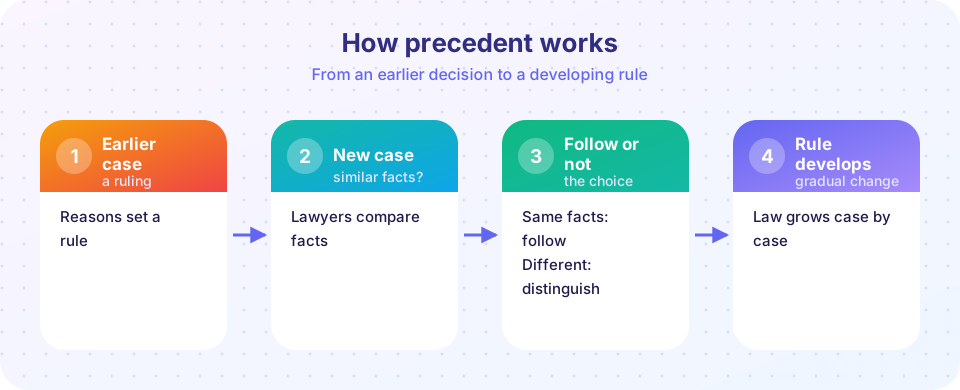
Imagine two neighbors with almost the same dispute, tried a year apart, and the judge reaches opposite results. Most people would call that unfair. The doctrine of precedent exists to prevent it: like cases should be decided alike. In common law systems, this idea is so central that earlier decisions are a source of binding law. In this lesson you will see how precedent works in practice, what makes a precedent binding and how law can still change.
What you will learn
- What stare decisis means and why courts follow it.
- The difference between vertical and horizontal precedent.
- How to find the ratio decidendi and why obiter dicta are different.
- How courts distinguish, overrule and develop earlier cases.
Key terms
Stare decisis: Latin for "to stand by things decided": the principle that courts generally follow earlier decisions.
Ratio decidendi: the legal principle necessary to the decision, which binds later courts.
Obiter dictum: a remark not necessary to the decision, which may persuade but does not bind.
Distinguishing: showing that an earlier case differs in a material way so that its rule does not apply.
Overruling: a higher (or sometimes the same) court declares that an earlier decision was wrong and no longer good law.
Why follow precedent?
Several reasons support the doctrine.
- Equality. Like cases should be treated alike.
- Predictability. People can plan, and lawyers can advise, if they can tell how courts have ruled before. Businesses sign contracts and people buy houses relying on settled law.
- Efficiency. Courts need not reargue basic questions in every case.
- Restraint. Following earlier decisions limits the personal preferences of judges.
The costs are also real: precedent can lock in old errors or outdated views, and in complex areas it can generate fine distinctions that confuse. The doctrine is therefore a strong presumption, not an absolute rule.
Vertical and horizontal precedent
Vertical precedent works up and down the court hierarchy: a lower court must follow decisions of courts above it in the same system. A county court in England must follow the Court of Appeal and the Supreme Court; a federal district court in the United States must follow its circuit court and the Supreme Court.
Horizontal precedent concerns whether a court follows its own earlier decisions. The practice varies. The English Court of Appeal is generally bound by its own previous decisions, with a few exceptions. The House of Lords, in a Practice Statement in 1966, announced it would treat its earlier decisions as normally binding but would depart from them when it appeared right to do so, a policy the UK Supreme Court inherited. The Supreme Court of the United States treats its own precedent with respect but has overruled many cases.
Decisions from courts in other systems or from courts of equal rank in other regions are not binding but may be persuasive. Common law courts often look at decisions of other common law countries when they face new questions.
Finding the ratio
Not everything in a judgment binds later courts. Only the ratio decidendi, the legal reasoning necessary to reach the decision on the material facts, counts. Everything else, such as hypothetical examples, side comments and discussions of points not needed to decide the case, is obiter dictum.
How do you find the ratio? A rough method: state the material facts, the legal rule the court applied to them and the result, and ask whether the result would have been the same without the point you are testing. Courts themselves sometimes disagree on what the ratio of an earlier case was, particularly when several judges gave different reasons. That is why later courts read earlier decisions carefully.
In Donoghue v Stevenson (1932), the House of Lords held that a manufacturer owes a duty of care to the ultimate consumer of products sold in a form that prevents inspection. Lord Atkin's general "neighbor" formulation, asking who is so closely and directly affected by one's acts that one ought to have them in mind, was influential but later narrowed and refined. Later cases extended the duty to other products, and in Caparo Industries v Dickman (1990) the House of Lords set out a more structured approach for when a duty of care arises in new situations, which English courts have since treated cautiously and incrementally.
Distinguishing and overruling
When a precedent seems to apply but the judge thinks the result would be unfair, there are two main tools.
- Distinguishing. The court points to a material difference between the earlier case and the present one. "In that case the buyer could inspect the goods; here, the product was sealed." The earlier case stays good law, but its rule does not reach the new facts. Distinguishing allows gradual change, and critics sometimes call it a way of avoiding precedent without admitting it.
- Overruling. A court with the authority declares that the earlier decision was wrong. A famous example: in Plessy v Ferguson (1896), the US Supreme Court upheld a state law requiring "separate but equal" railway accommodation. In Brown v Board of Education (1954), the Court held that racially segregated public schools were unconstitutional, rejecting the idea in the education context. Overruling is rare and normally comes from the highest court.
Other ways that precedent loses force: a statute changes the rule; the decision was made per incuriam (by oversight, without noticing a binding statute or case); or the reasoning is limited to its facts.
Precedent in civil law systems
In civil law systems there is no doctrine of binding precedent in the common law sense. A judge's duty is to apply the code. But consistency matters here too. Decisions of the highest courts, such as the French Cour de cassation or the German Federal Court of Justice, are published and widely followed, and lower courts generally do not depart from them without good reason. The difference is therefore between a formal doctrine (common law) and a strong practice (civil law). In some civil law countries, such as Germany, the constitutional court's decisions on constitutionality have legally binding force.
Common misconceptions
"Precedent means judges can never change the law." Distinguishing, overruling and statutes all allow change; precedent just makes change reasoned and gradual.
"Everything a judge says is binding." Only the ratio binds. Obiter remarks can be persuasive but are not binding.
"Precedent only exists in common law countries." Civil law courts also follow consistent lines of decisions, although not as a formal rule.
"An older case is always weaker." Age alone does not reduce authority. A case remains binding until a court with power to do so overrules it, or a statute changes it.
Try it
First, a simple binding-authority checker. Enter the court that decided the earlier case and the court now hearing the case; the program says whether the earlier decision is binding or persuasive, in a simplified English-style hierarchy.
Press Run (or Ctrl + Enter) to see the console output here.
No output.
Second, a distinguishing exercise. Compare the facts of an earlier case with a new one; the tool counts material differences and suggests whether a court is likely to follow or distinguish. It is a toy: real judges weigh the reasons, not just the count.
Check your understanding
Quick check · 5 questions
of 5 answered You scored / 5 · perfect!
-
1. What is the ratio decidendi?
The ratio is the principle required to reach the result on the material facts. It is the binding part. -
2. What is vertical precedent?
Vertical precedent runs up the hierarchy: lower courts are bound by higher courts. -
3. In Brown v Board of Education (1954), what did the US Supreme Court do to the 'separate but equal' idea from Plessy v Ferguson (1896)?
Brown held that segregated public schools were unconstitutional, rejecting the Plessy approach there. -
4. What is distinguishing?
Distinguishing limits an earlier case to its own facts without overruling it. -
5. Which statement about civil law systems is closest to accurate?
Consistency matters in civil law systems, but through practice and influence rather than a formal doctrine.
Summary
- Stare decisis promotes equality, predictability and restraint.
- Lower courts are bound by higher courts; courts treat their own earlier decisions as strongly persuasive or binding, depending on the system.
- Only the ratio decidendi binds; obiter dicta can persuade.
- Distinguishing and overruling let the law change in a reasoned way.
- Civil law systems rely on influence and practice rather than formal precedent.
Track your progress
Create a free account to tick off lessons and pick up where you left off on any device.
of Introduction to Law lessons completed