


















Lesson 36 of 47 · Property, Family and Employment Law
Employment law: status, contracts, dismissal and equality
Learn the basics of employment law: employee, worker or contractor, the employment contract, fair dismissal, redundancy and anti-discrimination rules.
Most adults spend a large share of their lives at work. Employment law sets the ground rules: who counts as an employee, what must be in a contract, how much notice is needed, when dismissal is fair and how discrimination is prevented. Because the law gives different rights to different kinds of workers, the first question is usually: what is this person's status?
Jurisdiction and change. This lesson mainly describes England and Wales and compares with US law. Employment rules change often, and several reforms were under discussion at the time of writing, so check current law before relying on any detail. This is educational information, not legal advice.
What you will learn
- The difference between employees, workers and contractors
- What an employment contract contains
- How unfair dismissal and redundancy work in outline
- The basics of discrimination law
- How US employment law differs
Key terms
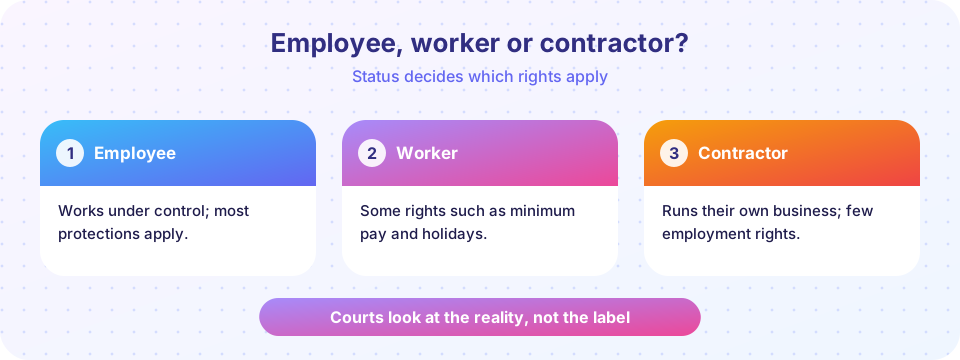
Employee: works under a contract of employment; has the fullest rights. Worker: a wider category with some rights, such as minimum pay and paid holiday. Independent contractor: runs their own business and offers services to clients. Dismissal: ending of employment by the employer. Discrimination: treating someone worse because of a protected characteristic.
Status: employee, worker or contractor
In the UK, three main groups exist. An employee has a contract of employment and receives the widest protections, including unfair dismissal rights, redundancy pay and statutory notice. A worker has a contract to personally do work but is not an employee, such as a casual or agency worker; workers receive protection such as the national minimum wage, paid holiday and protection against unlawful deductions. An independent contractor is in business on their own account and has few employment rights, but still benefits from health and safety law and from anti-discrimination law in many cases.
Labels in a contract do not decide the matter. Courts examine the reality of the relationship. In Ready Mixed Concrete v Minister of Pensions (1968), the court said a contract of employment exists where the worker agrees to provide their own work for a wage, subject to a degree of control by the employer, and the other terms are consistent with employment. Courts also look at integration into the business, mutuality of obligation and whether the person can send a substitute. In Uber BV v Aslam (2021), the UK Supreme Court held that a group of Uber drivers were workers, since Uber controlled pricing, contract terms, ratings and conditions, so the drivers were in a position of subordination. In Pimlico Plumbers v Smith (2018), a plumber who was said to be self-employed was found to be a worker, in part because he had very limited right to send someone else.
The employment contract
A contract of employment can be written or oral, but in the UK an employer must give a written statement of main terms from the first day of work. It covers pay, hours, holidays, notice, job title and place of work. Terms may be express, from custom, or implied. A famous implied term is mutual trust and confidence: neither side may act in a way likely to destroy the relationship without good reason.
Notice. The law sets minimums: for example, after one month of service, an employee is entitled to at least one week's notice from the employer; after two years, this rises by one week per completed year to a maximum of 12 weeks. Contracts may offer more.
Pay and time. The national minimum wage and national living wage set legal minimums per hour by age group. The Working Time Regulations 1998 set limits on weekly hours (with an option to opt out), rest breaks, and at least 5.6 weeks' paid holiday for full-time workers.
Ending employment
Unfair dismissal. In the UK, an employee with enough service (currently usually two years, though reforms were under discussion) may complain that they were dismissed unfairly. The employer must show a potentially fair reason: conduct, capability, redundancy, legal restriction, or "some other substantial reason". The tribunal then asks whether the employer acted reasonably in treating it as sufficient reason, including a fair process. The test is whether dismissal fell within the range of reasonable responses, from Iceland Frozen Foods v Jones (1983). Some dismissals are automatically unfair regardless of service, such as for whistleblowing or for asserting a statutory right.
Wrongful dismissal. A different claim for breach of contract, for example failing to give proper notice.
Redundancy. A dismissal because the employer's need for employees of a particular kind has ceased or diminished. Employees with enough service receive a statutory redundancy payment based on age, weekly pay and years of service, and the employer must consult in collective redundancies.
Remedies. Compensation is the usual remedy; reinstatement is rare.
Equality and discrimination
The Equality Act 2010 bans discrimination because of nine protected characteristics: age, disability, gender reassignment, marriage and civil partnership, pregnancy and maternity, race, religion or belief, sex and sexual orientation. Forms of prohibited conduct include direct discrimination (treating someone worse because of a characteristic), indirect discrimination (a neutral rule that puts a group at a disadvantage, unless justified), harassment, victimization, and failure to make reasonable adjustments for a disabled person. Employers may have a limited defence if a requirement is a genuine occupational requirement.
The United States and elsewhere
US employment law is mostly state-based and generally follows the idea of employment at will: either side may end the relationship at any time, for any lawful reason, with exceptions such as discrimination (under federal laws such as Title VII of the Civil Rights Act 1964), retaliation for protected activity, and written contracts. The Fair Labor Standards Act sets a federal minimum wage and overtime. The US has no general federal right to paid annual leave. Many European countries give stronger protection against dismissal and larger entitlements to leave, and in some, such as Germany, employee representatives sit on company boards.
Common misconceptions
"If my contract says I am self-employed, I am." Courts look at the reality, so the label is only one factor.
"An employer can dismiss anyone without a reason." In the UK, employees with enough service are protected against unfair dismissal; in the US, at-will employment is the starting point but with many exceptions.
"Discrimination only means treating someone worse on purpose." Indirect discrimination can arise from neutral rules with a disproportionate effect.
Try it
Press Run (or Ctrl + Enter) to see the console output here.
No output.
Check your understanding
Quick check · 5 questions
of 5 answered You scored / 5 · perfect!
-
1. In Uber BV v Aslam (2021), the Supreme Court held that the drivers were:
They were workers, with rights such as minimum pay and holiday. -
2. Which is a protected characteristic under the Equality Act 2010?
Nine characteristics are protected, including disability. -
3. Employment at will is typical of:
With exceptions, either side may end employment at will. -
4. Indirect discrimination means:
The effect, not the intent, counts. -
5. The 'range of reasonable responses' test concerns:
Iceland Frozen Foods v Jones: was the dismissal within the range of reasonable employer responses?
Summary
- Status (employee, worker, contractor) decides which rights apply, and courts look at reality.
- Contracts contain express and implied terms, including mutual trust and confidence.
- Dismissal can be fair, unfair or wrongful; redundancy has its own rules.
- The Equality Act 2010 prohibits discrimination on protected characteristics.
- US employment is mostly at will, with exceptions.
Next: Chapter 7 review
Track your progress
Create a free account to tick off lessons and pick up where you left off on any device.
of Introduction to Law lessons completed