


















Lesson 42 of 47 · Legal Reasoning and Practice
Chapter 8 review: Legal reasoning
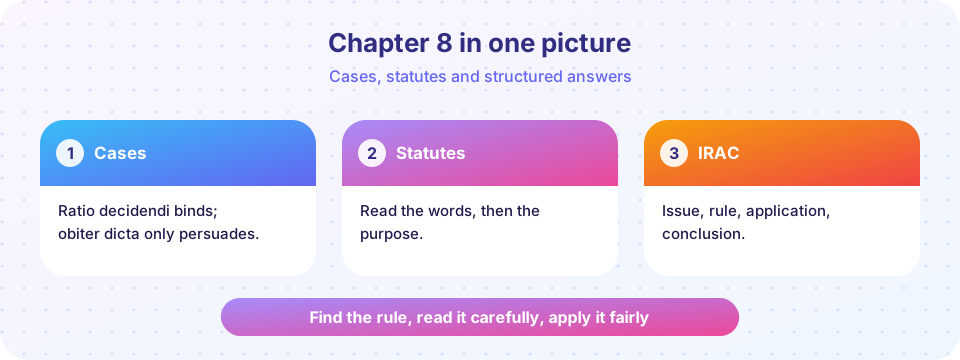
Review cases, precedent, statutory interpretation and IRAC with a one-page picture, a recap table and a ten-question mixed quiz.
You now have the tools lawyers use: reading cases, reading statutes and structuring an answer. This review pulls them together, so that you can apply them in the projects and practice sets of the final chapter.
What you will learn
- A summary of the three skills
- How they combine when you work on a problem
Recap table
| Skill | Key ideas |
|---|---|
| Cases | Ratio decidendi binds; obiter dicta persuades; higher courts bind lower ones; follow, distinguish, overrule |
| Statutes | Read the structure; literal, golden, mischief, purposive; aids such as Hansard; Latin canons |
| IRAC | Issue, rule, application (both sides), conclusion with confidence |
Working them together
Imagine a problem about a park rule. First, identify the issue: is a bicycle a "vehicle" under the rule? Second, find the rule: the statute's words, then any cases interpreting similar words. Third, interpret: a literal reading may catch the bicycle; a purposive reading may not. Fourth, check precedent: is there a binding case about the same word? If so, follow or distinguish it. Fifth, apply with arguments on both sides and conclude with a level of confidence. These steps repeat in every area of law.
Try it
Press Run (or Ctrl + Enter) to see the console output here.
No output.
Check your understanding
Quick check · 10 questions
of 10 answered You scored / 10 · perfect!
-
1. Which part of a judgment binds later courts?
The ratio. -
2. A High Court decision in England is:
It binds downward only. -
3. Which approach was used in Smith v Hughes (1960)?
The court looked at the mischief of nuisance in the street. -
4. The US term for following precedent is:
To stand by decisions. -
5. In IRAC, the Application step should:
It is the reasoning step. -
6. 'Ejusdem generis' helps to interpret:
It takes meaning from the list. -
7. Distinguishing a precedent means:
The precedent remains good law. -
8. Which is a feature of a strong conclusion?
Lawyers qualify their conclusions. -
9. Pepper v Hart (1993) relates to:
Parliamentary statements as an aid in limited circumstances. -
10. Which statement is true about the literal rule?
Certainty versus purpose.
Summary
- Reading cases means finding the ratio and knowing which courts bind.
- Reading statutes means careful structure reading and choosing an interpretation approach.
- IRAC organizes an answer.
Track your progress
Create a free account to tick off lessons and pick up where you left off on any device.
of Introduction to Law lessons completed