


















Lesson 9 of 47 · What Law Is and Where It Comes From
Rights, duties and the rule of law
What a legal right is, how rights pair with duties, powers and liabilities (Hohfeld), rules versus standards, and the main ideas of the rule of law from Dicey to Fuller.
Open any legal document and you will find the same words again and again: right, duty, power, liability, entitlement, obligation. They look simple, but lawyers use them precisely, and most legal problems can be restated in these terms. This lesson explains the basic vocabulary of legal relationships and then turns to the ideal that holds the whole system together: the rule of law.
What you will learn
- What a legal right is and how it pairs with a duty.
- Hohfeld's four pairs: right and duty, liberty and no-right, power and liability, immunity and disability.
- The difference between rules and standards.
- The main ideas of the rule of law, including Fuller's eight requirements.
Key terms
Right (claim-right): a legally protected entitlement that someone else must respect, matched by a duty on another party.
Duty: something the law requires you to do or not do.
Power: the legal ability to change legal relations, such as making a contract or a will.
Liability: exposure to having your legal position changed by someone else's power.
Rule of law: the ideal that government and citizens alike are bound by public, general, fairly applied law.
What is a right?
In everyday speech, "I have a right to..." can mean many things. In law, the clearest sense of a right is a claim against someone: because the law protects my interest, another person is under a duty to me. If you lend me money, you have a right to be repaid and I have a duty to repay. If I own a house, I have a right that others not enter it without permission and they have a duty to stay out.
Rights come from several places: contracts (your right to a delivered product), property law, statutes (a right to a minimum wage), constitutions (freedom of expression) and international human rights treaties. Some thinkers see human rights as grounded in natural law or in human dignity; others treat them as legal or political achievements. For lawyers the practical test is the same: can the right be recognized and enforced, and against whom?
A useful distinction in constitutional and human rights law separates negative rights, which require others to refrain (do not imprison me without a lawful reason; do not censor me), from positive rights, which require others, usually the state, to act (provide schools or emergency medical care). Legal systems differ on how far positive rights are enforced as rights rather than goals.
Hohfeld's four pairs
In 1913 the American jurist Wesley Newcomb Hohfeld published an influential analysis showing that "right" is used for four different legal relations. He paired each with an opposite and a correlative:
| Your position | The other person's position | Example |
|---|---|---|
| Right (claim) | Duty | You have a right to be paid, so your employer has a duty to pay |
| Privilege or liberty | No-right | You are free to wear a red coat; nobody has a legal claim that you not do so |
| Power | Liability | The person receiving an offer has the power to accept it; the offeror is liable to become bound by a contract |
| Immunity | Disability | A judge may be immune from being sued for judicial decisions; others lack the power to sue |
The value of Hohfeld's scheme is clarity. When someone says "I have a right to park here", you can ask: is this a claim that others must not block me, a liberty that nobody can stop me, or a power to do something such as reserving a space? Different answers lead to different legal consequences.
Rules, standards and principles
Law does not only speak in sharp rules. Compare these two ways of regulating speed:
- A rule: "The limit is 50 kilometers per hour in towns." It is clear and cheap to apply, but it is rigid. 50 km/h may be too fast in front of a school at closing time and pointlessly slow on an empty road at night.
- A standard: "Drive at a speed that is reasonable in the circumstances." It adapts to the facts, but it is less predictable and requires a judge to decide what is reasonable after the fact.
Tort law uses standards (the reasonable person), while many road and tax laws use rules. Legislators choose between them, weighing predictability against fairness in individual cases. Principles, as discussed in the last lesson, are more general still, such as fairness or proportionality, and guide interpretation without dictating a single outcome.
The rule of law
The rule of law is one of the most cited and most contested ideas in political thought. Its roots are old: the Magna Carta of 1215, forced on King John of England by rebellious barons, is often cited as a symbol of the idea that even a king is subject to law, though its practical terms were narrower than its legend. The English jurist A. V. Dicey, in his Introduction to the Study of the Law of the Constitution (1885), gave a famous formulation: no one should be punished except for a distinct breach of law established in the ordinary courts; everyone, whatever their rank, is subject to the ordinary law; and individual rights flow from ordinary court decisions.
The American legal philosopher Lon Fuller, in The Morality of Law (1964), listed eight requirements that make a system of rules genuinely law, using the story of a king, Rex, who fails at making law in each way:
- Generality: rules, not ad hoc commands.
- Promulgation: rules are made public.
- Non-retroactivity: no punishing for what was lawful when done.
- Clarity: rules can be understood.
- Consistency: rules do not contradict each other.
- Possibility: rules do not demand the impossible.
- Constancy: rules do not change so often that people cannot follow them.
- Congruence: officials actually apply the rules as written.
Writers disagree about how much more the rule of law includes. A thin or formal view stops at these procedural qualities. A thick or substantive view adds protection of human rights, democracy or equality. The English judge Tom Bingham, in his book The Rule of Law (2010), argued for a broad version with several principles, including that the law must be accessible, that questions of legal right should normally be resolved by law rather than discretion, that law should apply equally to all, that human rights must be protected, that ways must be provided to resolve disputes without excessive cost, and that state powers must be used reasonably and for their proper purpose. Not everyone agrees with each item, but the list shows how the ideal turns into practical tests.
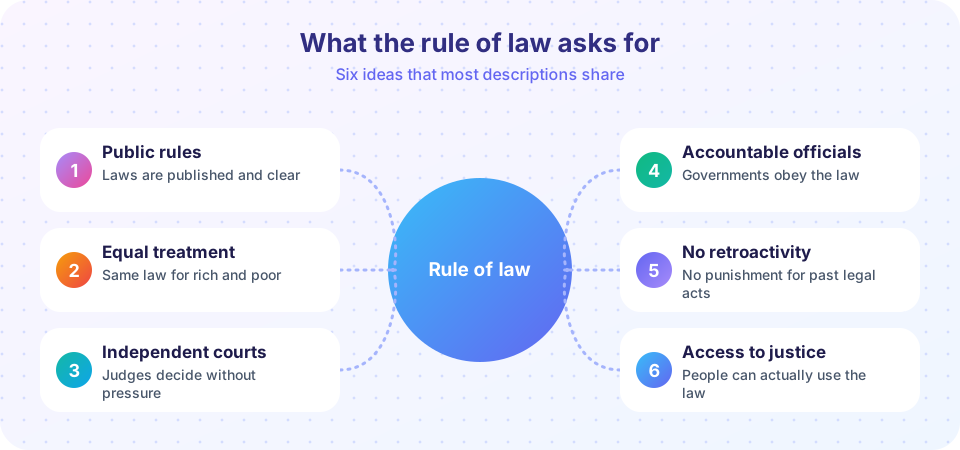
Many international organizations measure compliance with the rule of law by asking whether people can actually use courts, not only whether laws exist on paper. That is why the sixth idea in the picture, access to justice, matters: a right you cannot enforce is of little value.
Common misconceptions
"The rule of law means obey every law." It describes how government should operate: under public, fair rules. It does not mean that every law is just or must be obeyed without question.
"Rights are absolute." Most rights can be limited if the law allows and the limit is justified, for example freedom of speech may be limited to prevent defamation or incitement to violence. A few, such as the ban on torture in international law, are treated as absolute.
"A right always means a duty on the state." Rights can be held against private persons too, as with property and contract rights.
Try it
First, an exercise to practice Hohfeld's vocabulary. The tool names the correlative of each position and describes what each side may do.
Press Run (or Ctrl + Enter) to see the console output here.
No output.
Second, score a fictional legal system against Fuller's eight requirements. Tick the boxes to see how many it meets. It is a thinking aid, not a scientific index.
Check your understanding
Quick check · 6 questions
of 6 answered You scored / 6 · perfect!
-
1. In Hohfeld's scheme, what is the correlative of a right?
If you have a claim-right, someone else has a duty to respect it. -
2. A standard such as 'reasonable care' differs from a rule such as 'maximum 50 km/h' because it
Standards are flexible but leave more to later judgment, while rules are precise but rigid. -
3. Who listed eight requirements, such as generality, publicity and non-retroactivity, in The Morality of Law (1964)?
Fuller used the story of King Rex to illustrate eight ways of failing to make law. -
4. What does a 'thick' view of the rule of law add to the thin view?
Thin views focus on form (public, clear, stable rules), thick views add content such as rights. -
5. A negative right typically requires others to
Negative rights are protections against interference; positive rights require action. -
6. Which is an example of a power in Hohfeld's sense?
A power is the legal ability to change legal relations, such as creating a will or contract.
Summary
- A right is a legally protected claim that matches someone else's duty.
- Hohfeld distinguished four pairs: right and duty, liberty and no-right, power and liability, immunity and disability.
- Law uses rules for predictability and standards for flexibility.
- The rule of law has roots in Magna Carta, was formulated by Dicey and refined by Fuller and Bingham.
- Thin views list formal qualities; thick views add rights and equality.
Next: Chapter 2 review
Track your progress
Create a free account to tick off lessons and pick up where you left off on any device.
of Introduction to Law lessons completed