


















Lesson 6 of 47 · What Law Is and Where It Comes From
Chapter 2 overview: what law is and where it comes from
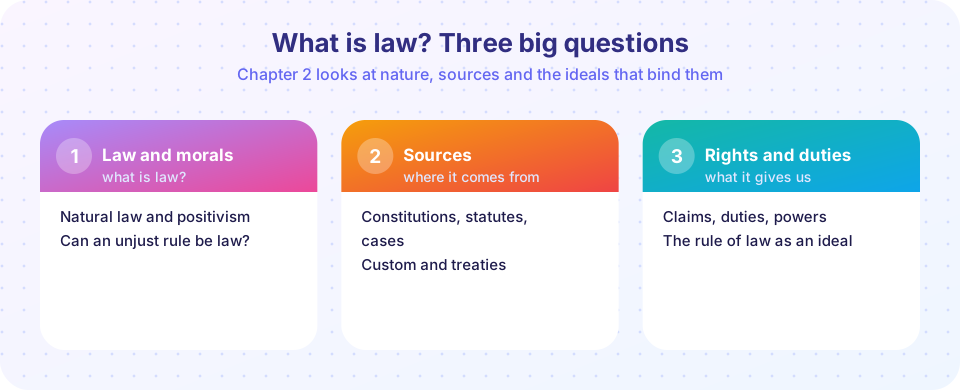
A preview of chapter 2: the old debate about law and morality, the sources lawyers rely on, and the rights, duties and rule of law ideas behind them.
Chapter 1 gave you a map. Chapter 2 asks the deeper question underneath it: what makes something law at all? A parking fine is law. So is a constitution. A rule your school sets, or a house rule at home, is not. A tyrant's order to arrest critics might be called law by the tyrant's lawyers, and many people would deny that it deserves the name. These puzzles have occupied philosophers and lawyers for more than two thousand years, and they have practical consequences: they affect how judges read statutes, how citizens judge their governments and how the world responded to atrocities in the twentieth century.
What you will learn
- How this chapter's four lessons fit together.
- What each of the three big questions asks.
- Why theory matters for practice.
The big picture
Every legal system has to answer three questions, even if it never says so out loud.
- What counts as law? Which rules are valid and binding, and is validity just a matter of correct procedure or does it also depend on content? This is the subject of the debate between natural law and legal positivism.
- Where does law come from? In practice, lawyers do not argue about philosophy first. They look for sources: a constitution, a statute, a regulation, a previous court decision, a treaty or a custom. Knowing the sources and how they rank against each other is the working toolkit of the profession.
- What does law give people and demand of them? The law gives rights, imposes duties, grants powers and creates liabilities. An ideal runs through all of it: the rule of law, the idea that law should be public, stable, fairly applied and binding on those in power.
Question 1: what counts as law?
Question 2: where does it come from?
Question 3: what does it give?
The four lessons
- Law and morality: natural law, positivism, legal realism and the idea of principles, with the Nuremberg trials as a test case.
- Sources of law: constitutions, legislation, delegated rules, judicial decisions, custom, treaties and scholarship, and the hierarchy among them.
- Rights, duties and the rule of law: what a right is, how rights and duties pair up, the difference between rules and standards, and the main ideas behind the rule of law.
- Chapter 2 review: a recap and a longer quiz.
Why theory matters for practice
It is tempting to skip theory and go straight to the "real" rules. That would be a mistake, for three reasons.
First, hard cases need theory. When a statute is unclear or yields an absurd result, judges must decide how far to follow the words, how far to follow the purpose and how far to let moral principle guide them. Different views of what law is lead to different answers.
Second, theory explains disagreement. Two lawyers can agree on every fact and still disagree about the outcome, because they hold different views about how to read sources. Seeing the difference lets you follow arguments instead of just picking a side.
Third, theory shapes institutions. The belief that government must be bound by law led to constitutions, independent courts and human rights treaties. Understanding the ideal helps you judge whether an institution actually delivers it.
Try it
First, a quick map of the chapter in code. It lists the questions, the key names to remember and where to find them. Add your own notes as you study.
Press Run (or Ctrl + Enter) to see the console output here.
No output.
Second, a pre-test: guess where you stand before the lessons. There is no right answer; the point is to notice your own intuitions.
Check your understanding
Quick check · 4 questions
of 4 answered You scored / 4 · perfect!
-
1. Which question is most closely tied to natural law versus positivism?
Natural law and positivism disagree about whether the moral quality of a rule affects whether it is law. -
2. What is the main job of the sources of law in practice?
Sources are the places binding rules are found, and the hierarchy tells you which prevails in a conflict. -
3. The rule of law is best described as
It is an ideal about how law works, not a single rule. -
4. Why is it useful to study legal theory?
Theory helps in hard cases and shows why competent lawyers can reach different answers.
Summary
- Chapter 2 asks what counts as law, where law comes from and what it gives and demands.
- Natural law, positivism and interpretivism are different answers to the first question.
- Sources and their hierarchy are the lawyer's working map.
- Rights, duties and the rule of law describe what law does for people.
- Theory matters because hard cases and institutional design depend on it.
Next: Law and morality
Track your progress
Create a free account to tick off lessons and pick up where you left off on any device.
of Introduction to Law lessons completed