


















Lesson 10 of 47 · What Law Is and Where It Comes From
Chapter 2 review: what law is and where it comes from
Review chapter 2: natural law, positivism and interpretivism, sources of law and their hierarchy, rights, duties and the rule of law, with a ten question quiz.
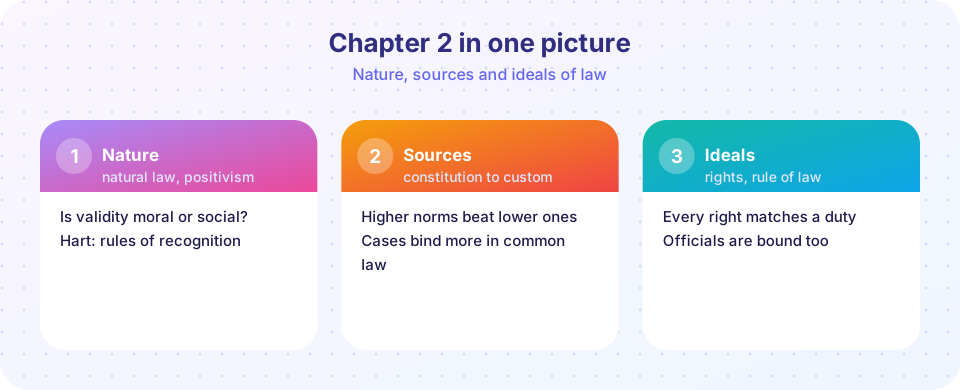
This chapter moved from the philosophical question "what is law?" to the practical toolkit of sources, and finally to the ideals of rights and the rule of law. Use the picture, the table and the quiz below to check what has stuck.
What you will check
- You can state the main claim of each school of legal theory.
- You can rank sources of law and resolve a conflict between them.
- You can use the vocabulary of rights, duties, powers and the rule of law.
The chapter in brief
The chapter began with the oldest question in legal philosophy: what makes a rule law? Natural law answered that law has a moral core and that extreme injustice weakens a rule's claim to be law. Positivism answered that validity depends on social facts, such as whether officials recognize a rule as law, and that morality is a separate matter. Dworkin added that principles also belong to law, and the realists reminded us to watch what courts actually do. None of these views has won, and each helps explain something about real legal systems.
The practical half of the chapter dealt with sources and ideals. Constitutions, statutes, regulations, judicial decisions, custom and treaties form a hierarchy in which higher norms beat lower ones, later beat earlier and specific beat general. Rights match duties, and Hohfeld showed that "right" can mean a claim, a liberty, a power or an immunity. The rule of law ties it together as an ideal: law should be public, clear, stable, equal and binding on those who govern.
Recap table
| Topic | Key point | Names and works |
|---|---|---|
| Natural law | Law has a moral core; extreme injustice may fail to be law | Aquinas, Locke, Radbruch, Finnis |
| Legal positivism | Validity comes from social facts, not morality | Bentham, Austin, Kelsen, Hart (The Concept of Law, 1961) |
| Interpretivism | Law includes moral principles | Dworkin, Riggs v Palmer (1889) |
| Legal realism | Look at what courts really do | Holmes, The Path of the Law (1897) |
| Sources | Constitution, statute, regulation, case law, custom, treaty | Hierarchy: higher beats lower, later beats earlier, specific beats general |
| Rights and duties | Right matches duty; Hohfeld's four pairs | Hohfeld (1913) |
| Rule of law | Public, general, fairly applied law binding on officials | Dicey (1885), Fuller (1964), Bingham (2010) |
Common mistakes to avoid
- Saying positivists believe unjust laws must be obeyed: positivism is about what law is, not about obedience.
- Treating case law as binding in every system: common law and civil law differ.
- Using "right" loosely: ask whether you mean a claim, a liberty, a power or an immunity.
- Confusing the rule of law (an ideal) with rule by law (using law as a tool of power).
Try it
Run the quick self-test. It prints one question at a time in random order; try to answer before reading the line below it.
Press Run (or Ctrl + Enter) to see the console output here.
No output.
Check your understanding
Quick check · 10 questions
of 10 answered You scored / 10 · perfect!
-
1. Which pairing is correct?
Austin described law as the commands of a sovereign backed by sanctions. Dworkin emphasized principles; Kelsen proposed a pure theory. -
2. A legislature passes an Act that conflicts with a supreme written constitution. In a system with judicial review, what is likely to happen?
Where the constitution is supreme and courts have the power of review, conflicting statutes can be struck down. -
3. Which source is usually lowest in the hierarchy listed in this chapter?
In the simple hierarchy used here, case law and custom come below statutes and regulations, though their exact place varies by system. -
4. A narrow statute on cycling conflicts with a general statute on vehicles passed later. Which tie-breaker favors the cycling statute?
Lex specialis says the more specific rule prevails, even though lex posterior might favor the later general one. Conflict rules can pull in different directions. -
5. What does a Hohfeldian immunity correlate with?
Immunity is paired with disability: others lack the power to change your legal position. -
6. Which is true of the Radbruch formula?
Radbruch restricted it to extreme injustice, a point often missed. -
7. What did Riggs v Palmer (1889) illustrate for Dworkin?
The court denied inheritance to a murderer on a principle even though the statute did not mention it. -
8. Which of these is NOT one of Fuller's eight requirements?
Voting rules are not among Fuller's eight desiderata. -
9. Which kind of rights require others, usually the state, to act?
Positive rights call for action such as providing a service; negative rights call for restraint. -
10. Why might a regulation be invalid in English law?
Delegated legislation is only valid within the authority conferred by the statute.
Summary
- Natural law, positivism, interpretivism and realism offer competing views of what law is.
- Sources rank in a hierarchy, with tie-breakers for conflicts.
- Rights pair with duties, and Hohfeld's four pairs sharpen the vocabulary.
- The rule of law is an ideal with formal and substantive versions.
Track your progress
Create a free account to tick off lessons and pick up where you left off on any device.
of Introduction to Law lessons completed