


















Lesson 15 of 47 · Legal Systems and Courts
Civil and criminal procedure: how a case moves through court
Follow a case from filing to appeal: stages of civil and criminal procedure, burden and standard of proof, the presumption of innocence and the right to a fair hearing.
A legal right means little if you cannot enforce it, and a rule is only fair if the process that applies it is fair. Procedure is the set of rules governing how cases are started, prepared, heard and appealed. It can feel dry, but it is where much of the practical difference between systems lies, and where basic protections such as the right to be heard and the presumption of innocence do their work.
What you will learn
- The main stages of a civil case and a criminal case.
- What burden of proof and standard of proof mean.
- Which fair trial rights are widely recognized.
- How remedies and sentences are enforced.
Key terms
Claimant (plaintiff): the person who starts a civil claim. Use varies: "plaintiff" in the United States, "claimant" in England and Wales.
Defendant: the person against whom a civil claim or criminal charge is brought.
Burden of proof: the duty of a party to prove a point.
Standard of proof: how convincing the evidence must be for the party to succeed.
Disclosure (discovery): the exchange of relevant documents and information before trial.
A civil case from start to finish
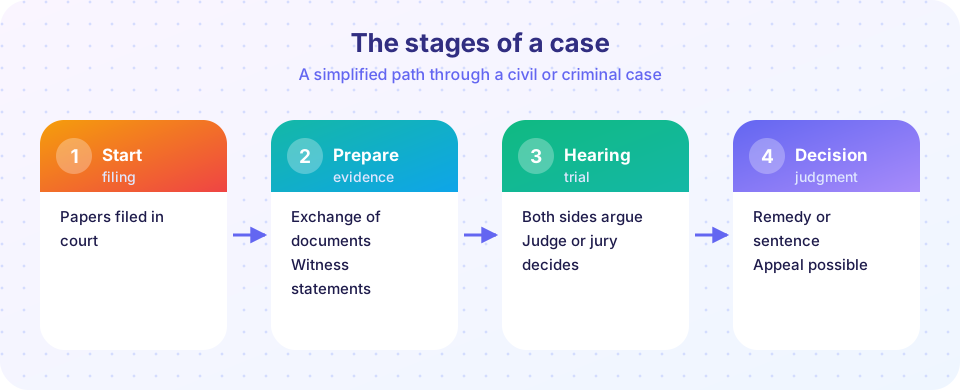
Civil procedure varies, but the typical common law path looks like this. We use a simple example: a customer says a builder did poor work and wants to be repaid.
- Pre-action steps. Many systems expect the parties to exchange letters and try to settle before suing. Courts may penalize a party who refuses reasonable efforts.
- Starting the claim. The claimant files a claim form (or complaint, in the United States) stating the facts and the remedy sought, and serves it on the defendant. Time limits matter: the limitation period is a deadline after which the claim is barred.
- Response. The defendant files a defense, admitting, denying or putting the claimant to proof. The defendant can also make a counterclaim.
- Disclosure. The parties exchange documents. In the United States, the discovery process is broad and includes depositions (sworn questioning); in England and Wales and in many other systems, disclosure is narrower and controlled by the court.
- Case management. Judges set timetables, limit issues and push parties to settle. Many cases end here, by settlement or by an application for summary judgment if one side has no real chance.
- Trial. Each side presents evidence through witnesses and documents; lawyers cross-examine witnesses. In most civil cases in common law countries a judge decides, though juries are used in some, notably in many US cases.
- Judgment. The court decides who wins and orders a remedy: damages (money), an injunction (an order to do or stop doing something), specific performance (an order to carry out a contract) or a declaration of rights.
- Costs and enforcement. Many systems require the loser to pay a large part of the winner's costs; the United States generally follows the rule that each side pays its own, with exceptions. If the loser does not comply, the winner may seek enforcement: seizing assets, garnishing wages or registering a charge on property.
- Appeal. Either side may seek permission to appeal, within a deadline.
In civil law countries, the sequence is similar in broad outline, but the judge plays a larger role in directing the process and written submissions are more prominent, with hearings often shorter and spread over several sessions.
A criminal case from start to finish
Criminal procedure carries heavier consequences, so it has more safeguards.
- Investigation. Police or prosecutors gather evidence. Powers such as search, arrest and questioning are regulated by law and in many systems need judicial authorization.
- Charge. A prosecutor (a public official) decides whether to bring charges. In England and Wales this is the Crown Prosecution Service; in the United States it is a district or federal prosecutor; in France and some other countries a prosecutor or investigating judge supervises the investigation.
- Pre-trial steps. The accused is informed of the charges and rights, may be released on bail or held in custody, and has a lawyer. Evidence obtained unlawfully may be excluded in some systems.
- Plea. The accused pleads guilty or not guilty. In the United States, most criminal cases end in guilty pleas, often after negotiation with the prosecutor (plea bargaining). Other countries have narrower or different plea procedures.
- Trial. The prosecution presents evidence; the defense challenges it and may present its own. A jury or a judge, or a mixed panel, decides.
- Verdict and sentence. If the accused is found guilty, the court imposes a sentence: a fine, community sentence, imprisonment or other measures, guided by statutes and sentencing principles.
- Appeal. The defendant can usually appeal conviction or sentence. Prosecution appeals are more limited in many systems to protect against being tried twice for the same offense (the rule against double jeopardy).
Burden and standard of proof
Two ideas are often confused.
- The burden of proof says who must prove what. In a criminal case the prosecution carries the burden of proving guilt. This is the presumption of innocence, recognized in the Universal Declaration of Human Rights (1948, Article 11), the International Covenant on Civil and Political Rights (Article 14) and the European Convention on Human Rights (Article 6). In a civil case the claimant usually must prove the claim.
- The standard of proof says how convincing the proof must be. In criminal cases, common law systems use beyond reasonable doubt. In civil cases the standard is the balance of probabilities (England and Wales and many other places) or preponderance of the evidence (United States), meaning more likely than not. Some systems use an intermediate level such as "clear and convincing evidence" for specific kinds of issue, for instance in some US civil cases involving serious allegations. Civil law systems often speak of the judge's inner conviction (intime conviction in France).
Statutes sometimes shift the burden for particular points, for example requiring a defendant to prove a defense. Such rules are controversial in criminal cases because they sit uneasily with the presumption of innocence.
Fair trial rights
International and national instruments recognize a core of procedural rights. Typical ones:
- A hearing by an independent and impartial tribunal.
- A public hearing, with exceptions for privacy or security.
- Being informed of the charge, with enough time and means to prepare a defense.
- Legal assistance, free in serious criminal cases for those who cannot pay.
- The ability to examine witnesses or have them examined.
- An interpreter if you do not understand the language.
- A decision within a reasonable time: "justice delayed is justice denied".
- Protection from compelled self-incrimination (the right to silence, in different forms).
- Appeal rights.
The balance between speed, cost and thoroughness is a recurring problem. Many courts struggle with backlogs, so reforms often aim at simplification, mediation and digital filing.
Common misconceptions
"The defendant must prove they are innocent." In criminal cases the prosecution has the burden of proving guilt to the required standard.
"The standard of proof is a number." It is a legal standard expressed in words. People sometimes put rough percentages on them for illustration, but courts do not calculate probabilities.
"Procedure is a technicality." Procedural rules protect fairness and the reliability of outcomes. Cases have been overturned because of unfair process, even when the underlying facts seemed clear.
"All trials look like television." Most disputes end by settlement, and most criminal cases in some countries end by plea. Trials are the exception.
Try it
First, a step-through of a civil case. It prints the stages with an example event for each and shows where a settlement can end the case early.
Press Run (or Ctrl + Enter) to see the console output here.
No output.
Second, a visual comparison of standards of proof. Move the slider to represent how strongly the evidence points to the claim. The illustration shows which standard would be met; it is a teaching picture, not a calculation courts use.
Check your understanding
Quick check · 6 questions
of 6 answered You scored / 6 · perfect!
-
1. In a criminal case, who normally carries the burden of proof?
The prosecution must prove guilt to the required standard, which reflects the presumption of innocence. -
2. What does the balance of probabilities mean?
It is the usual civil standard in many systems: the claim is more likely true than not. -
3. What is disclosure (or discovery)?
Disclosure lets each side see the relevant evidence before trial. -
4. Which is a remedy in a civil case?
Injunctions, damages, specific performance and declarations are civil remedies. Imprisonment and probation are criminal sentences. -
5. Why do many legal systems require claims to be filed within a limitation period?
Time limits protect fairness and the reliability of evidence. -
6. What does the rule against double jeopardy protect against?
It limits repeated prosecutions for the same offense after acquittal or conviction.
Summary
- A civil case runs from pre-action steps and claim, through defense, disclosure and trial, to judgment, enforcement and appeal.
- A criminal case runs from investigation and charge through plea and trial to verdict, sentence and appeal.
- The burden of proof says who must prove; the standard of proof says how strongly.
- Fair trial rights protect independence, publicity, legal help, time to prepare and reasonable speed.
- Most cases settle or end by plea; trials are the exception.
Next: Chapter 3 review
Track your progress
Create a free account to tick off lessons and pick up where you left off on any device.
of Introduction to Law lessons completed