


















Lesson 4 of 47 · Getting Started
How to study law: reading statutes and cases
A practical guide to legal study: primary and secondary sources, how to read a statute and a case, and the facts-rule-application-conclusion method.
Studying law is different from studying history or biology. You are not mainly memorizing facts about the world; you are learning to read special kinds of texts and to reason with them. A lawyer asks: what rule applies, what are the facts, and how does the rule fit them? This lesson teaches the reading and reasoning routine that the rest of the course depends on.
What you will learn
- The difference between primary and secondary sources of law.
- How to break a statute into elements and test facts against each one.
- How to read a court judgment: facts, issue, holding and reasoning.
- The facts, rule, application, conclusion routine (often called IRAC).
Key terms
Primary source: the law itself: constitutions, statutes, regulations, treaties and court decisions.
Secondary source: writing about the law: textbooks, articles, commentaries and encyclopedias.
Element: one condition that must be proved for a rule to apply.
Holding: the court's answer to the legal question that the case had to decide.
Obiter dictum: a remark by a judge that is not necessary to the decision (plural: obiter dicta, Latin for "said in passing").
Primary and secondary sources
When you want to know what the law says, the best evidence is the primary source: the text of the statute or the judgment of the court. A textbook, a news article or a video summary is a secondary source. These are useful for orientation and commentary, but they can be wrong, incomplete or out of date. Professionals read the primary source whenever it matters, and they check that it is still in force, because statutes are amended and cases are overruled.
Different systems cite sources differently, but every system has a way to point at the exact text. A common law case name looks like Donoghue v Stevenson, followed by a year and a reference to a law report. A statute is cited by title and section, such as "section 1 of the Theft Act 1968" in England and Wales. A civil code is cited by article number, as in "Article 1240 of the French Civil Code". The details of citation style are not essential for this course, but the habit is: always say exactly which provision or decision you rely on.
Reading a statute
Statutes are written in compressed language. The method is to break each provision into elements and then match facts to each element. Here is a made-up rule for practice (it is fiction, not a real law):
A person commits the offense of bicycle taking if, without the owner's consent, the person takes a bicycle that belongs to another with the intention of keeping it permanently.
Break it into elements:
- A person (the actor).
- Takes a bicycle (a physical act).
- The bicycle belongs to another.
- There was no consent of the owner.
- The actor had the intention of permanent deprivation.
All five elements must be present. If your friend lends you their bike, element 4 fails. If you take a bike you honestly thought was yours, element 3 or the intention may fail. If you borrow it and plan to return it the next day, element 5 fails. Learning to see statutes as checklists of elements is the single most useful reading skill in law.
Some other reading habits help:
- Look for definitions (often in a section at the start or end), because a defined word may mean something unusual.
- Note words like "and", "or", "must" and "may". "Must" imposes a duty; "may" gives a choice.
- Check for exceptions ("unless", "except where", "subject to").
- Read the neighboring sections: the meaning of a clause depends on its context.
Reading a case
In common law systems, court decisions are themselves a source of law. A judgment usually contains five parts you should learn to find:
- Facts: what happened, as the court found it.
- Procedural history: how the case reached this court (who appealed and why).
- Issue: the legal question to be answered.
- Holding: the answer the court gave. The part of the reasoning necessary to reach it is called the ratio decidendi (the reason for deciding).
- Reasoning: the arguments, earlier cases and principles the judges used. Statements that go beyond what was needed are obiter dicta, which may persuade later courts but do not bind them.
A famous English example: in Donoghue v Stevenson (1932), a woman became ill after drinking ginger beer from an opaque bottle that, she claimed, contained a decomposed snail. The House of Lords held that the manufacturer owed her a duty of care even though she had no contract with it. The case is a foundation of the modern law of negligence in many countries. Notice how much you can learn from a short summary: the facts, the issue (does a manufacturer owe a duty to the final consumer?), the holding (yes) and a rule that later courts could apply to other products. In Chapter 6 we return to how the idea developed.
Civil law systems rely less on the reasoning of individual cases, but courts there still give reasons, and higher-court decisions are influential. The difference is a matter of degree and of formal doctrine, which Chapter 3 explains.
The routine: facts, rule, application, conclusion
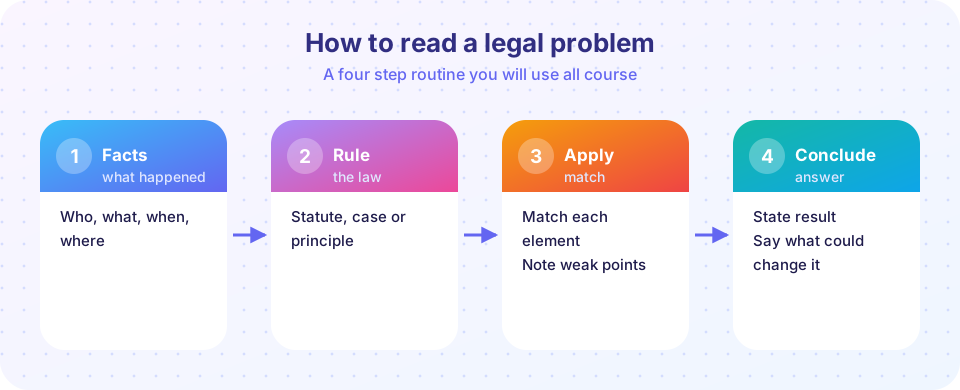
Almost every legal analysis, whether in an exam, a memo or a courtroom, follows the same four-step pattern, often remembered as IRAC (Issue, Rule, Application, Conclusion).
- Facts and issue. State the relevant facts and the question they raise.
- Rule. State the rule that governs, with its source.
- Application. Apply the rule to the facts, element by element. Mention the counter-arguments, because honest analysis shows where it could go either way.
- Conclusion. Give the likely answer and say what facts or arguments might change it.
Worked example using the made-up bicycle rule. Facts: Sam picks up a bike leaning against a fence, rides it to a party across town and leaves it unlocked in the street. Issue: did Sam commit bicycle taking? Rule: the five elements above. Application: Sam is a person, took a bike, it belonged to another and there was no consent. The hard part is intention: Sam did not keep it, but abandoning a bike in the street may show that Sam did not care whether the owner got it back. A court might well find that Sam treated it as his own. Conclusion: probably yes on these facts, but if Sam can show an intention to return it, element 5 may fail. Notice how the conclusion names its own weak point.
Common misconceptions
"Law is a list of facts to memorize." Law is a reasoning skill. Memory helps, but the ability to apply a rule to new facts is what matters.
"The answer must always be yes or no." Many legal questions are arguable. A good analysis says which way the better argument points and why.
"A summary of a case is as good as the case." Summaries leave things out. For important decisions, read the judgment itself.
Try it
The first demonstration is an element checker for the made-up bicycle rule. Change the facts at the top and see which element fails.
Press Run (or Ctrl + Enter) to see the console output here.
No output.
The second demonstration helps you write an IRAC answer by filling in a template.
Press Run (or Ctrl + Enter) to see the console output here.
No output.
Check your understanding
Quick check · 4 questions
of 4 answered You scored / 4 · perfect!
-
1. Which of these is a primary source of law?
Primary sources are the law itself, such as statutes, constitutions, regulations and court decisions. -
2. What is an element of a legal rule?
Rules are broken down into elements, and each element must be met on the facts. -
3. What is obiter dictum?
Obiter dicta are statements made in passing. They may persuade but do not bind later courts. -
4. In an IRAC answer, what should the conclusion include?
A good conclusion states the likely result and names facts or arguments that could change it.
Summary
- Read primary sources whenever accuracy matters, and check they are still current.
- Break a statute into elements and test the facts against each one.
- A case has facts, an issue, a holding and reasoning; only the reasoning needed for the decision is binding as the ratio.
- The standard routine is facts and issue, rule, application, conclusion.
- Honest legal analysis names the counter-argument and the weak point.
Track your progress
Create a free account to tick off lessons and pick up where you left off on any device.
of Introduction to Law lessons completed