


















Lesson 26 of 47 · Contracts
Breach of contract and remedies
What happens when a contract is broken: kinds of breach, expectation damages, remoteness in Hadley v Baxendale, mitigation and specific performance.
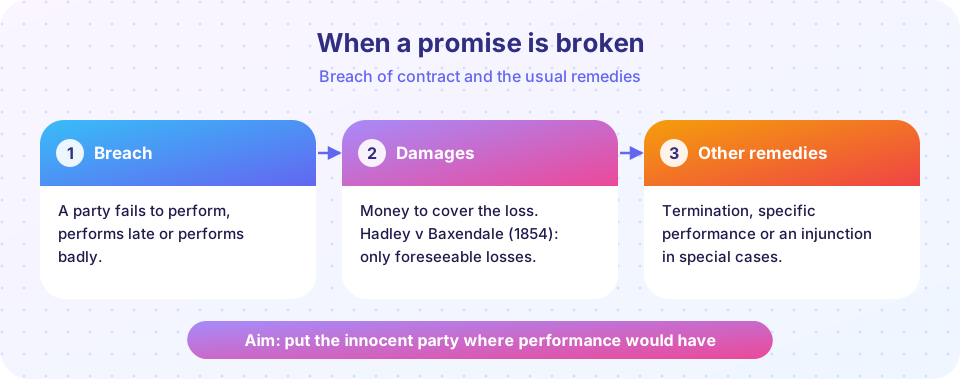
A promise is only as strong as what happens when it is broken. Contract law does not exist to punish people who break promises; its main aim is to put the innocent party, as far as money can, in the position they would have been in if the contract had been performed. This lesson follows a breach from start to finish: what counts as one, what the innocent party can do, and how courts calculate compensation.
Jurisdiction. England and Wales, with US comparisons where helpful. Educational information, not legal advice.
What you will learn
- The main kinds of breach, including anticipatory breach
- How expectation damages are calculated
- The limits: remoteness, mitigation and penalty clauses
- When a court orders performance instead of money, and when a contract ends without breach
Key terms
Breach: failure to perform a contractual obligation without lawful excuse. Damages: money awarded as compensation. Expectation loss: the value the innocent party expected to gain. Remoteness: how far removed a loss may be before it is not recoverable. Mitigation: the duty to take reasonable steps to reduce your loss.
What counts as a breach?
A party breaches a contract by failing to perform, performing late, performing defectively, or performing something different from what was promised. A breach can also come early. Anticipatory breach occurs when one party announces before the performance date that they will not perform. In Hochster v De La Tour (1853), a man engaged a courier for a European tour starting on 1 June, then told the courier in May that he no longer wanted him. The court allowed the courier to sue at once rather than wait until June.
The innocent party's choices depend on how serious the breach is. For breach of a condition, or a repudiatory breach, they may accept the breach, end the contract and claim damages. Or they may affirm the contract and carry on, still claiming damages for the loss. They must choose; staying silent and carrying on for a long time can be read as affirmation.
Expectation damages
The standard rule comes from Robinson v Harman (1848): the innocent party should be put in the position they would have been in had the contract been performed. This is the expectation measure.
Example (a simple invented case): a company agrees to supply 1,000 chairs at 40 pounds each. The buyer plans to resell them at 55 pounds each. The seller refuses to deliver, and the buyer cannot get replacements at the same price. The buyer's expected profit was 15 pounds a chair, so a court would aim at 15,000 pounds, less any costs saved. If a replacement can be bought at 45 pounds, the measure is the difference between contract price and market price, 5 pounds a chair, or 5,000 pounds.
Two alternatives exist. Reliance damages repay the money the innocent party spent preparing to perform, useful when profit is hard to prove. Restitution makes the defendant give back a benefit they should not keep.
Damages for non-financial harm are usually restricted. For example, damages for distress are generally available only when the contract's main purpose was to provide enjoyment or peace of mind, as in Jarvis v Swans Tours (1973), where a disappointing holiday led to damages for loss of enjoyment.
Limits on damages
Three rules prevent compensation from becoming unlimited.
Remoteness. The leading case is Hadley v Baxendale (1854). A mill's crankshaft broke. The mill owners gave it to a carrier to take to the engineers for copying, but delivery was delayed and the mill stayed idle. The court refused to award lost profits, because the carrier did not know that the mill had no spare shaft. Losses are recoverable only if they arise naturally from the breach, or were within the reasonable contemplation of both parties when they made the contract because of special facts one told the other. Later cases, such as Victoria Laundry v Newman Industries (1949) and The Achilleas (2008), refined the test.
Mitigation. The innocent party must take reasonable steps to reduce the loss; for example, by buying substitute goods or looking for another tenant. They cannot claim for losses they could have avoided. The expenses of mitigation are recoverable.
Causation. The loss must actually be caused by the breach.
Penalties and agreed damages
Parties sometimes write the amount of damages into the contract. A genuine pre-estimate of loss is enforceable. In Dunlop Pneumatic Tyre v New Garage (1915), a clause fixing damages was distinguished from a penalty. In Cavendish Square Holding v Makdessi (2015), the Supreme Court said the modern question is whether the clause is out of all proportion to a legitimate interest in performance.
Other remedies
Specific performance. The court orders the defendant to perform. It is discretionary and available where damages are inadequate, mainly for contracts about land or unique goods such as a rare painting. Courts will not order personal services, and they may refuse where it would require constant supervision (Co-operative Insurance v Argyll Stores (1998)).
Injunction. A court order to stop doing something, such as a negative covenant not to work for a competitor.
Rescission. Undoing the contract, usually for misrepresentation, so each side returns what it received.
When a contract ends without breach
Frustration applies when an event after the contract was made, for which neither party is to blame, makes performance impossible or radically different. In Taylor v Caldwell (1863), a music hall burned down before a booked series of concerts. The contract was discharged, and the Law Reform (Frustrated Contracts) Act 1943 in England governs the money. The doctrine is narrow: a contract that has merely become more expensive is not frustrated.
Common misconceptions
"If you break a contract, a court can make you perform." Usually only money damages. Specific performance is the exception.
"I can claim every loss I suffered." Only those not too remote, not avoidable by reasonable steps, and caused by the breach.
"Penalty clauses are always void." Only clauses that protect no legitimate interest or are out of all proportion are struck down; agreed damages clauses are common.
Try it
Press Run (or Ctrl + Enter) to see the result here.
Program input · what you'd type while the program runs
Type the answers before you press Run, one per line. Each time the program reads a line (with input()), it gets the next line from this box.
Check your understanding
Quick check · 6 questions
of 6 answered You scored / 6 · perfect!
-
1. What does the expectation measure of damages aim to do?
Robinson v Harman: compensate for the loss of the bargain. -
2. In Hadley v Baxendale, why were lost profits refused?
The carrier did not know the mill had no spare crankshaft, so the loss was too remote. -
3. Hochster v De La Tour is a leading case on:
The courier could sue as soon as the employer announced he would not perform. -
4. Specific performance is most likely for:
Land is regarded as unique, so damages are inadequate. -
5. The duty to mitigate means:
You cannot recover for losses you could reasonably have avoided. -
6. Taylor v Caldwell (1863) established:
A music hall burned down, and the contract was discharged.
Summary
- A breach is any unjustified failure to perform, including early repudiation.
- Damages usually compensate the loss of the bargain (expectation).
- Remoteness, mitigation and causation limit recovery.
- Specific performance and injunctions are special, discretionary remedies.
- Frustration can end a contract without any breach.
Next: Chapter 5 review
Track your progress
Create a free account to tick off lessons and pick up where you left off on any device.
of Introduction to Law lessons completed