


















Lesson 17 of 47 · Constitutional and Public Law
Chapter 4 overview: constitutional and public law
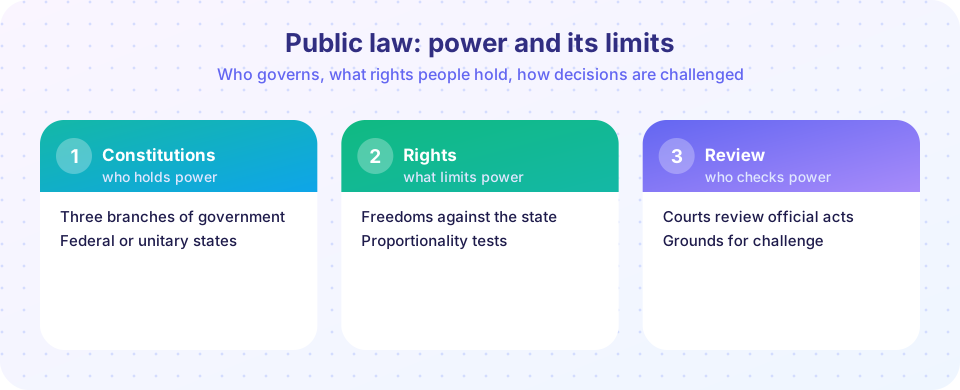
A preview of chapter 4: how constitutions organize power, how states are structured, how human rights limit government and how courts review official decisions.
Every state has power: to tax, to arrest, to regulate, to wage war. Public law asks how that power is organized and restrained. Constitutional law sets up the main institutions and says who may do what. Human rights law protects individuals from abuse. Administrative law governs the everyday decisions of ministries, agencies and local officials, and lets people challenge them in court. These areas touch your life constantly, from passport offices to police powers, and they decide whether a society lives under the rule of law.
What you will learn
- The three big questions of public law.
- How the four lessons of this chapter fit together.
- Why public law is about balance, not just restriction.
The big picture
Think of a government as a powerful machine. Public law adds three kinds of control.
- Share the power. A constitution divides authority among bodies: a legislature that makes laws, an executive that carries them out, courts that decide disputes. States are also structured territorially: some concentrate power in the center (unitary), others share it with regions (federal).
- Limit the power. Even a legitimate government may not do anything it likes. Constitutions and treaties protect rights such as liberty, fair treatment, expression and privacy, and require that limits on those rights be justified.
- Review the power. Officials make millions of decisions. Courts and other bodies can check whether those decisions were lawful, reasonable and fair.
Share power
Limit power
Review power
The four lessons
- Constitutions and the separation of powers: what constitutions do, how branches check each other, and examples from several countries.
- Federalism and the structure of states: unitary, federal and confederal models, and the relationship between national and international law.
- Human rights and proportionality: sources of human rights, absolute and qualified rights, and the proportionality test.
- Administrative law and judicial review: how courts check official decisions, with the classic grounds of review.
- Chapter 4 review: recap and a longer quiz.
How to use this chapter
Read the lessons in order. The constitutional lesson gives you the vocabulary of branches and checks. The lesson on federalism extends it across territory and borders. The rights lesson introduces the proportionality test, which you can practice on any news story about a law that restricts a freedom. The administrative law lesson shows how those ideas turn into everyday remedies. Where possible, connect each idea to a real example from the country where you live, and remember to name the system whenever you state a rule.
A caution about politics
Public law is closely connected to politics, and many of its questions are contested: how much power the executive should have in an emergency, whether judges should strike down laws passed by elected legislatures, which rights deserve constitutional protection. This course describes the main positions and the arguments for them, and it uses real examples from several countries, but it does not try to tell you what to think. Where scholars and citizens disagree, we say so.
Try it
First, a quick profile builder: enter a few facts about a fictional country and it summarizes its constitutional structure. Change the values to see different combinations.
Press Run (or Ctrl + Enter) to see the console output here.
No output.
Second, an interactive power diagram: click a branch to see its main job and one example check on the others.
Check your understanding
Quick check · 3 questions
of 3 answered You scored / 3 · perfect!
-
1. What are the three kinds of control public law adds to government power?
Public law shares power among institutions, limits it through rights and reviews it through courts. -
2. Which area of law governs everyday decisions of agencies and ministries?
Administrative law deals with how public bodies decide and how those decisions can be challenged. -
3. Why does this course describe several positions on contested public law questions?
The aim is balanced understanding, not telling you what to think.
Summary
- Public law shares, limits and reviews state power.
- Constitutions organize institutions; human rights law protects individuals; administrative law governs official decisions.
- Many public law questions are contested, and this course presents the main positions.
Track your progress
Create a free account to tick off lessons and pick up where you left off on any device.
of Introduction to Law lessons completed