


















Lesson 19 of 47 · Constitutional and Public Law
Federalism and the structure of states
How states are organized: unitary, federal and confederal models, how powers are divided, devolution, and how national law relates to international and EU law.
A constitution divides power horizontally (legislature, executive, judiciary) but also vertically: between the national government and regions, provinces, states or cities. This vertical question is as important as the horizontal one. Who may pass laws about schools, police, taxes or the environment: the capital or the regions? And what happens when national law meets international commitments? This lesson maps the main models.
What you will learn
- The differences between unitary, federal and confederal states.
- How federal constitutions divide powers and resolve conflicts.
- What devolution and subsidiarity mean.
- How national law relates to international law and regional bodies such as the EU.
Key terms
Unitary state: a state in which the central government holds ultimate legal authority and may delegate power to local bodies.
Federation: a state in which the constitution divides power between a national government and regional governments, each with its own sphere.
Devolution: the transfer of powers from a central government to regional bodies, without changing the unitary structure formally.
Subsidiarity: the principle that decisions should be made at the lowest level capable of making them effectively.
Monism and dualism: two views of how international law relates to national law.
Unitary states
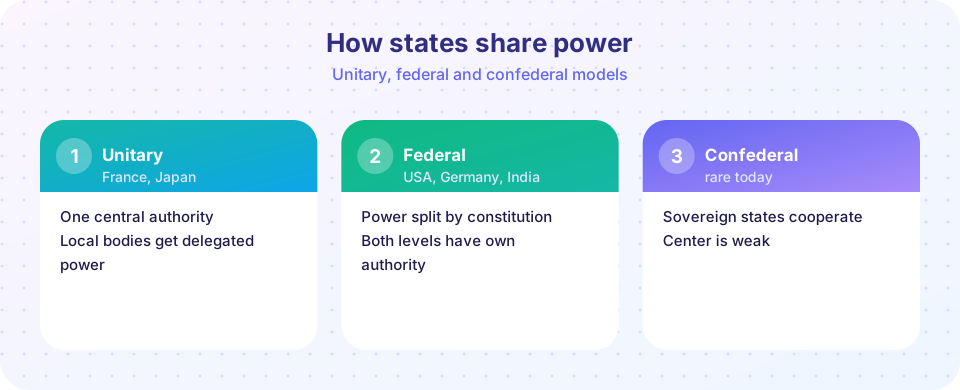
In a unitary state, such as France, Japan or Italy, there is one source of legislative authority. Regions and municipalities exist and may have significant powers, but those powers come from national laws that the national legislature can change. France has regions and departments, but their roles are defined by statute.
Unitary does not mean uniform. The United Kingdom is a unitary state in which Parliament remains sovereign, yet it has devolved much power to the Scottish Parliament, the Senedd (Welsh Parliament) and the Northern Ireland Assembly, beginning with legislation in 1998. In theory Parliament could take those powers back; in practice, political conventions make that very difficult. Spain's constitution creates "autonomous communities" with broad powers, a model sometimes described as a "quasi-federal" arrangement.
Federations
In a federation, the constitution itself divides authority, and neither level can unilaterally abolish the other's powers. Well-known federations include the United States, Germany, Canada, Australia, India, Switzerland, Brazil, Mexico and Nigeria, each with different structures.
How are powers divided? Constitutions use several techniques:
- Lists of exclusive powers. Canada's Constitution Act 1867 lists federal powers (section 91) and provincial powers (section 92). Some matters go to the center, such as defense and currency, others to the provinces, such as property and civil rights and, in most respects, education.
- Concurrent powers. Both levels may legislate, with the national law prevailing if there is a conflict, as in Germany for many fields.
- Residual powers. The constitution says who holds powers not listed. In the United States, the Tenth Amendment reserves powers not delegated to the federal government to the states or the people. In India the residual power belongs to the Union (center); in Canada, to the federal Parliament.
- Supremacy clauses. The US Constitution's Supremacy Clause (Article VI) makes valid federal law the supreme law of the land, so state law that conflicts with it is invalid.
A constitutional court or supreme court usually acts as the referee in disputes between levels. In Germany the Federal Constitutional Court and in the United States the Supreme Court hear such cases. Many federations also give regions a voice at the center through a second chamber: the US Senate gives each state two senators, and the German Bundesrat represents state governments.
Reasons for choosing federalism include size and diversity (Canada, India), a wish to keep power closer to people, protection for linguistic or ethnic groups (Switzerland, Belgium) and the historical union of previously separate states (the United States, Australia). Critics point to complexity, duplication and inequalities between regions; supporters say it allows local experiments and checks central power.
Confederations
A confederation is an association of sovereign states that delegate limited tasks to a common body, which usually cannot act directly on individuals. The Articles of Confederation (1781 to 1789) in the early United States were an example, and the weakness of the center helped lead to the 1787 Constitution. Pure confederations are rare today; some describe the European Union as unique, with confederal and federal features, but it is generally treated as its own category.
Local government and subsidiarity
Even in unitary states, local councils run schools, planning, waste and many other services. In many constitutions, the principle of subsidiarity guides who should decide: matters best handled locally should be. The European Union incorporated it in the Maastricht Treaty (1992): in areas where the EU does not have exclusive competence, it should act only if the objectives cannot be sufficiently achieved by member states.
National law and international law
States are also members of an international system. Public international law governs relations among states, and its main sources are treaties, customary international law and general principles. A state is generally described, in a classic definition from the Montevideo Convention (1933), by a permanent population, a defined territory, a government and capacity to enter relations with other states.
How does international law enter domestic law?
- Monist systems treat international law and national law as one legal order: a ratified treaty can be applied directly by courts. Many civil law countries are monist to a degree.
- Dualist systems treat them as separate: a treaty must be turned into national law by legislation before courts apply it. The United Kingdom and many Commonwealth countries follow this approach.
Regional organizations add another layer. In the European Union, the Court of Justice held in Costa v ENEL (1964) that EU law takes priority over conflicting national law within its field. Many national constitutional courts accept this with qualifications, reserving the right to review in extreme cases. Human rights treaties, such as the European Convention on Human Rights (1950), create supervisory courts that can hold states accountable.
The United Nations Charter (1945) is the founding treaty of the modern international order. It prohibits the threat or use of force against other states, with exceptions for self-defense and Security Council authorization, and it creates bodies such as the International Court of Justice. International law's enforcement is weaker than domestic law's, because there is no world police or compulsory jurisdiction over most disputes, yet states follow most of it most of the time for reasons of reciprocity, reputation and interest.
Common misconceptions
"Federal means big, unitary means small." Size is not the test. Some large countries (China, France) are unitary, and some small ones (Switzerland) are federal.
"Devolution makes a country federal." Not necessarily. The UK's devolved bodies exist by statute that Parliament could in theory change.
"International law is not real law." It has recognized sources and bodies, but its enforcement works differently, relying more on states' consent and diplomacy.
"EU law replaces national law." EU law has priority within the areas where the EU has competence; elsewhere national law governs.
Try it
First, a power-allocation tester for a fictional federation. Enter a subject and see which level may legislate. Change the lists to explore different arrangements.
Press Run (or Ctrl + Enter) to see the console output here.
No output.
Second, a monist or dualist switch that shows how a ratified treaty reaches national courts.
Check your understanding
Quick check · 5 questions
of 5 answered You scored / 5 · perfect!
-
1. What distinguishes a federation from a unitary state?
In a federation neither level can unilaterally take away the other's constitutional powers. -
2. What does the Supremacy Clause of the US Constitution say?
Conflicting state law gives way to valid federal law. -
3. What is devolution in the UK?
Devolution is a transfer of powers within a unitary state, which Parliament formally could reverse. -
4. Which approach requires a treaty to be turned into national law by legislation?
Dualist systems treat international law and national law as separate orders. -
5. What did Costa v ENEL (1964) decide?
The Court of Justice established the primacy of EU law.
Summary
- Unitary states centralize ultimate authority; federations divide it by constitution; confederations rest on sovereign states.
- Federal constitutions use lists, concurrent and residual powers, supremacy clauses and a referee court.
- Devolution and subsidiarity shift decisions closer to people without necessarily creating a federation.
- Monist and dualist systems treat international law differently; regional bodies such as the EU add a further layer.
Track your progress
Create a free account to tick off lessons and pick up where you left off on any device.
of Introduction to Law lessons completed