


















Lesson 30 of 47 · Torts and Criminal Law
Other torts: nuisance, trespass, defamation and defences
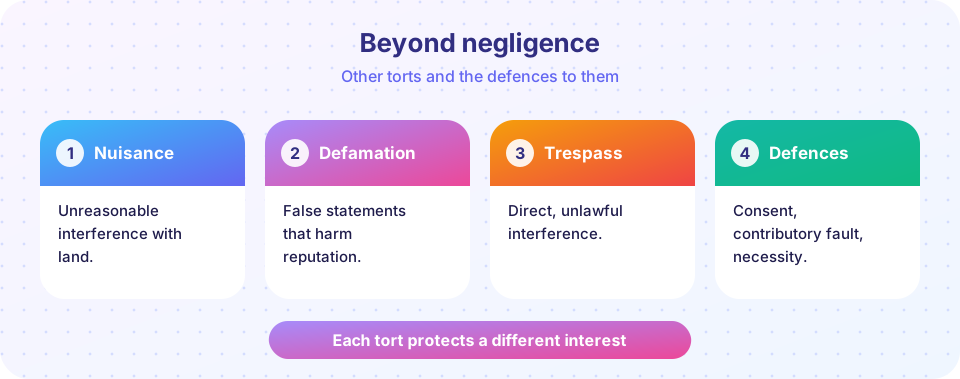
Beyond negligence: private nuisance, Rylands v Fletcher, trespass, defamation and the main defences such as consent, necessity and honest opinion.
Negligence protects you from careless harm. But the law of torts protects other interests too: your right to enjoy your home in peace, to keep strangers off your land, to control who touches your body, and to keep your good name. Each of these has its own tort with its own rules. This lesson tours the most important ones and the defences that can defeat a claim.
Jurisdiction. England and Wales, with a few US comparisons. Educational information, not legal advice. Defamation law varies a great deal between countries.
What you will learn
- What private nuisance protects and how courts balance neighbors' interests
- The rule in Rylands v Fletcher
- Trespass to land, goods and the person
- How defamation balances reputation and free speech
- Core defences: consent, necessity, self-defence, truth and honest opinion
Key terms
Nuisance: unreasonable interference with another person's use or enjoyment of land. Trespass: direct, unjustified interference with a person, goods or land. Defamation: a false statement that harms someone's reputation. Libel / slander: defamation in permanent form / in spoken or transient form. Defence: a reason why a defendant is not liable even though the tort elements are present.
Private nuisance
Private nuisance protects your use and enjoyment of land. Typical examples are noise, smells, smoke, vibrations or encroaching tree roots. It is not enough that you are annoyed. The interference must be unreasonable, and courts weigh several factors.
- Locality. In Sturges v Bridgman (1879), a confectioner's noisy machinery had run for years without complaint until a doctor built a consulting room next door. The court famously said that what is a nuisance in one area may not be in another, but it still found the noise a nuisance to the doctor, because the confectioner had not gained a right to make it. In St Helen's Smelting Co v Tipping (1865), the court distinguished physical damage to property (not excused by the locality) from mere discomfort (where locality matters).
- Duration and frequency. A one-off noise is less likely to count than constant noise.
- Sensitivity. The claimant cannot rely on unusual sensitivity.
- Malice. Acting out of spite weighs against the defendant.
The claimant must usually have a right in the land (an owner or tenant, not a visitor), as confirmed in Hunter v Canary Wharf (1997). Remedies are damages and, often more usefully, an injunction to stop the nuisance. In Coventry v Lawrence (2014), the Supreme Court took a more flexible approach, treating damages instead of an injunction as an option where the public interest or the balance of harm supports it.
Rylands v Fletcher
In Rylands v Fletcher (1868), a mill owner built a reservoir on his land. Water burst through old mine shafts and flooded a neighbor's mine. The House of Lords held the owner liable even though he had not been careless. The rule: someone who brings onto their land and keeps there something likely to do mischief if it escapes is liable for the damage if it does. Modern English law keeps the rule narrow, requiring a non-natural use of land and foreseeable damage of the relevant kind (Cambridge Water v Eastern Counties Leather, 1994).
Trespass
Trespass to land is the unjustified intrusion on someone's land. It is actionable without proof of damage. In Entick v Carrington (1765), government officers searched a man's house without lawful authority and were held liable; the case is a cornerstone of the rule that officials need legal authority to enter private property. Trespass to the person includes battery (unwanted physical contact), assault (making someone fear imminent contact) and false imprisonment. Ordinary touching in everyday life, such as tapping a shoulder, is impliedly consented to (Wilson v Pringle, 1987). Trespass to goods covers interference with someone else's property, such as taking or damaging it.
Defamation
Defamation protects reputation. A statement is defamatory if it lowers the claimant in the estimation of right-thinking people generally. In England, a claimant must show the statement has caused, or is likely to cause, serious harm to their reputation (Defamation Act 2013, section 1), and the statement must be published to a third party and refer to the claimant.
The main defences under the 2013 Act are truth (the statement is substantially true), honest opinion, and publication on a matter of public interest, and there is also a defence for operators of websites. The burden is on the defendant to prove truth, unlike in the US, where in New York Times v Sullivan (1964), the Supreme Court held that a public official suing about a statement concerning official conduct must show "actual malice": knowledge of falsity or reckless disregard for the truth. Different balances between protecting reputation and protecting speech lead to very different law.
General defences in tort
- Consent (volenti). A person who freely agrees to the risk of harm cannot generally sue for it. Consent must be informed and genuine, which is why a boxer in a fight cannot sue over legal punches but can over illegal ones.
- Necessity. Acting to avoid greater harm can justify what would otherwise be a tort, such as a surgeon operating on an unconscious patient to save their life.
- Self-defence and defence of others. Reasonable and proportionate force may be used.
- Contributory negligence. In negligence, the claimant's own fault reduces damages.
- Illegality. Courts may refuse a claim that arises directly from the claimant's own serious wrongdoing.
- Limitation. Claims must be brought within a set period, usually six years for most torts and three years for personal injury in England, and one year for defamation under the 2013 Act.
Common misconceptions
"Any noise from a neighbor is a nuisance." Only unreasonable interference counts, judged by locality, duration and sensitivity.
"Trespass needs damage." Trespass to land is actionable without proof of harm.
"A statement I think is false is defamatory." It must be false (or unproven by the defendant), published, refer to the claimant and cause serious harm.
Try it
Press Run (or Ctrl + Enter) to see the console output here.
No output.
Check your understanding
Quick check · 5 questions
of 5 answered You scored / 5 · perfect!
-
1. Private nuisance protects:
It addresses unreasonable interference with land. -
2. In Rylands v Fletcher, the defendant was liable although he was not careless because:
The rule imposes liability for escape of something likely to do mischief, kept in a non-natural use. -
3. Trespass to land requires:
It is actionable per se. -
4. Under the Defamation Act 2013 a claimant must show:
Section 1 requires serious harm or likely serious harm. -
5. New York Times v Sullivan (1964) concerns:
A public official must prove knowledge of falsity or reckless disregard.
Summary
- Nuisance protects enjoyment of land and turns on reasonableness.
- Rylands v Fletcher is a narrow rule about the escape of dangerous things.
- Trespass is direct interference and needs no proof of damage (for land).
- Defamation balances reputation against free speech, differently in different countries.
- Defences include consent, necessity, truth, honest opinion and limitation.
Next: Criminal law basics
Track your progress
Create a free account to tick off lessons and pick up where you left off on any device.
of Introduction to Law lessons completed