


















Lesson 24 of 47 · Contracts
Formation: offer, acceptance and consideration
How a contract is formed under English common law: offer, acceptance, consideration, intention and capacity, with Carlill, Hyde v Wrench and more.
A contract is not created by good feelings. It is created by a specific set of events that the law can recognize. In this lesson you will follow the steps a court looks for: an offer, an acceptance, consideration, an intention to create legal relations, and capacity. The cases below are all real, and each one is still taught because it answers a question people keep asking.
Jurisdiction. This lesson describes the common law of England and Wales, with a few US comparisons. Educational information only, not legal advice.
What you will learn
- The difference between an offer and an invitation to treat
- How acceptance works, including counter-offers and the postal rule
- What counts as consideration, and what does not
- How intention and capacity complete the picture
Key terms
Offeror / offeree: the person who makes the offer / the person who receives it. Invitation to treat: an invitation to make offers, not an offer itself. Counter-offer: a reply that changes the terms; it rejects the original offer. Consideration: the price paid for a promise. Capacity: legal ability to make a contract.
Step 1: The offer
An offer is a clear statement that someone is willing to be bound on certain terms if the other person simply says yes. The test is objective. Courts do not ask what the speaker secretly felt; they ask what a reasonable person would have understood.
The key distinction is between an offer and an invitation to treat. A shop window with price tags, a menu or a catalogue is usually an invitation to treat. In Pharmaceutical Society of Great Britain v Boots Cash Chemists (1953), the court held that goods on a self-service shelf were not offers. The customer makes the offer at the till, and the shop accepts by ringing up the sale. In Fisher v Bell (1961), a flick knife in a shop window was an invitation to treat, so the shopkeeper had not "offered for sale" it under the criminal statute then in force.
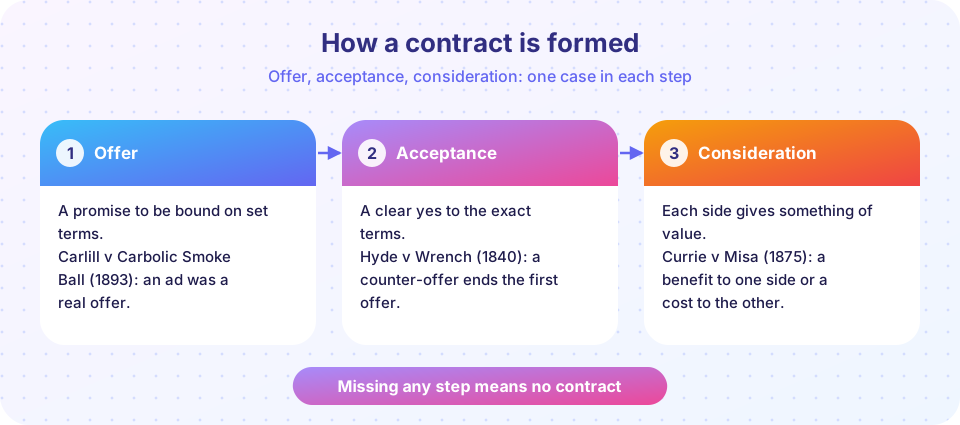
An advertisement can still be an offer. In Carlill v Carbolic Smoke Ball Co (1893), a company promised 100 pounds to anyone who used its smoke ball as directed and still caught influenza. It said it had deposited 1,000 pounds at a bank to show sincerity. Mrs Carlill used the ball, caught flu and sued. The Court of Appeal held that the advertisement was a unilateral offer to the whole world, accepted by anyone who performed the conditions. The bank deposit showed that the company meant it.
Step 2: The acceptance
Acceptance must be a clear, unqualified agreement to the terms. Two rules matter most.
The mirror image rule. The acceptance must match the offer. If the offeree adds or changes a term, that is a counter-offer, and it kills the original offer. In Hyde v Wrench (1840), Wrench offered his farm for 1,200 pounds. Hyde replied offering 1,000 pounds. Wrench refused. Hyde then said he would pay 1,200 pounds, but the court held that his earlier counter-offer had ended the original offer, so there was nothing left to accept.
Communication. Normally acceptance must reach the offeror. Entores v Miles Far East Corp (1955) applied this to instant communications such as telex. The main exception is the postal rule, from Adams v Lindsell (1818): a letter of acceptance is effective when posted, not when received. Modern courts apply it narrowly, and parties can exclude it. Silence is not acceptance: you cannot be bound by a notice saying "if I hear nothing, you have agreed."
Step 3: Consideration
English law does not enforce bare promises. Each party must give something. In Currie v Misa (1875), consideration was described as some right, interest, profit or benefit to one party, or some forbearance, detriment, loss or responsibility given or suffered by the other. In practice, think of it as the price of the promise.
Four rules help:
- It must be sufficient but need not be adequate. The courts do not weigh whether you got a good deal. Selling a car for one pound can be a contract if the pound is actually paid. In Chappell v Nestlé (1960), chocolate wrappers were valid consideration even though they were thrown away.
- It must not be past. A promise made after the act is not supported by that act. In Re McArdle (1951), a promise to repay a family member for home improvements already finished was not supported by consideration.
- Performing an existing duty is usually not enough. In Stilk v Myrick (1809), sailors promised extra pay for sailing a short-handed ship home had already agreed to do their job. But in Williams v Roffey Bros (1991), the Court of Appeal accepted that a practical benefit, such as avoiding a delay penalty, could be enough when no pressure was used.
- It must move from the promisee. The person who wants to enforce the promise must have given the value. The related rule of privity says only parties to a contract can sue on it, with exceptions such as the Contracts (Rights of Third Parties) Act 1999.
Other systems differ. Many civil-law codes enforce serious promises without requiring consideration, and US courts have extended enforcement through promissory estoppel when someone reasonably relied on a promise.
Step 4: Intention to create legal relations
Even if there is an offer, acceptance and consideration, the parties must have intended to be legally bound. Courts apply presumptions. Social and domestic agreements are presumed not to be legally binding: in Balfour v Balfour (1919), a husband's promise to send his wife a monthly allowance while she was abroad was held to be a family arrangement. Commercial agreements are presumed to be binding. Both presumptions can be rebutted. A phrase like "binding in honor only" can show that no legal effect was intended. In Merritt v Merritt (1970), the presumption was rebutted for a separated couple who had signed a written agreement.
Step 5: Capacity
Most adults have capacity. Special rules protect minors: in England, contracts with people under 18 are generally voidable by the minor, apart from contracts for necessaries and some beneficial contracts of service. People who lack mental capacity are protected by statute, and companies can contract only through their directors and according to their constitutions.
Common misconceptions
"A contract must be in writing." Not in general. Most contracts can be spoken or inferred from conduct. Writing is required only for specific types, such as contracts for the sale of land in England.
"Silence means yes." It does not. An offeror cannot impose acceptance by silence.
"The price must be fair." Consideration must be sufficient, not adequate. Courts do not usually rewrite bad bargains.
Try it
Press Run (or Ctrl + Enter) to see the console output here.
No output.
Check your understanding
Quick check · 5 questions
of 5 answered You scored / 5 · perfect!
-
1. In Boots (1953), where was the offer made?
The shelf display was an invitation to treat. The customer's presentation of goods at the till was the offer. -
2. Hyde offered 1,000 pounds for Wrench's farm after Wrench had asked 1,200. What was the legal effect?
In Hyde v Wrench the court treated the lower figure as a counter-offer, which rejected the original offer. -
3. Which statement about consideration is correct?
Courts check that something of value was given, not that the bargain was a good one. -
4. Domestic agreements, such as in Balfour v Balfour, are generally presumed to be:
The presumption can be rebutted, as in Merritt v Merritt. -
5. Which is the usual position on silence?
An offeror cannot force acceptance by silence.
Summary
- An offer shows willingness to be bound; shop displays are usually invitations to treat.
- Acceptance must mirror the offer; a counter-offer ends it.
- Consideration is the price of a promise: sufficient, not necessarily adequate, and not past.
- Intention is presumed in business and absent in family settings.
- Minors and others with limited capacity have special protection.
Next: Terms and defects
Track your progress
Create a free account to tick off lessons and pick up where you left off on any device.
of Introduction to Law lessons completed