


















Lesson 37 of 47 · Property, Family and Employment Law
Chapter 7 review: Property, family and employment
Review property, family and employment law with a one-page picture, a recap table, a worked scenario and a ten-question mixed quiz.
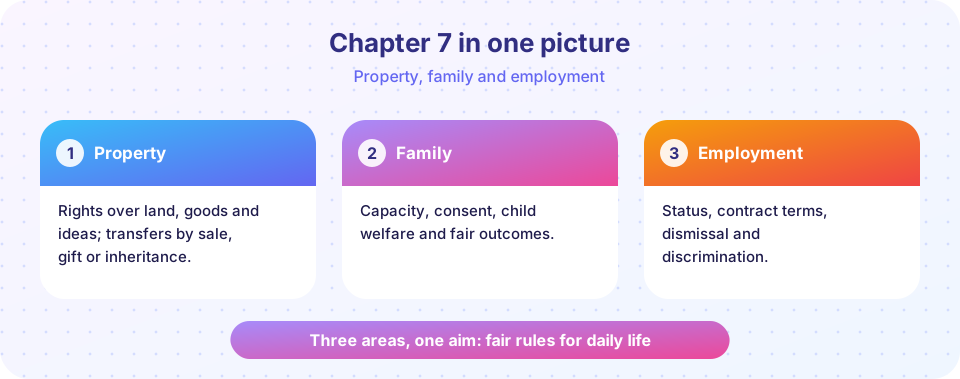
This chapter covered three areas of law that shape everyday life. Before you move to legal reasoning, check that you can explain the main ideas of each, and that you can spot which area a real situation belongs to.
What you will learn
- A summary of the key ideas in each area
- How to apply them to one mixed scenario
Recap table
| Area | Key ideas | Examples from the lessons |
|---|---|---|
| Property | Bundle of rights; land, goods, ideas; freehold and leasehold; registration; inheritance | Armory v Delamirie, Parker v British Airways Board, Wills Act 1837 |
| Family | Capacity and consent; parental responsibility; welfare principle; no-fault divorce; financial remedies | Children Act 1989, Divorce, Dissolution and Separation Act 2020, White v White |
| Employment | Status tests; contract terms; unfair dismissal; discrimination | Ready Mixed Concrete, Uber v Aslam, Equality Act 2010 |
A worked scenario
Dana rents a flat on a 12-month lease. She works as a delivery rider through an app, which sets her prices and rates her performance. She is expecting a baby with her partner Eli, whom she has lived with for three years but never married.
Property. Dana is a tenant: she has the right to occupy for the term, to exclude others including the landlord (except as the lease allows) but not to sell the flat. She does not own it.
Employment. The app is not just a platform if it controls pricing and conditions. By analogy with Uber v Aslam, a court could treat Dana as a worker, with minimum pay and holiday rights, although the answer depends on the facts. The label "self-employed" in the app's terms is not decisive.
Family. Dana and Eli are not married, so there is no "common law marriage". Dana will automatically have parental responsibility for the baby. Eli will have it if he is registered on the birth certificate. In any dispute about the child, the child's welfare is the paramount consideration.
Notice that one person's life touches all three areas at once. Break the facts into questions, and answer each separately.
Try it
Press Run (or Ctrl + Enter) to see the console output here.
No output.
Check your understanding
Quick check · 10 questions
of 10 answered You scored / 10 · perfect!
-
1. Ownership is best described as:
Use, exclude, transfer, and more. -
2. A freehold lasts:
Fee simple absolute is not limited in time. -
3. Which statement about copyright is correct?
It arises automatically for original works. -
4. In England and Wales, a mother's parental responsibility arises:
Children Act 1989. -
5. No-fault divorce was introduced by:
In force since April 2022. -
6. Which tool decides if someone is an employee?
Courts look at control, integration and substitution. -
7. Employment at will is typical of:
With statutory exceptions. -
8. A neutral rule that disproportionately affects a protected group may be:
Unless it can be justified. -
9. In a child dispute the court's paramount consideration is:
Welfare principle. -
10. Is there common-law marriage in England and Wales?
Cohabitation does not create marital rights.
Summary
- Property, family and employment law each protect a different part of daily life.
- Facts decide which area, and often more than one, applies.
- Always name the jurisdiction.
Track your progress
Create a free account to tick off lessons and pick up where you left off on any device.
of Introduction to Law lessons completed