


















Lesson 33 of 47 · Property, Family and Employment Law
Chapter 7 overview: Property, family and work
A tour of three areas of law that touch everyday life: who owns what, how families are recognized and ended, and the rights of people at work.
Most people never go to court over a contract or a crime, but nearly everyone meets property law, family law and employment law. You live somewhere, you may form or end a relationship, and you probably work or will work for someone. These three areas turn those everyday facts into rights and duties. They are also areas where countries differ most, because they reflect local values about ownership, family and work.
Which legal system? This chapter mainly describes England and Wales and mentions the US and other systems for comparison. Rules change often, especially in family and employment law, so treat this as educational information, not legal advice. Always check current law and your own country's rules.
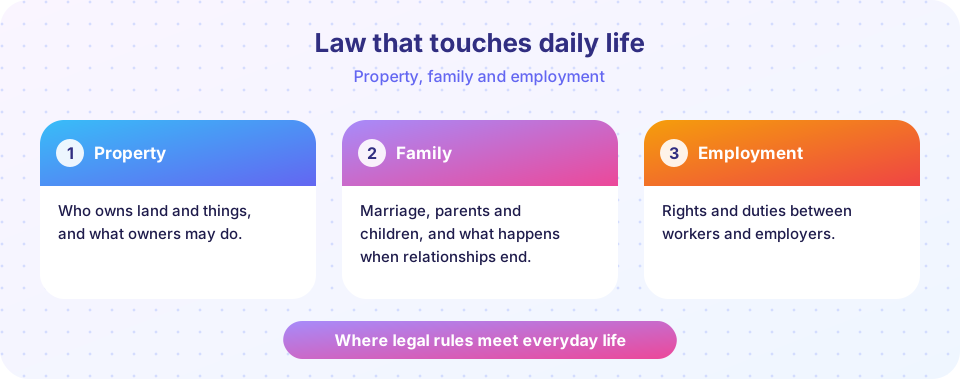
What you will learn
- What each of the three areas protects
- Why these areas vary between countries
- What each lesson in this chapter covers
Key terms
Property: a bundle of rights over a thing, such as land, goods or an idea. Family law: rules about marriage, parenthood, children and the end of relationships. Employment law: rules about the relationship between employer and worker. Statute: a law passed by a legislature such as Parliament.
Property: who owns what
Property law answers questions like: Who owns this land? What can the owner do with it? How is ownership transferred? Law divides property into land (real property), goods (personal property) and intangible property such as ideas protected by copyright. Ownership is better pictured as a bundle of rights, including the right to use, to exclude others and to transfer. Disputes are usually about boundaries, leases, mortgages and inheritance.
Family: relationships and children
Family law deals with who may marry, who is a legal parent, how children are protected and what happens when a relationship ends. In many countries, the guiding idea in decisions about children is the child's welfare. Family law is also an area where religion and culture influence legal systems, so some countries have separate rules for different communities.
Employment: rights at work
Employment law protects people at work and gives employers a framework for managing staff. It covers pay, working time, safety, discrimination, notice and dismissal. A basic question is whether someone is an employee, a worker or an independent contractor, because that decides which rights apply.
A map of this chapter
- Property law basics: land, goods, ideas, transfers and inheritance.
- Family law basics: marriage, parenthood, children's welfare and divorce.
- Employment law basics: status, contracts, dismissal and discrimination.
- Chapter review: recap and a ten-question quiz.
Try it
Press Run (or Ctrl + Enter) to see the console output here.
No output.
Check your understanding
Quick check · 4 questions
of 4 answered You scored / 4 · perfect!
-
1. Property law is best described as:
Ownership gives rights to use, exclude and transfer. -
2. In decisions about children, the guiding idea in many countries is:
Welfare or best interests of the child. -
3. Why does employment status matter?
Employees, workers and contractors have different rights. -
4. Which is intangible property?
Copyright protects ideas in a fixed form.
Summary
- Property, family and employment law shape daily life.
- They vary widely between countries.
- Each lesson in this chapter takes one area in turn.
Next: Property law basics
Track your progress
Create a free account to tick off lessons and pick up where you left off on any device.
of Introduction to Law lessons completed