


















Lesson 18 of 47 · Constitutional and Public Law
Constitutions and the separation of powers
What constitutions do, how written and uncodified constitutions differ, how the separation of powers and checks and balances work, and how presidential and parliamentary systems compare.
A constitution is the law about law-making: it says who may make laws, who may enforce them, who may judge disputes and what none of them may do. Nearly every country has one, although the forms differ a great deal. In this lesson you will learn what constitutions are for, how power is divided among branches and how different systems arrange the relationship between the legislature and the executive.
What you will learn
- The three functions of a constitution: constituting, limiting and expressing values.
- The difference between written and uncodified constitutions, and rigid and flexible ones.
- The theory of the separation of powers and checks and balances.
- How presidential, parliamentary and semi-presidential systems differ.
Key terms
Constitution: the fundamental rules that establish the institutions of the state, distribute power and often protect rights.
Separation of powers: dividing government into branches with different functions, so that power is not concentrated in one body.
Checks and balances: powers that let each branch restrain the others.
Constitutional supremacy: the principle that the constitution prevails over ordinary laws.
Judicial review: the power of courts to decide whether laws or acts of government comply with the constitution or other higher law.
What constitutions do
A constitution usually does three things.
- Constitutes the state. It creates the institutions (a parliament, a president, a supreme court), says how their members are chosen and what powers they have.
- Limits power. It sets boundaries, typically through a bill of rights, rules about the division of powers and procedures that must be followed.
- Expresses identity and values. Preambles and principles often state a country's aims: dignity, equality, democracy, a particular religion or secularism.
Some constitutions are short, such as the Constitution of the United States (1787), which has seven articles and 27 amendments. Others are very long, for instance the Constitution of India (1950), which is among the longest national constitutions in the world. The Constitution of South Africa (1996), adopted after the end of apartheid, includes a detailed bill of rights and was drafted through a long and public process.
Written and uncodified constitutions
Most countries have a codified constitution, a single document of special status. A few, including the United Kingdom, New Zealand and Israel, have constitutional rules scattered across statutes, court decisions and conventions (unwritten practices that officials follow). The UK's constitution includes statutes such as the Human Rights Act 1998 and the Parliament Acts, common law principles and conventions such as the rule that the monarch acts on ministerial advice.
Constitutions are also classed by how hard they are to change.
- Rigid constitutions need a special procedure for amendment, such as a supermajority, approval by regional governments or a referendum. In the United States, an amendment needs a two-thirds vote in both houses of Congress and ratification by three-quarters of the states. In Germany, amendments need two-thirds of both houses, and the Basic Law contains an "eternity clause" (Article 79(3)) that forbids amendments abolishing the basic principles of human dignity or the federal and democratic order.
- Flexible constitutions can be changed by ordinary legislation. The United Kingdom's is the standard example.
Rigidity gives stability and protects minorities from sudden majorities, but it can make adaptation difficult. Flexibility allows change but offers less protection.
The separation of powers
The idea that government should be divided goes back to ancient writers, but the classic modern statement is by the French thinker Montesquieu in The Spirit of the Laws (1748), drawing on his reading of English government. He argued that liberty is endangered when legislative, executive and judicial power are united in the same person or body. The framers of the United States Constitution, writing in the 1780s, adopted the idea, and James Madison defended it in The Federalist papers.
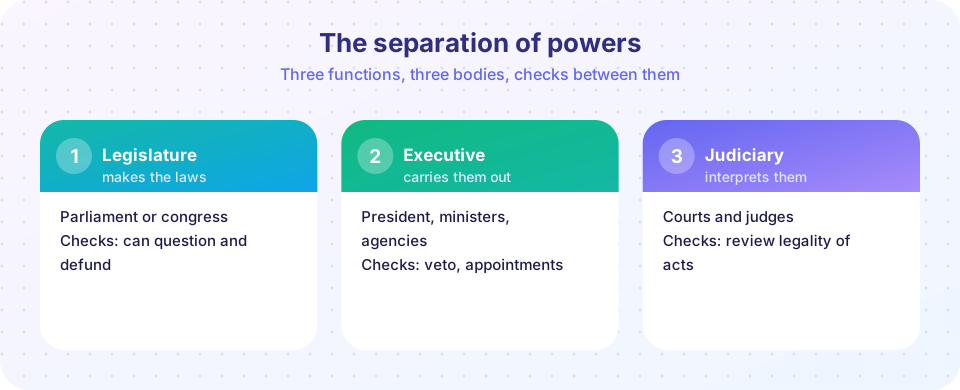
The three functions are:
- Legislative: making general rules.
- Executive: carrying out the law and running the government and administration.
- Judicial: deciding disputes and applying the law to individual cases.
In practice, the branches overlap. Legislatures hold hearings and sometimes act like courts (impeachment trials); executives issue regulations; judges make law through interpretation. Constitutional design is therefore less about total separation than about checks and balances: giving each branch some power over the others, so that none dominates. Common checks:
| Branch | Typical checks on others |
|---|---|
| Legislature | Controls public money, investigates, can remove officials (impeachment) in some systems, confirms appointments |
| Executive | May propose laws, veto bills in some systems, appoints judges and officials |
| Judiciary | Reviews acts of government for legality and, where allowed, constitutionality |
Presidential, parliamentary and semi-presidential systems
How the executive relates to the legislature is a basic design choice.
- Presidential (United States, Brazil, Mexico): the president is elected separately from the legislature, serves a fixed term and cannot be removed except by impeachment. Powers are strongly separated, and conflicts can arise when the president and the legislature are controlled by different parties.
- Parliamentary (United Kingdom, Canada, India, Germany, Japan): the executive (prime minister and cabinet) is drawn from the legislature and stays in office only while it keeps the confidence of a majority. Powers are fused rather than separated, but parliament holds government accountable through questions and votes of no confidence.
- Semi-presidential (France, and several others): there is an elected president with real powers and a prime minister who needs parliamentary support.
No type is perfect. Political scientists debate their merits, but the empirical evidence is complicated by differences in countries' histories and electoral rules.
Constitutional supremacy and judicial review
If the constitution is supreme, someone must decide what it means. In Marbury v Madison (1803), the US Supreme Court, under Chief Justice John Marshall, asserted the power to declare an Act of Congress unconstitutional and refuse to apply it. The Constitution does not say this in so many words, and scholars still debate the history, but the practice has become established. Many countries now have judicial review, either through ordinary courts or a specialist constitutional court. The United Kingdom takes a different approach: under parliamentary sovereignty (the doctrine associated with A. V. Dicey), Parliament can make or unmake any law, and courts do not strike down Acts. Under the Human Rights Act 1998, UK courts can issue a "declaration of incompatibility", which signals a conflict with Convention rights but leaves the Act in force.
The legitimacy of judicial review is debated. Supporters say it protects rights against temporary majorities; critics say it gives unelected judges power over elected legislatures. Some countries try intermediate solutions, such as legislative override clauses (Canada's Charter has a "notwithstanding clause") or dialogue between courts and legislatures.
Emergencies
Governments may need extra powers in a crisis, such as war, terrorism or pandemic. Constitutions may allow a state of emergency, with limits on duration and scope and with some rights remaining non-negotiable. The risk is that emergency powers become permanent; the constitution's safeguards are tested most when they are most inconvenient.
Common misconceptions
"The separation of powers means three completely separate branches." In real systems the branches overlap, and checks and balances are about shared control.
"The UK has no constitution." It has one; it is just not collected in a single document.
"Judicial review exists everywhere." It is common but not universal, and its form varies widely.
"A constitution guarantees good government." It sets a framework. Its effect depends on institutions, political culture and the willingness of officials to follow it.
Try it
First, a constitution amendment calculator that applies a supermajority rule to a vote count, using the rules for the United States as an example. It shows how rigidity works in numbers.
Press Run (or Ctrl + Enter) to see the console output here.
No output.
Second, a table of system types: pick a feature and see how presidential, parliamentary and semi-presidential systems differ.
Check your understanding
Quick check · 6 questions
of 6 answered You scored / 6 · perfect!
-
1. Who set out the classic modern statement of the separation of powers in The Spirit of the Laws (1748)?
Montesquieu argued that liberty is endangered when legislative, executive and judicial power are united. -
2. What does 'checks and balances' mean?
Checks and balances share control so no branch dominates. -
3. Which case is famous for asserting the power of judicial review in the United States?
Marbury v Madison established the practice of striking down unconstitutional laws. -
4. In a parliamentary system, what keeps the government in office?
Governments in parliamentary systems must retain parliamentary confidence. -
5. What is parliamentary sovereignty in the UK?
The doctrine places Parliament at the top of the legal hierarchy, though modified by modern developments. -
6. Why are rigid constitutions harder to amend than flexible ones?
Special procedures protect stability but make change harder.
Summary
- Constitutions constitute the state, limit power and express values.
- They may be written or uncodified, rigid or flexible.
- The separation of powers divides legislative, executive and judicial functions and uses checks and balances.
- Presidential, parliamentary and semi-presidential systems arrange executive-legislative relations differently.
- Judicial review is common but contested; the UK's parliamentary sovereignty is a notable alternative.
Track your progress
Create a free account to tick off lessons and pick up where you left off on any device.
of Introduction to Law lessons completed