


















Lesson 38 of 47 · Legal Reasoning and Practice
Chapter 8 overview: Legal reasoning and practice
Meet the skills of legal reasoning: finding facts, finding rules, applying them and reaching a conclusion, plus a map of the lessons in this chapter.
Knowing rules is only half of law. The other half is using them. A lawyer faced with a messy story must decide which facts matter, which rule applies, how the rule fits the facts and what the likely outcome is. This chapter teaches these skills one at a time, so that you can read a case, read a statute and write a clear answer to a legal problem.
Which legal system? The methods here are those of the common law, as practiced in England and Wales, with comparisons to the US. The same habits of careful reading and reasoning help in any legal system. Educational information, not legal advice.
What you will learn
- The four steps of legal reasoning
- Why precedent and statutes are the two main sources of rules
- What each lesson in this chapter covers
Key terms
Precedent: an earlier decision that guides later cases. Statute: a written law made by a legislature. Ratio decidendi: the legal reasoning needed to reach the decision. Application: comparing the facts of your problem with the rule.
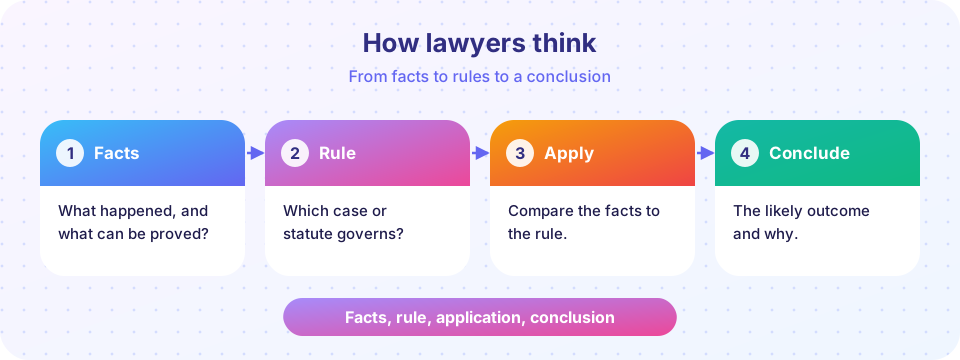
The four steps
Facts. What happened, and what can be proved? Lawyers separate facts that are agreed from facts that are disputed, and facts that matter legally from background detail.
Rule. Which legal rule governs? It may come from a statute, a case, or both. Finding and reading it accurately is a skill.
Application. Compare the facts to the rule element by element. This is where most arguing happens, because each side will say the facts fit, or do not fit, the rule.
Conclusion. State the likely outcome, say how confident you are and explain the weak points.
You have used this pattern all through the course. In contract law, the rule was "offer plus acceptance plus consideration," and you tested the facts of a bakery against it. In negligence, you walked through duty, breach, causation and damage. Now you will practice it deliberately.
Why argument matters
Law is not a machine that outputs answers. Rules are written in general words, and real events are specific. Is a bicycle a "vehicle" under a rule banning vehicles in a park? Is a driver "on a road" in a car park? Lawyers argue both sides, judges decide, and their reasons become new precedent. The system is stable enough for people to plan their affairs, and flexible enough to meet new problems.
A map of this chapter
- Reading cases and precedent: how a judgment is built, what binds and what only persuades.
- Reading statutes: how Acts are organized and how judges interpret them.
- IRAC and legal writing: a clear structure for answering problem questions.
- Chapter review: recap and quiz.
Try it
Press Run (or Ctrl + Enter) to see the console output here.
No output.
Check your understanding
Quick check · 3 questions
of 3 answered You scored / 3 · perfect!
-
1. Which is NOT one of the four steps of legal reasoning?
The steps are facts, rule, application and conclusion. -
2. Where do legal rules come from in common-law systems?
Both Acts and judicial decisions. -
3. Why do lawyers argue about application?
Fitting facts to general words is where the debate lies.
Summary
- Legal reasoning moves from facts to rule to application to conclusion.
- Rules come from statutes and cases.
- This chapter teaches cases, statutes and a structure for answers.
Track your progress
Create a free account to tick off lessons and pick up where you left off on any device.
of Introduction to Law lessons completed