


















Lesson 20 of 47 · Constitutional and Public Law
Human rights and proportionality
Where human rights come from, which are absolute and which can be limited, and how courts use the proportionality test to balance rights against public goals.
Human rights are claims that people hold simply because they are human, protected by law against abuse by public authorities (and in some systems against private actors as well). They are among the most visible parts of public law: free speech, fair trial, privacy, freedom from torture, equality before the law. But rights are rarely absolute. Societies limit them to protect others and the public interest, and the difficult question is how far those limits may go. This lesson explains where human rights come from and how courts decide whether a limit is justified.
What you will learn
- The history and main sources of human rights law.
- The difference between absolute and qualified rights.
- How the proportionality test works, step by step.
- How different systems (Europe, Canada, United States) approach rights limits.
Key terms
Human rights: rights recognized as belonging to every person, protected by constitutions and international treaties.
Absolute right: a right that may not be limited or balanced away, such as the ban on torture in international law.
Qualified right: a right that may be limited if the limit is lawful and justified, such as freedom of expression.
Proportionality: a structured test asking whether a limit on a right is justified.
Margin of appreciation: room that an international court gives states to decide how to apply a right in local conditions.
Where human rights come from
Ideas about rights have a long history. Magna Carta (1215), the English Bill of Rights (1689), the United States Declaration of Independence (1776) and Bill of Rights (1791) and the French Declaration of the Rights of Man and of the Citizen (1789) were all important steps. The atrocities of World War II prompted a new, international approach. The United Nations General Assembly adopted the Universal Declaration of Human Rights (UDHR) on 10 December 1948. The Declaration is not itself a treaty, but it inspired treaties and national constitutions.
The main binding instruments include:
- The International Covenant on Civil and Political Rights (ICCPR) and the International Covenant on Economic, Social and Cultural Rights (ICESCR), both adopted in 1966 and in force from 1976.
- Regional treaties: the European Convention on Human Rights (signed 1950, in force 1953, enforced by the European Court of Human Rights), the American Convention on Human Rights (1969) and the African Charter on Human and Peoples' Rights (1981).
- Specialist treaties on racial discrimination, discrimination against women, torture, children's rights, disability and others.
- National constitutions and bills of rights, such as the Basic Law of Germany (1949), the Canadian Charter of Rights and Freedoms (1982) and the South African Bill of Rights (1996).
Rights are often described as civil and political (liberty, fair trial, expression, vote) or economic, social and cultural (education, health, work, housing). Systems differ in how far the second group are enforceable in court, and how far they are treated as goals that governments must progressively achieve.
Absolute and qualified rights
Some rights allow no balancing. The prohibition of torture and inhuman or degrading treatment, the prohibition of slavery and the rule against retroactive criminal penalties are treated as non-derogable, meaning they cannot be suspended even in an emergency, in the main human rights treaties.
Most rights are qualified. Free speech is protected, but laws against defamation, incitement to violence or disclosure of state secrets may limit it. Privacy may give way to a lawful police investigation. Religious freedom is strong, but practices that harm others may be restricted. In many instruments, a restriction must satisfy three conditions: it must be lawful (prescribed by law, not by arbitrary decision), pursue a legitimate aim (such as national security, public safety, health, morals, or the rights of others) and be necessary in a democratic society, which brings us to proportionality.
In emergencies, some treaties allow a state to derogate (temporarily suspend some rights), but only to the extent strictly required and subject to supervision.
The proportionality test
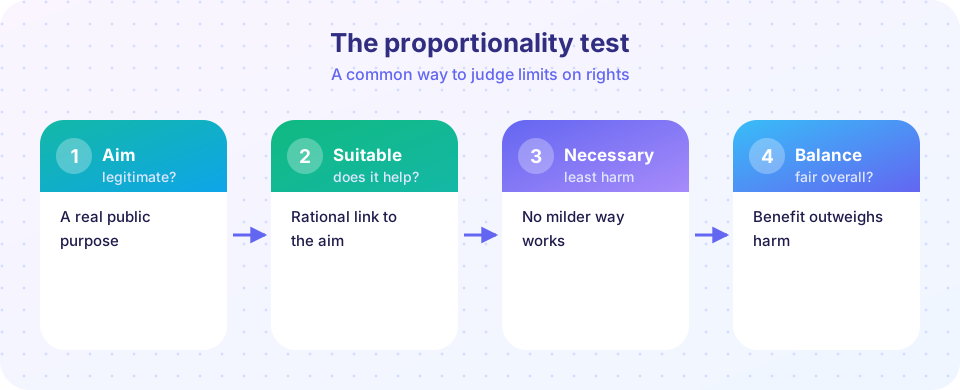
Courts in many countries use proportionality to decide whether a restriction on a right is justified. The German courts developed it, and it spread to the European Court of Human Rights, the Court of Justice of the EU, Canada, South Africa, Israel and elsewhere. Canada's classic version comes from R v Oakes (1986). The usual steps:
- Legitimate aim. Does the measure pursue a goal that justifies limiting rights, for instance protecting public health or the rights of others? A purely discriminatory or arbitrary goal fails at once.
- Suitability (rational connection). Is the measure capable of helping to achieve the aim? A ban that does nothing to advance the goal is not justified.
- Necessity (least restrictive means). Is there a less intrusive way to achieve the aim equally well? If a milder option exists, the harsher one fails.
- Balance (proportionality in the strict sense). Weigh the benefit of the measure against the harm to the right. Even a suitable and necessary measure can fail if its harm to the right clearly outweighs its benefit.
Example, using fictional facts. A city bans all public protests for a month to prevent disorder. Legitimate aim: yes, public order. Suitable: probably, it reduces crowds. Necessary: probably not, because narrower measures (limiting routes, requiring notice, policing specific events) would address the risk with far less impact on freedom of assembly. A court is likely to find the blanket ban disproportionate.
The test does not give mechanical answers. At the balancing stage, judges decide what weight to give each interest, and critics worry it gives judges too much power or hides value judgments behind technical language. Defenders say it forces governments and courts to justify limits openly with reasons.
Different approaches
- Europe. The European Court of Human Rights applies proportionality under the "necessary in a democratic society" test, together with the margin of appreciation: where there is no European consensus (on moral questions, for instance) states get a wider margin. In Handyside v United Kingdom (1976), the Court said freedom of expression covers ideas that offend, shock or disturb, but accepted that the UK could restrict a book on grounds of morals, given the margin.
- Canada. Section 1 of the Charter allows "reasonable limits... demonstrably justified in a free and democratic society", analyzed under the Oakes test.
- United States. US courts typically use tiers of scrutiny instead: "rational basis" review for most laws, "intermediate scrutiny" for some classifications, and "strict scrutiny" for laws that burden fundamental rights or use suspect classifications such as race, which requires a compelling interest and narrow tailoring. The First Amendment gives especially strong protection to speech compared with many other countries.
The US Bill of Rights generally restricts government action; many other constitutions also give rights some effect between private persons ("horizontal effect"), for example through courts interpreting private law in light of rights. The extent differs.
Common misconceptions
"Human rights are absolute." Only a few are; most can be limited if the limit is lawful, aimed at a legitimate goal and proportionate.
"Human rights only protect good people." They protect everyone, including suspects and prisoners, because rights that depend on being liked would not protect anyone.
"Courts that apply proportionality simply impose their own opinions." Judges weigh interests, which involves judgment, but the structured steps and the requirement to give reasons are designed to discipline that judgment.
"The UDHR is a binding treaty." It is a declaration; its influence comes from its moral authority and from the treaties and constitutions it inspired, though some of its provisions are also regarded as customary law.
Try it
First, a proportionality checker. Enter the answers for a measure; the program walks through the four steps and stops at the first failure, as a court often does.
Press Run (or Ctrl + Enter) to see the console output here.
No output.
Second, a balance scale. Move the sliders for the benefit of a measure and the harm it does to a right, and see which side of the scale falls.
Check your understanding
Quick check · 5 questions
of 5 answered You scored / 5 · perfect!
-
1. When was the Universal Declaration of Human Rights adopted?
The UN General Assembly adopted it on 10 December 1948. -
2. Which of these is generally treated as an absolute right?
The ban on torture and inhuman treatment is non-derogable in the main treaties. -
3. In the proportionality test, what does necessity ask?
If a milder option works as well, the harsher measure fails the necessity step. -
4. What is the margin of appreciation?
It reflects that states are often better placed to judge local conditions, especially where there is no consensus. -
5. Which approach does US constitutional law typically use instead of proportionality?
US courts use levels of scrutiny that depend on the right and classification involved.
Summary
- Human rights have roots in older documents and developed internationally after 1945, through the UDHR and treaties.
- A few rights are absolute; most are qualified and may be limited if lawful, for a legitimate aim and necessary.
- Proportionality asks about aim, suitability, necessity and balance.
- Systems differ: European margin of appreciation, Canada's Oakes test and US tiers of scrutiny.
Track your progress
Create a free account to tick off lessons and pick up where you left off on any device.
of Introduction to Law lessons completed