


















Lesson 39 of 47 · Legal Reasoning and Practice
Reading cases and the doctrine of precedent
Learn how to read a court judgment, find the ratio decidendi, and understand binding and persuasive precedent, distinguishing and overruling.
In a common-law system, much of the law lives in judgments. When a court decides a dispute, it explains its reasons, and those reasons guide later courts. This is the doctrine of precedent. It is one of the main ideas that lets lawyers predict outcomes: like cases should be treated alike. To use it, you must learn to read a case, to tell the part that binds from the part that does not, and to understand how courts follow, distinguish or overrule earlier decisions.
Jurisdiction. The hierarchy described is that of England and Wales, with a comparison to the United States. Other countries differ. Educational information, not legal advice.
What you will learn
- How a judgment is structured and how to read it
- The difference between ratio decidendi and obiter dicta
- Which courts bind which, and what persuasive precedent is
- How courts follow, distinguish, overrule and reverse earlier decisions
Key terms
Precedent: a past decision treated as authority in later cases. Ratio decidendi: the legal principle needed to decide the case; this is what binds. Obiter dictum: a remark "by the way"; persuasive only. Binding / persuasive: must be followed / may be considered. Distinguishing: showing a case differs on its facts so the precedent does not apply.
What is in a judgment?
A reported case usually has these parts: the names of the parties and court; the year; a summary (headnote) written by the law reporter; the facts; the procedural history; the arguments; and the judgment, which gives the court's reasoning and decision. In a court with several judges, each may give a separate opinion. When a majority agrees, their reasoning forms the decision; a dissenting judge disagrees and may be cited later, especially if the law changes.
A case citation tells you where to find it. For example, Donoghue v Stevenson [1932] AC 562 refers to the year (in square brackets because the year is part of the citation), the series (Appeal Cases) and the page. Modern cases from the UK Supreme Court have neutral citations such as [2015] UKSC 11, which show year, court and number. In US citations, a case like Brown v Board of Education, 347 U.S. 483 (1954), shows volume, reporter, page and year.
Always read the case, not only the headnote, because the headnote is not part of the judgment and may oversimplify.
Ratio and obiter
Most of a judgment is explanation, but only part of it forms the precedent. The ratio decidendi is the legal reason necessary to reach the decision on the facts. Everything else is obiter dicta: remarks about hypothetical facts, side comments, or general observations. Obiter statements can be persuasive, especially from senior judges, but they do not bind.
Finding the ratio is not mechanical, and later judges often disagree about what the ratio of an earlier case was. In Donoghue v Stevenson, the key ratio concerns a manufacturer's duty of care to the ultimate consumer of a product that cannot be inspected before use. Lord Atkin's wider neighbour principle was broader language that later courts used, treated with caution, to build the general duty of care. A useful technique is to ask: if the court had reached the opposite view on this point, would the decision have changed? If yes, it is part of the ratio.
The hierarchy in England and Wales
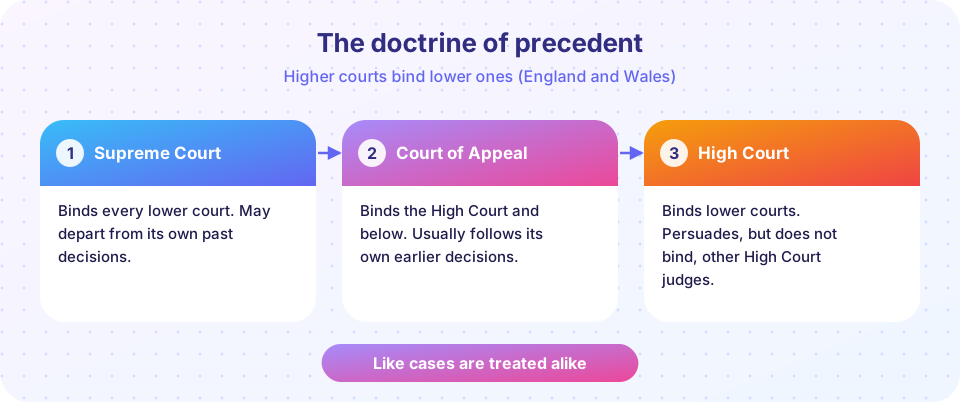
- The Supreme Court (which replaced the House of Lords as the final court of appeal in 2009) binds all lower courts. Under a 1966 Practice Statement, the House of Lords gave itself the freedom to depart from its own earlier decisions when it appeared right to do so, and the Supreme Court retains this power, used sparingly.
- The Court of Appeal binds the High Court and lower courts. It generally follows its own previous decisions, subject to exceptions explained in Young v Bristol Aeroplane (1944): for example, it may choose between conflicting earlier decisions, or refuse to follow one that is inconsistent with a later Supreme Court decision. The Court of Appeal criminal division is more flexible where liberty is at stake.
- High Court decisions bind courts below, but are only persuasive for other High Court judges.
- Magistrates' and county courts are bound by higher courts and set no binding precedent.
Persuasive precedent includes decisions of lower or equal courts, obiter dicta, decisions from other common-law countries (such as Australia, Canada or the US), and academic writing. English judges often cite foreign cases when facing new problems.
In the United States, the principle is called stare decisis. State supreme courts bind lower courts in their state; the US Supreme Court binds all courts on federal law. US courts overrule their own earlier decisions more often than the English: Brown v Board of Education (1954) overruled the "separate but equal" doctrine from Plessy v Ferguson (1896), and Dobbs v Jackson Women's Health Organization (2022) overruled Roe v Wade (1973).
Working with precedent
When a court faces an earlier decision, it can:
- Follow it because the material facts and issue are the same.
- Distinguish it by showing a relevant difference in facts, so the earlier rule does not govern. This is the most common flexibility in the system.
- Overrule it, when a higher court declares an earlier decision of a lower court wrong, or a court departs from its own earlier decision.
- Reverse a decision on appeal in the same case.
- Approve it, when a higher court agrees with an earlier decision.
Example: in Bolton v Stone (1951), the cricket club was not liable when a ball very rarely hit out of the ground injured a passer-by. A later case where balls were frequently struck over the fence could be distinguished on the probability of harm, because the main facts differ in a way that matters to the rule.
Why precedent?
The reasons are fairness (like cases alike), certainty (people can plan), efficiency (judges need not start from scratch) and legitimacy (a decision constrained by rules is less arbitrary). The costs are rigidity (a bad decision can persist), and complexity (the law builds up in layers). Systems manage the tension with the mix of rules above: binding authority, with room to distinguish and a mechanism for higher courts to overrule.
Civil-law systems such as France or Germany give less weight to individual precedent, relying on codes. In practice, though, decisions of top courts still carry strong influence.
Common misconceptions
"A court is bound by every word of an earlier judgment." Only the ratio binds; obiter does not.
"A higher court's decision always binds." Only courts in the same hierarchy are bound. A decision from a foreign court can only persuade.
"Overruling is the same as distinguishing." Distinguishing leaves the earlier case standing; overruling says it was wrong.
Try it
Press Run (or Ctrl + Enter) to see the console output here.
No output.
Check your understanding
Quick check · 5 questions
of 5 answered You scored / 5 · perfect!
-
1. The part of a judgment that binds later courts is the:
The legal reasoning necessary to the decision. -
2. High Court judges in England:
They are bound upward and only persuaded sideways. -
3. Distinguishing a precedent means:
The earlier case stays good law. -
4. Which of these is persuasive only?
Obiter dicta do not bind. -
5. The US phrase for the doctrine of precedent is:
To stand by things decided.
Summary
- Judgments contain facts, reasons and a decision; read the full case.
- Only the ratio decidendi binds; obiter dicta persuade.
- Higher courts bind lower ones; equal courts persuade.
- Courts follow, distinguish, overrule or reverse earlier decisions.
- Precedent gives consistency but can be rigid.
Next: Reading statutes
Track your progress
Create a free account to tick off lessons and pick up where you left off on any device.
of Introduction to Law lessons completed