


















Lesson 8 of 47 · What Law Is and Where It Comes From
Sources of law: constitutions, statutes, cases and custom
Learn the main sources of law, how they rank in a typical hierarchy, how common law and civil law use them differently, and how to resolve conflicts between sources.
When a lawyer asks "what is the law on this?" the first move is not to argue about morality but to look for sources. A source of law is a place where binding rules come from or can be found. Knowing the sources and how they rank is like knowing a library's catalog: it tells you where to look and which book wins if two disagree.
What you will learn
- The main sources of law: constitutions, legislation, delegated rules, case law, custom, treaties and scholarship.
- How hierarchy settles conflicts between them.
- Why common law and civil law treat judicial decisions differently.
- The difference between binding and persuasive authority.
Key terms
Legislation (statute): written law made by a legislature, such as a parliament or congress.
Delegated (secondary) legislation: rules made by ministers or agencies under powers given by a statute.
Case law: rules and principles drawn from judicial decisions.
Precedent: an earlier decision that a court treats as guiding or binding in later cases.
Binding versus persuasive authority: a binding source must be followed; a persuasive one may be considered.
Constitutions
A constitution sets up the main institutions of the state and states their powers and limits. In many countries it is a single written document, such as the Constitution of the United States (1787), the Basic Law of Germany (1949) or the Constitution of India (1950). Some countries, including the United Kingdom, New Zealand and Israel, have no single constitutional document but rely on a set of statutes, conventions and court decisions; the UK is often called an "uncodified" constitution. Where a written constitution is the supreme law, any statute that conflicts with it can be struck down by a court (Chapter 4 explains judicial review).
Legislation
Statutes are the main way modern states create new law. In a parliamentary democracy a bill passes through the legislature and becomes an Act. Statutes can create offenses, set tax rates, regulate industries or reform private law. Many countries organize statutes into codes, which are systematic collections covering a whole field. The best known is the French Civil Code of 1804 (the Napoleonic Code), which influenced legal systems around the world. Germany's Civil Code (the BGB) came into force in 1900.
Delegated legislation
Legislatures cannot write every detail. A statute often gives a minister or an agency the power to make regulations or orders that fill in the details: safety standards, procedure rules, fee tables. Delegated legislation has legal force but ranks below the statute that authorizes it. If a regulation goes beyond the powers given, a court may declare it invalid (in English law this is called acting ultra vires, beyond the powers).
Case law and precedent
Judges decide cases, and the way they do so can become a source of law. In common law systems, such as England and Wales, the United States and Canada, a judgment is not only a decision between two parties; it is a precedent. Under the doctrine of stare decisis ("to stand by things decided"), a court generally follows earlier decisions of higher courts (and often its own) on similar facts. In civil law systems, the formal source of law is the code, and a judicial decision is not strictly binding on later courts. In practice, though, decisions of high courts are widely followed because they show how the code is applied. Chapter 3 compares the two traditions in detail.
Custom and general principles
Custom is a settled practice that people follow because they regard it as legally required. It plays a role in many systems: for example, in international law (customary international law), in commercial law (trade usages) and in some countries' family and land law. In many places, such as parts of Africa and the Pacific, customary law is formally recognized alongside the state's legal system. General principles of law common to many legal systems, such as good faith or the duty to give reasons, are another recognized source, especially in international and EU law.
International sources
Treaties are agreements among states and bind those that ratify them. How a treaty affects domestic law depends on the country. In "monist" systems, a ratified treaty becomes part of domestic law directly; in "dualist" systems such as the United Kingdom, it needs a statute to take effect in national courts. Membership in regional organizations adds further layers; the law of the European Union, for example, has priority over conflicting national law in matters within the EU's powers, a principle the EU's Court of Justice established in the 1960s.
Scholarly writing
Textbooks, treatises and law review articles are not binding, but courts may find them persuasive, especially in civil law countries where scholars ("doctrine") have long influenced the interpretation of codes. In international law, "the teachings of the most highly qualified publicists" are listed as a subsidiary means of identifying law in the Statute of the International Court of Justice.
The hierarchy of norms
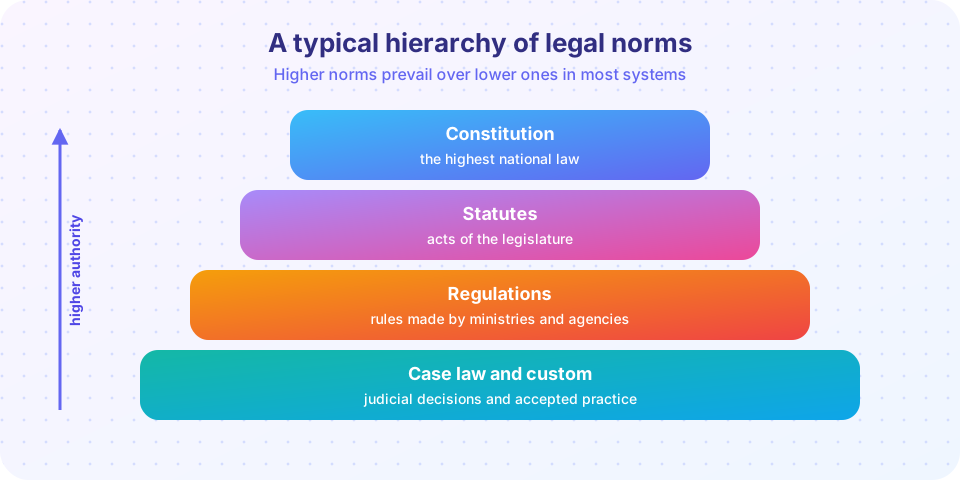
The Austrian jurist Hans Kelsen described legal systems as a hierarchy: each norm gets its validity from a higher one. In a typical national system the order from highest to lowest is:
- the constitution,
- statutes,
- delegated legislation,
- case law and custom (the exact place of case law varies).
When norms conflict, the higher one prevails. A regulation cannot override its parent statute; a statute cannot override a supreme constitution (in systems with judicial review). The United Kingdom is an exception to the last point: under the doctrine of parliamentary sovereignty, an Act of Parliament can override earlier law, and courts have traditionally not struck down Acts, though the situation has been modified by human rights legislation and by past EU membership.
Other conflict rules help inside the same level:
- Later law beats earlier law (lex posterior): a newer statute generally prevails over an older conflicting one.
- Specific law beats general law (lex specialis): a rule written for a particular situation prevails over a general rule.
Binding and persuasive authority
A source is binding when a court must follow it, and persuasive when the court may take it into account. A decision of the highest court of a country binds lower courts in that system. A decision from another country's court, a scholarly article, or a case from a lower court is only persuasive. Courts in common law countries often cite persuasive decisions from other common law countries when they face new problems, because the traditions are similar.
Common misconceptions
"Statutes are the only law." Statutes are central, but regulations, case law, custom and treaties are also sources, and in some systems they matter as much.
"Judges in common law countries make up law freely." They are constrained by precedent, by statutes and by principles of reasoning. They develop law incrementally rather than inventing it.
"Civil law judges never look at earlier cases." They do, and high court decisions are very influential, although they are not formally binding in the same way.
Try it
First, a small conflict resolver. Give it two conflicting norms and it applies the hierarchy and the tie-breakers. It is a teaching model with simplified rules.
Press Run (or Ctrl + Enter) to see the console output here.
No output.
Second, a sorting game in the browser: match each example to its source.
Check your understanding
Quick check · 5 questions
of 5 answered You scored / 5 · perfect!
-
1. What does stare decisis mean?
It means 'to stand by things decided', the basis of precedent in common law systems. -
2. A regulation conflicts with the statute that authorizes it. Which usually prevails?
Delegated legislation ranks below the statute that gives the power to make it. -
3. Which country is often called a country with an uncodified constitution?
The UK has no single constitutional document, relying on statutes, conventions and cases. -
4. What does lex specialis say?
A rule designed for a particular situation prevails over a general rule on the same subject. -
5. A textbook argument about a legal question is usually
Scholarship is not binding but can influence courts.
Summary
- The main sources are constitutions, legislation, delegated legislation, case law, custom, treaties and scholarship.
- Hierarchy resolves conflicts: higher beats lower, later beats earlier, specific beats general.
- Common law treats precedent as formally binding; civil law relies on codes, with court decisions highly influential.
- Authority can be binding or persuasive.
Track your progress
Create a free account to tick off lessons and pick up where you left off on any device.
of Introduction to Law lessons completed