


















Lesson 32 of 47 · Torts and Criminal Law
Chapter 6 review: Torts and criminal law
Review negligence, other torts and criminal law with a one-page picture, a comparison table, a mixed scenario and a ten-question quiz.
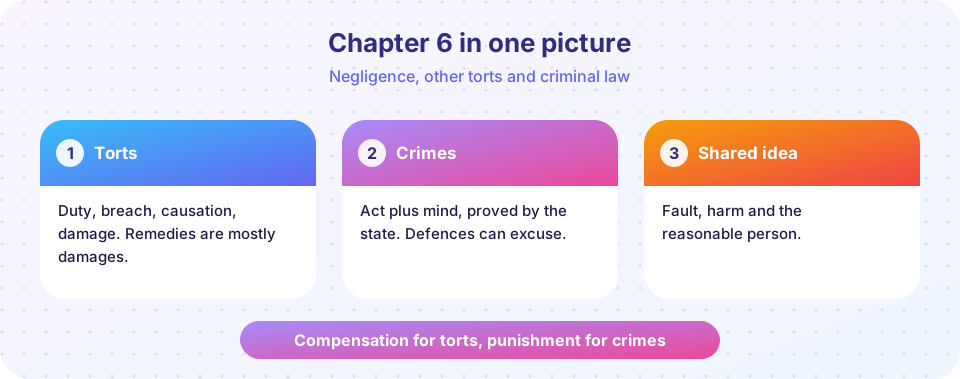
Torts and crimes both deal with wrongs, but they use different questions, different courts and different standards of proof. In this review you will compare them, practice on one scenario that involves both, and test yourself with ten mixed questions.
What you will learn
- How to tell which area of law an event raises
- The key tests in each area side by side
- How to reason through a mixed scenario
Recap table
| Topic | Key test | Landmark cases |
|---|---|---|
| Negligence | Duty, breach, causation, damage | Donoghue v Stevenson (1932), Caparo v Dickman (1990), Bolton v Stone (1951), Wagon Mound (1961) |
| Nuisance and Rylands | Unreasonable interference; escape of dangerous things | Sturges v Bridgman (1879), Rylands v Fletcher (1868) |
| Trespass | Direct interference, no proof of damage for land | Entick v Carrington (1765) |
| Defamation | Serious harm; defences of truth, honest opinion, public interest | Defamation Act 2013; NYT v Sullivan (1964) in the US |
| Criminal law | Actus reus plus mens rea, beyond reasonable doubt | Woolmington (1935), Woollin (1999), Miller (1983) |
A mixed scenario
Sam is late for work and drives through a red light at 80 km/h in a 50 zone. He hits Lena, a cyclist, who breaks her wrist. Sam is a competent driver but was checking his phone.
Tort. Duty: road users owe each other a duty (an established category). Breach: running a red light and speeding below the standard of a reasonable driver. Causation: but for Sam's driving Lena would not be hurt. Damage: a broken wrist, which is foreseeable personal injury. Lena can claim damages for medical costs, lost earnings and pain. If she had been cycling without lights at night, Sam might argue contributory negligence.
Crime. The prosecution might charge a driving offense. The actus reus is the driving manner and consequence; the required mental element depends on the charge, from carelessness to recklessness. The standard is beyond reasonable doubt, and the penalty could be a fine, disqualification or imprisonment, depending on the offense.
Both cases can proceed separately. Notice how the same facts are fitted into two different frameworks.
Try it
Press Run (or Ctrl + Enter) to see the console output here.
No output.
Check your understanding
Quick check · 10 questions
of 10 answered You scored / 10 · perfect!
-
1. Which element is NOT part of a negligence claim?
Negligence is about carelessness, not intention. -
2. The reasonable person test is used for:
It sets the standard of care. -
3. Which standard of proof applies in a criminal trial?
The prosecution must make the jury sure. -
4. In Wagon Mound (No 1), the key limit on liability was:
Fire damage was not reasonably foreseeable. -
5. Trespass to land is actionable:
It protects the right to exclude. -
6. Oblique intention involves:
Woollin. -
7. Which is NOT a defence to a tort claim?
Mens rea is a criminal law concept. -
8. The case that began the modern law of the duty of care is:
The snail in the bottle case of 1932. -
9. A person who creates a dangerous situation and fails to act may be liable for:
There is a duty to counteract a danger you created. -
10. A tort claim and a prosecution for the same event:
Different courts, parties and standards.
Summary
- Torts compensate victims; crimes are prosecuted by the state.
- Negligence needs four elements; crimes need act and mind.
- Standards of proof differ: probabilities for civil, beyond reasonable doubt for criminal.
- Defences matter in both areas.
Track your progress
Create a free account to tick off lessons and pick up where you left off on any device.
of Introduction to Law lessons completed