


















Lesson 47 of 47 · Projects and Practice
Further study: where to go after this course
Next steps after an introduction to law: how legal education works, related fields, careers that use legal skills, and how to keep reading real cases.
You have covered the shape of the legal world: where law comes from, how courts work, the main areas of private and public law, and how lawyers reason. This final lesson looks ahead. Where can you go from here, how is legal education organized in different countries, and how can you keep building skill on your own?
A note on advice. Nothing in this course is legal advice. If you have a real legal problem, speak to a qualified lawyer or a recognized advice service in your own country. Education rules and career routes differ a lot, so check the current requirements of the country where you want to work.
What you will learn
- How legal education is organized in different places
- Which fields connect with law
- How to continue learning independently
Studying law formally
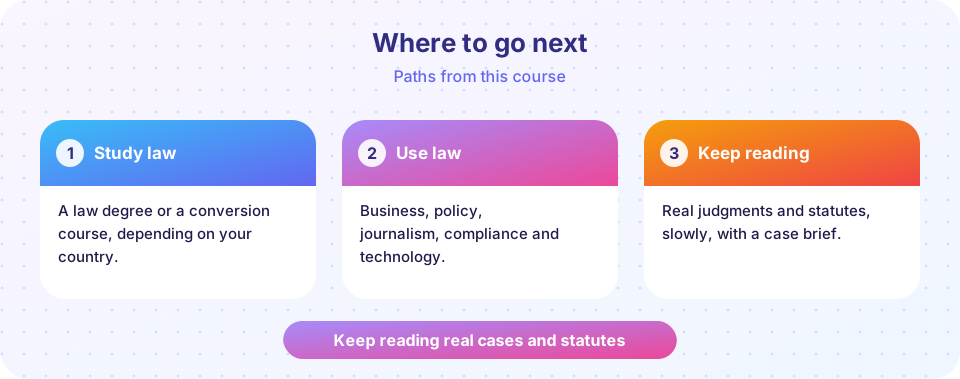
England and Wales. Many people take a three-year undergraduate law degree (LLB). Those who studied another subject can take a conversion course. To practice as a solicitor, candidates must pass the Solicitors Qualification Examination (SQE) and complete qualifying work experience; barristers complete vocational training and a period of pupillage. Routes have changed in recent years, so check the Solicitors Regulation Authority and the Bar Standards Board for current rules.
United States. Law is normally a postgraduate degree. Students take a bachelor's degree in any subject, sit the LSAT, and complete a three-year Juris Doctor (JD), followed by a state bar exam.
Civil-law countries. In much of continental Europe, Latin America and Asia, law is an undergraduate degree, followed by professional exams and training.
International and comparative law. Master's programs and specialist study cover areas such as international human rights, trade law and comparative law, which look at how legal systems differ.
Related fields on this site
Law connects to many subjects.
- Civics and government covers how governments are organized and how citizens take part.
- Political science looks at power, institutions and policy.
- Ethics and Philosophy: Introduction explore the questions behind justice, rights and responsibility.
- Business studies covers organizations and the contracts and regulations that surround them.
- Microeconomics and Macroeconomics explain markets and incentives, which law often tries to shape.
- Sociology studies how society and institutions work.
- Study skills and exam technique helps with the reading, note-taking and writing that law study demands.
- English writing and composition supports clear writing, a core legal skill.
Careers that use legal skills
Not everyone who studies law becomes a lawyer. Reading carefully, building arguments and writing precisely are valuable in many jobs: compliance and risk, policy and public administration, journalism, business and contract management, human resources, technology policy and privacy, charity and advocacy work, and academic research. Lawyers themselves work in private practice, in-house for companies, in government, in the judiciary, in prosecution and defence, and in non-profit legal aid.
Keep learning on your own
- Read real judgments. Many courts publish decisions free. Start with short ones and write a brief using the project in this chapter.
- Read statutes. Choose a short Act and apply the interpretation approaches to a few sentences.
- Follow current cases through the websites of national courts, which often publish plain-language summaries of important decisions.
- Visit a court. Most courts have a public gallery. Watching a hearing makes the process real.
- Try a mock trial or debate at school or in a community group.
- Be careful with online sources. Check dates and jurisdictions, because laws change and differ by country.
A word about humility
Law is a human system. It can be fair or unfair, clear or confusing, and it changes. Studying it gives you tools to ask better questions, not final answers. As you go deeper, keep asking: which system, which rule, which facts, and what would the other side say?
Try it
Press Run (or Ctrl + Enter) to see the console output here.
No output.
Check your understanding
Quick check · 3 questions
of 3 answered You scored / 3 · perfect!
-
1. In the United States, law is usually studied as:
Most US lawyers hold a JD. -
2. Which skill is most useful across many careers after studying law?
These skills transfer. -
3. A good way to practice after this course is to:
Briefing builds the habit.
Summary
- Legal education routes differ by country; check current requirements.
- Law connects to civics, politics, ethics, economics and writing.
- Keep learning by reading real judgments and statutes, carefully and with the system in mind.
Back to the course: Introduction to Law
Track your progress
Create a free account to tick off lessons and pick up where you left off on any device.
of Introduction to Law lessons completed