


















Lesson 23 of 47 · Contracts
Chapter 5 overview: Contracts
A big-picture tour of contract law: what a contract is, the four building blocks, and a map of the lessons in this chapter.
Almost every day you make contracts without noticing. You buy a bus ticket, accept an app's terms, rent a flat or agree to mow a neighbor's lawn for ten dollars. Contract law is the part of private law that decides which promises the courts will enforce, and what happens when someone breaks one.
Which legal system? This chapter mainly describes the common-law rules of England and Wales, and points out where US law differs. Other countries, especially civil-law countries, organize contract law differently. This course is educational information, not legal advice for any real situation.
What you will learn
- Why the law enforces some promises and not others
- The four building blocks of a valid contract
- How terms, defects and remedies fit around those blocks
- What each lesson in this chapter covers
Key terms
Contract: an agreement the law will enforce. Offer: a promise to be bound if the other side accepts the stated terms. Consideration: the value each side gives, such as money, goods, work or a promise. Breach: failing to do what the contract requires. Remedy: what a court can order to put the situation right.
The big picture
Why should a court force anyone to keep a promise? Societies need people to plan. A farmer plants a crop because a buyer promised to take it. A builder buys materials because a client promised to pay. If promises could be dropped whenever it was convenient, nobody would invest time or money in them. Contract law therefore gives promises a legal backbone, but only the promises that show certain signs of seriousness.
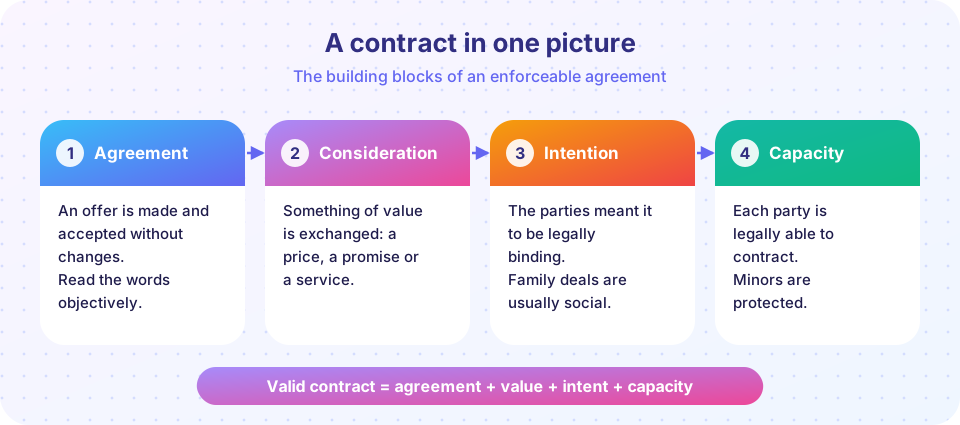
English law asks four questions. First, was there agreement: an offer and a matching acceptance? Second, did each side give consideration, meaning something of value? Third, did the parties intend to create legal relations? Fourth, did each have the capacity to contract? If the answers are yes, there is a contract. Then you ask what the contract says (its terms), whether anything spoiled the consent (misrepresentation, duress, mistake), and what the innocent party can claim if the other side fails to perform (remedies).
An everyday example
Priya sees a poster at a market: "Handmade bicycle, 150 pounds." She says, "I will take it," and pays. The seller hands it over. Every block is easy to spot. The poster and her reply are the agreement. The money and the bicycle are the consideration. Both meant a real sale, so intention is clear. Both are adults, so capacity is fine.
Now change one fact. Priya's brother says, "I will give you my old bicycle if you wash my car." Is that a contract? Courts often treat promises between close family members as social, not legal. Changing a single block can change the whole answer. This is how lawyers think: they break a situation into parts, then test each part.
Contract law around the world
Common-law systems such as England, the United States, Canada, Australia and India rely on judges' decisions as well as statutes. Civil-law systems such as France, Germany and Japan rely mainly on codes. They reach similar results in ordinary sales, but the reasoning differs. For instance, many civil-law codes do not require consideration, while English law does. When you read a rule, always ask: which country and which system?
The United States adds a twist. Sales of goods are governed in nearly every state by the Uniform Commercial Code (UCC), which relaxes some older common-law rules. In England, the Sale of Goods Act 1979 and the Consumer Rights Act 2015 play a similar role.
What each lesson covers
- Formation covers offer, acceptance, consideration, intention and capacity, with the classic cases.
- Terms and defects covers what a contract says, exclusion clauses, and why consent may fail.
- Breach and remedies covers what happens when a promise is broken and how courts calculate damages.
- Chapter review pulls everything together with a mixed quiz.
Try it
Press Run (or Ctrl + Enter) to see the console output here.
No output.
Check your understanding
Quick check · 4 questions
of 4 answered You scored / 4 · perfect!
-
1. Which is NOT one of the four building blocks used in this chapter?
English law does not usually require a written document. Most contracts can be formed orally or by conduct. -
2. What does consideration mean?
Consideration is the value each party gives, such as a price, goods or a promise. -
3. Why might a promise between family members not be a contract?
Domestic and social agreements are usually presumed not to be intended as legally binding, though the presumption can be rebutted. -
4. Which two main legal families are contrasted?
Common-law systems rely heavily on judicial decisions; civil-law systems rely mainly on codes.
Summary
- A contract is an agreement the law will enforce.
- Four blocks: agreement, consideration, intention, capacity.
- Terms, defects and remedies surround the blocks.
- Rules differ between countries; always name the system.
Track your progress
Create a free account to tick off lessons and pick up where you left off on any device.
of Introduction to Law lessons completed