


















Lesson 22 of 47 · Constitutional and Public Law
Chapter 4 review: constitutional and public law
Review chapter 4: constitutions and the separation of powers, federal and unitary states, human rights and proportionality, and judicial review, with a ten question quiz.
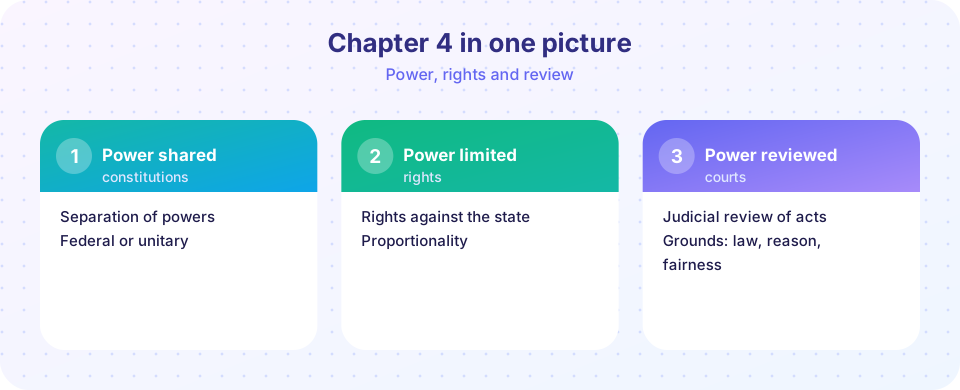
Chapter 4 showed how public law shares, limits and reviews state power. This review puts the chapter on one page and tests whether the ideas connect: constitutions and branches, the structure of states, rights and the proportionality test, and administrative review.
What you will check
- You can explain separation of powers and compare presidential and parliamentary systems.
- You can distinguish unitary, federal and confederal states and monism from dualism.
- You can apply the proportionality test to a limit on a right.
- You can name the grounds of judicial review and what remedies follow.
The chapter in brief
Public law answers three questions about state power. First, who holds it? Constitutions divide power among legislatures, executives and courts, and states divide it again between center and regions. Presidential, parliamentary and semi-presidential systems arrange the executive differently, and unitary, federal and confederal states arrange territory differently. Second, what limits it? Human rights, drawn from national constitutions and treaties such as the 1948 Universal Declaration and later conventions, restrict what governments may do. A few rights are absolute, but most can be limited if the limit is lawful, pursues a legitimate aim and passes the proportionality test. Third, who checks it? Courts reviewing official decisions ask whether a public body acted within its powers, rationally and fairly, and they can quash decisions that fail. Different countries use ordinary courts or separate administrative courts, but the principle is shared: public power must itself obey the law.
Recap table
| Lesson | Key points | Examples |
|---|---|---|
| Constitutions and separation of powers | Constitute, limit, express values; checks and balances; judicial review | Montesquieu (1748), Marbury v Madison (1803), UK parliamentary sovereignty |
| Federalism and state structure | Unitary, federal, confederal; powers lists and supremacy; monism and dualism | US Tenth Amendment, Canada ss. 91-92, devolution in the UK, Costa v ENEL (1964) |
| Human rights and proportionality | UDHR 1948, treaties; absolute and qualified rights; four-step test | R v Oakes (1986), Handyside (1976), margin of appreciation |
| Administrative law and judicial review | Illegality, irrationality, procedural impropriety; quashing orders | GCHQ (1985), Wednesbury (1948), Ridge v Baldwin (1964) |
Common mistakes to avoid
- Treating the separation of powers as total separation rather than checks and balances.
- Saying the UK has no constitution.
- Assuming that every right can be limited, or that none can.
- Confusing judicial review with an appeal on the merits.
- Calling a devolved UK region a federal state.
Try it
A round of flashcards on the chapter's cases. Each card names a case; try to say what it decided before reading the answer.
Press Run (or Ctrl + Enter) to see the console output here.
No output.
Check your understanding
Quick check · 10 questions
of 10 answered You scored / 10 · perfect!
-
1. Which pair of terms describes the two core principles of natural justice?
Audi alteram partem and nemo iudex in causa sua are the two core natural justice rules. -
2. Which system has the executive drawn from the legislature and dependent on its confidence?
In parliamentary systems the government must keep the confidence of a legislative majority. -
3. In a federation, what usually acts as a referee between levels of government?
Disputes about the division of powers are decided by a constitutional or supreme court. -
4. In a dualist system, what must happen before a ratified treaty is applied by national courts?
Dualism separates the international and national legal orders. -
5. Which is an absolute right in the main human rights treaties?
Torture is prohibited without exception; other rights may be restricted within limits. -
6. At the necessity stage of proportionality, a court asks
If a milder alternative achieves the aim, the harsher measure is not necessary. -
7. What is the main idea of Wednesbury unreasonableness?
The test is deliberately high, to respect the role of public bodies. -
8. What is devolution in the UK?
Devolved powers come from Acts of Parliament, which is formally still sovereign. -
9. Which statement about judicial review is accurate?
Review is about legality and process; successful claimants often get a new decision, not a guaranteed result. -
10. Which source made the UDHR possible in 1948?
The UN General Assembly adopted the Declaration on 10 December 1948.
Summary
- Public law shares power through constitutions and federal structures, limits it through rights and reviews it through courts.
- Proportionality gives a structured way to judge limits on rights.
- Judicial review checks the legality and fairness of official decisions.
- The next chapter turns to private law, starting with contracts.
Track your progress
Create a free account to tick off lessons and pick up where you left off on any device.
of Introduction to Law lessons completed