


















Lesson 35 of 47 · Property, Family and Employment Law
Family law: marriage, children and ending relationships
A balanced introduction to family law: forming marriages and partnerships, parental responsibility, the welfare principle, divorce and financial arrangements.
Family law is where the law meets people at some of the most important moments of their lives: forming a family, raising children and sometimes separating. It is also an area where laws differ widely from country to country, reflecting different traditions, religions and ideas about families. This lesson gives a calm, general overview and uses England and Wales as the main example, with comparisons elsewhere.
Educational information only. Family cases are personal and the details matter. This lesson does not give legal advice. If you or someone you know is facing a family law problem, speak to a qualified lawyer or a recognized advice service in your own country.
What you will learn
- What is needed to form a valid marriage or civil partnership
- Who has parental responsibility and what it means
- The welfare principle in decisions about children
- How divorce and financial arrangements work in outline
- How family law differs around the world
Key terms
Marriage / civil partnership: legally recognized relationships with rights and duties. Parental responsibility: the rights, duties and authority a parent has toward a child. Welfare principle: the child's welfare is the court's paramount consideration. Divorce: the legal ending of a marriage. Financial remedy: a court order about money and property after a relationship ends.
Forming relationships
In England and Wales, marriage requires that both people are free to marry (not already married), consent freely, and meet age and formality rules. Since 2023, the minimum age is 18 and cannot be waived, to protect children from forced marriage. Valid ceremonies follow rules about place and registration, set out in the Marriage Act 1949 and later changes. A marriage entered into under force is voidable, and forced marriage is a criminal offense. Civil partnerships, originally created for same-sex couples in 2004, are open to all couples in England and Wales since the end of 2019.
Law elsewhere varies widely. Some countries recognize only civil marriage; others recognize religious marriages too; some recognize same-sex marriage and some do not; and some recognize registered cohabitation. Many countries do not give unmarried couples the same rights as married ones. In England and Wales, there is no "common law marriage". Living together does not by itself create legal rights between partners, although there are rules about children and about property ownership under trust law.
Parents and children
Parental responsibility is the bundle of rights and duties a parent has: for example, to provide a home, to make decisions about education and medical treatment, and to administer the child's property. Under the Children Act 1989, a mother automatically has parental responsibility. A father has it if married to the mother at the time of the birth, or if he is registered on the birth certificate (for births registered after December 2003), or in other ways such as by agreement or court order. Others, such as step-parents, can acquire it.
When courts decide questions about a child's upbringing, such as where the child will live or whom they will see, section 1 of the Children Act 1989 says the child's welfare is the court's paramount consideration. The courts consider factors in a "welfare checklist": the child's wishes and feelings in light of age and understanding, physical, emotional and educational needs, the likely effect of any change, the child's background, any harm suffered or at risk, and how capable each parent is of meeting the child's needs. The court should also avoid delay and make an order only if doing so is better for the child than making none.
International law supports this approach. The UN Convention on the Rights of the Child (1989) says in Article 3 that the best interests of the child shall be a primary consideration in actions concerning children, and Article 12 gives children the right to express their views in matters affecting them. Almost every country has ratified it, with the United States a notable exception.
Child protection law gives the state power to step in when a child is at risk of significant harm. In England, local authorities can apply to court for a care or supervision order. These powers are seen as a last resort and are subject to the paramount welfare principle.
Ending a relationship
Divorce in England and Wales. Until 2022, a spouse had to prove one of five facts to show the marriage had irretrievably broken down. The Divorce, Dissolution and Separation Act 2020, in force since April 2022, introduced "no-fault" divorce. One or both spouses give a statement that the marriage has broken down irretrievably, and the court treats the statement as conclusive evidence. There is a minimum period of 20 weeks between the start of proceedings and a conditional order, followed by a further six weeks before the divorce is finalized. The purpose is to reduce conflict by removing blame from the process.
Money and property. Divorce and the financial arrangements are separate steps. Under the Matrimonial Causes Act 1973, section 25, the court has wide discretion and considers factors such as the welfare of any children, each party's income and resources, their needs and obligations, the standard of living, the length of the marriage, contributions to the family (including looking after the home), and conduct only in rare cases. In White v White (2000), the House of Lords stressed fairness and said the court should check its result against a yardstick of equal sharing, though equality is not required in every case. The result for each family depends on needs, resources and fairness.
Children after separation. Parents are encouraged to agree arrangements through mediation. If they cannot, the court decides, again with the child's welfare paramount. A parent who does not live with the child usually pays child maintenance, calculated under a government formula in the UK.
Elsewhere. Some countries require a period of separation before divorce, some still require proof of fault, and some religious legal systems provide different procedures for different communities. The United States leaves most family law to individual states, and the rules about property division differ: some states are "community property" states, others use "equitable distribution".
Common misconceptions
"If you live together long enough you become common-law spouses." In England and Wales, no. Rights come from marriage, civil partnership, property ownership and parental status. Some US states recognize common-law marriage, with conditions.
"Mothers always get custody." The law makes the child's welfare paramount, not a parent's gender.
"Divorce is a contest to decide who was at fault." In England and Wales since 2022 it is not; fault is not part of the divorce itself.
Try it
Press Run (or Ctrl + Enter) to see the console output here.
No output.
Check your understanding
Quick check · 5 questions
of 5 answered You scored / 5 · perfect!
-
1. Under the Children Act 1989, the court's paramount consideration is:
Section 1: the welfare principle. -
2. Who automatically has parental responsibility in England and Wales?
A mother does; a father does if married to the mother or on the birth certificate (after December 2003). -
3. The 2020 Act introduced:
A statement of irretrievable breakdown is enough. -
4. Is there 'common law marriage' in England and Wales?
Living together does not create marriage-like rights. -
5. Which international treaty centres the child's best interests?
Article 3 makes the best interests a primary consideration.
Summary
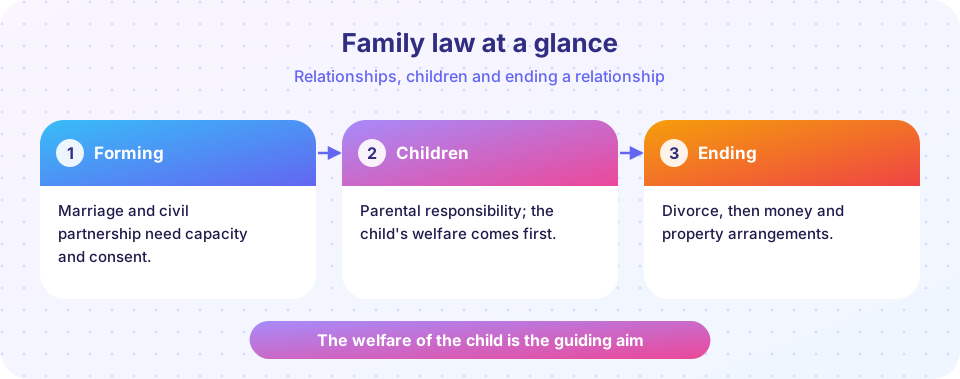
- Marriage and civil partnership need capacity and free consent.
- Parental responsibility and the welfare principle guide decisions about children.
- England and Wales have had no-fault divorce since 2022; money and property are decided separately.
- Family law differs widely worldwide, so always name the system.
Next: Employment law basics
Track your progress
Create a free account to tick off lessons and pick up where you left off on any device.
of Introduction to Law lessons completed