


















Lesson 16 of 47 · Legal Systems and Courts
Chapter 3 review: legal systems and courts
Review chapter 3: common law and civil law, court hierarchies and appeals, precedent and stare decisis, and civil and criminal procedure, with a ten question quiz.
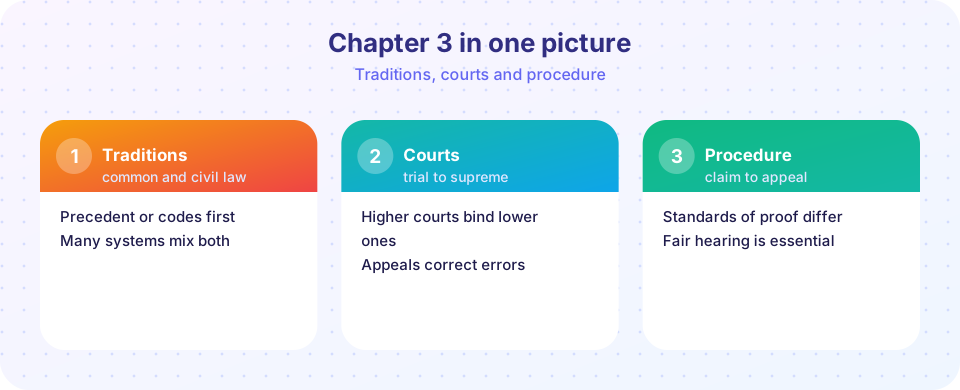
You have seen how legal traditions differ, how courts are arranged, how precedent steers decisions and how a case moves from filing to appeal. This review collects the main points in one picture and one table, and tests you with ten mixed questions.
What you will check
- You can contrast common law and civil law without overstating the differences.
- You can describe a court hierarchy and the purpose of appeals.
- You can explain ratio, obiter, distinguishing and overruling.
- You can set out the stages and standards of civil and criminal cases.
The chapter in brief
You began with two traditions. The civil law tradition grew from Roman law and spread through nineteenth century codes; the common law grew from the royal courts of medieval England and treats judicial decisions as a source of law. Today they borrow from each other, and many legal systems, from Scotland to South Africa, are mixed.
Next came structure. Courts are arranged in tiers: trial courts hear evidence and find facts, appeal courts correct mistakes of law, and top courts settle disputed questions and keep the law consistent. Some countries add constitutional courts or separate administrative courts. Precedent links the tiers together: only the ratio decidendi binds, and later courts can follow, distinguish or, at the highest level, overrule. Finally, procedure turns rights into outcomes. A civil case moves from claim to judgment and enforcement; a criminal case moves from investigation and charge to verdict and sentence. The burden of proof says who must prove a point, the standard of proof says how strongly, and fair trial rights protect everyone involved.
Recap table
| Lesson | Key point | Examples |
|---|---|---|
| Common law and civil law | Case-based development versus codes first; converging; many mixed systems | Justinian, 1066, Code civil 1804, BGB 1900, Scotland, South Africa |
| Courts and appeals | Jurisdiction, trial versus appeal, fact versus law, supreme and constitutional courts | UK Supreme Court (2009), US circuits, Cour de cassation, Bundesverfassungsgericht |
| Precedent | Ratio binds, obiter persuades; distinguish or overrule | Donoghue v Stevenson (1932), Plessy (1896), Brown (1954), 1966 Practice Statement |
| Procedure | Stages, burden and standard of proof, fair trial rights | Beyond reasonable doubt, balance of probabilities, presumption of innocence |
Common mistakes to avoid
- Mixing up the two meanings of "civil law".
- Describing an appeal as a complete second trial.
- Treating every statement in a judgment as binding.
- Forgetting that the burden of proof and the standard of proof are different ideas.
- Assuming that a description of one country's courts applies everywhere.
Try it
A quick mix-and-match drill: it pairs terms with their meanings and shuffles the order.
Press Run (or Ctrl + Enter) to see the console output here.
No output.
Check your understanding
Quick check · 10 questions
of 10 answered You scored / 10 · perfect!
-
1. Which of these statements about the two traditions is most accurate?
Differences are tendencies; both traditions borrow from each other. -
2. Who ordered the compilation of Roman law that became the Corpus Juris Civilis?
The Roman emperor Justinian had the Roman jurists' writings collected in the sixth century. -
3. What is the main function of an appeal court?
Appeals mostly check legal errors and help unify the law. -
4. Which is an example of concentrated constitutional review?
Concentrated review gives the task to one specialized court; diffuse review spreads it across courts. -
5. What did the 1966 Practice Statement of the House of Lords announce?
The statement allowed flexibility in departing from the House's own decisions. -
6. Which is the ratio of a case?
Only the necessary reasoning binds later courts. -
7. What does distinguishing do to an earlier case?
The earlier case stays good law; it just does not reach the new facts. -
8. Which pair correctly matches the standard of proof?
Criminal cases require a higher standard than civil cases in common law systems. -
9. What is a counterclaim?
A defendant may bring its own claim in the same proceedings. -
10. Which right is part of a typical fair trial standard?
Independent, impartial and generally public hearings are central fair trial guarantees.
Summary
- Common law and civil law are tendencies with deep roots, and many systems are mixed.
- Courts are tiered; trial courts find facts, appeals correct legal errors and top courts unify the law.
- Precedent guides courts through ratio, distinguishing and overruling.
- Procedure sets stages, burdens, standards and fair trial protections.
Track your progress
Create a free account to tick off lessons and pick up where you left off on any device.
of Introduction to Law lessons completed