


















Lesson 40 of 47 · Legal Reasoning and Practice
Reading statutes and the rules of interpretation
How to read an Act of Parliament and how judges interpret words: literal, golden, mischief and purposive approaches, with Fisher v Bell and Smith v Hughes.
Statutes are the other great source of law. Parliament (or Congress, in the US) writes rules in general words, and judges must decide what those words mean when a real situation arises. Reading a statute well means understanding how it is built, and knowing the approaches courts use when the words are unclear. Because the same words can support different meanings, this is one of the places where legal argument gets interesting.
Jurisdiction. The examples are from England and Wales, with a comparison to US practice. Educational information, not legal advice.
What you will learn
- How an Act is organized and how to read a section
- The literal, golden, mischief and purposive approaches
- Helpful aids and the Latin rules of language
- How statutes interact with human rights and with precedent
Key terms
Statute / Act: a law passed by the legislature. Section / subsection: the numbered parts of an Act. Primary / secondary legislation: Acts of Parliament / detailed rules made under powers given by an Act. Interpretation: working out what words mean when applied to facts. Ambiguity: where words can reasonably have more than one meaning.
How an Act is built
An Act has a long title (its purpose in a sentence) and sections numbered 1, 2, 3, divided into subsections (1), (2) and paragraphs (a), (b). There is usually an interpretation section defining key terms, a commencement provision saying when the Act takes effect, and sometimes schedules with detail. Read in this order: the title and long title; the definitions; the main operative section; then exceptions and defences. Look for connecting words: "and" requires all conditions; "or" requires one; "must" imposes a duty; "may" gives a power.
Statutes are often supplemented by secondary legislation such as regulations, made by ministers under powers in an Act. Courts also consider whether the Act has been amended; always check you have the current version from an official source.
A tiny example (invented): "A person commits an offense if he drives a vehicle in the park." Break it down: Who? "A person". What conduct? "drives". What object? "a vehicle". Where? "in the park". Each word may become a battleground.
The four approaches
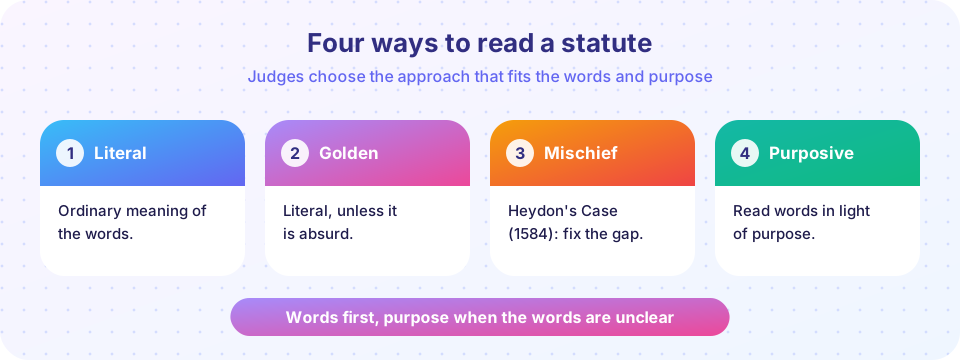
1. The literal rule. Give words their plain, ordinary meaning, even if the result seems harsh. In Fisher v Bell (1961), a statute made it an offense to "offer for sale" a flick knife. A shopkeeper displayed one in his window. Under the law of contract, a display is an invitation to treat, not an offer, so the court read "offer for sale" in its technical sense and acquitted him. In Whiteley v Chappell (1868), a man who voted in the name of a dead person was held not to have impersonated "a person entitled to vote", because the dead are not entitled. The literal approach respects Parliament's words and gives certainty, but may produce results Parliament never wanted.
2. The golden rule. Start literally, but avoid an absurd result. The narrow version chooses between two possible meanings of an ambiguous word. In Adler v George (1964), an offense of obstructing a guard "in the vicinity of" a prohibited place was held to cover obstruction inside it. The wide version modifies the meaning to avoid repugnance. In Re Sigsworth (1935), a son who had murdered his mother was prevented from inheriting from her under intestacy rules, although the literal words would have given him the estate.
3. The mischief rule. From Heydon's Case (1584): ask what the common law was before the Act, what the "mischief" or defect was, what remedy Parliament adopted, and then interpret to suppress the mischief and advance the remedy. In Smith v Hughes (1960), a law made it an offense for a prostitute to "solicit in a street or public place". The women solicited from windows and balconies. The court held that they were within the Act because the mischief was the nuisance to people in the street.
4. The purposive approach. Interpret words in light of the purpose of the legislation, using context and background. It is now the dominant modern approach in England and in European Union law (which influenced it). In Pepper v Hart (1993), the House of Lords allowed courts, in limited circumstances, to consult parliamentary statements (Hansard) when the legislation is ambiguous and the statement is clear. The Human Rights Act 1998 (section 3) goes further, requiring legislation to be read and given effect, so far as it is possible to do so, in a way compatible with Convention rights.
Other aids and language rules
- Intrinsic aids: the long title, headings and definitions inside the Act itself.
- Extrinsic aids: explanatory notes, law reform reports, and Hansard in limited cases.
- Presumptions: for example, that criminal statutes require a guilty mind unless clear words say otherwise, and that statutes do not take away fundamental rights without clear words.
- Latin canons. Ejusdem generis: a general word at the end of a list takes its meaning from the list; "cats, dogs, and other animals" probably means domestic pets, not elephants. Noscitur a sociis: a word is known by the company it keeps. Expressio unius est exclusio alterius: expressing one thing excludes others.
The US comparison
American courts argue about similar choices under different names. Textualists focus on the text and its ordinary meaning at the time of enactment; purposivists emphasize the statute's purpose and context. Some judges consult legislative history, others reject it. In Riggs v Palmer (1889), a New York court refused to let a grandson who murdered his grandfather inherit under the will, even though the statute on wills did not exclude murderers, a case often used in the debate over whether principles of law can limit the literal text. Each approach has strengths: textualism gives predictability and restrains judges; purposivism avoids absurd results and follows the legislature's goals.
Common misconceptions
"Judges just apply the words." Words are often ambiguous, so interpretation involves choice and justification.
"The literal rule is the only fair one." It gives certainty, but can defeat the law's purpose.
"Courts can rewrite statutes they dislike." In a system of parliamentary sovereignty, courts interpret; they do not usually strike down Acts (the UK Parliament can change them). In the US, courts can invalidate statutes that violate the Constitution.
Try it
Press Run (or Ctrl + Enter) to see the console output here.
No output.
Check your understanding
Quick check · 5 questions
of 5 answered You scored / 5 · perfect!
-
1. In Fisher v Bell (1961), the shopkeeper was not guilty because:
The court applied the literal rule with the contract meaning of 'offer'. -
2. The mischief rule comes from:
Ask what defect the Act was meant to remedy. -
3. Which approach avoids absurd results by modifying the literal meaning?
The golden rule. -
4. Ejusdem generis means:
Of the same kind. -
5. Pepper v Hart (1993) allowed courts, in limited cases, to consult:
Parliamentary statements where legislation is ambiguous.
Summary
- Read an Act from its title and definitions to its operative sections and exceptions.
- Courts use literal, golden, mischief and purposive approaches, now favoring purpose.
- Aids include Hansard in limited cases and Latin canons.
- Human rights law can require compatible readings.
Next: IRAC and legal writing
Track your progress
Create a free account to tick off lessons and pick up where you left off on any device.
of Introduction to Law lessons completed